Although green smoothies and salads are fantastic, most people cannot live on them alone 🙂
So, today I have a vegetable soup recipe for you.
Vegetable soups are a great healthy standby and are easy to prepare, digest and absorb. They are great comfort food, and are a great dish to warm us up in the middle of cold weather.
I recommend that you make a big pot that will last you a couple of days, or even longer (keep several portions in your freezer for “emergencies”).
The following recipes are just an inspiration. Don’t feel you cannot prepare the soup if you are missing one (or more) ingredients. Just as when making the green smoothies, experiment with your recipes, using what’s available in your kitchen, garden or grocery store.
Keep in mind that:
- You may add any vegetables of your choice, including leafy greens.
- Add beans, chickpeas, or lentils for more protein and “staying power.”
- Add some mushrooms.
- Add some whole grains, such as fine barley or quinoa.
- Use vegetable stock to add even more flavor.
- Add fresh herbs right before serving, such as parsley, dill or cilantro.
- Serve alone or with a side-dish of raw leafy green salad.
Vegetable Quinoa Soup: Easy to Prepare, Versatile and Simply Delicious!
Ingredients
- 2 large onions, chopped
- 5 clove garlic, minced
- 2 large leeks, washed well and chopped (white and green parts)
- 3 carrots, chopped
- 2 stalks of celery (with the tops) chopped
- 2 red skin potatoes, chopped
- 1 large red bell pepper chopped (optional)
- 1/2 medium butternut squash, remove skin and seeds, dice same as potatoes
- 1/2 head small cabbage, coarsely chopped
- a few white button mushrooms or other mushrooms of choice, cleansed and chopped
- 1 cup fresh parsley or dill, chopped
- 1 tsp. cumin (optional)
- 1 cup quinoa
- 8 cups water or vegetable broth
Instructions
- In a large saucepan, saute in the oil the garlic, onions, leeks and celery in a few tablespoons of water or vegetable broth for several minutes - until onions are translucent.
- Add other ingredients, water or broth and simmer till all ingredients are tender, about 30 minutes.
- Add fresh parsley or dill. Season with pepper and salt (if using) to taste. Time permitting, let the soup sit for 30 minutes to fully develop the flavor. Heath through and pour into individual bowls and serve.
- Serve alone, with a side salad or bread.
3.1
https://greenreset.com/vegetable-soups/
*This recipe uses quinoa, a gluten-free grain, that can be found in health food stores and some supermarkets. If you cannot find it, you may try substituting with millet, amaranth, fine barley, or other grain.
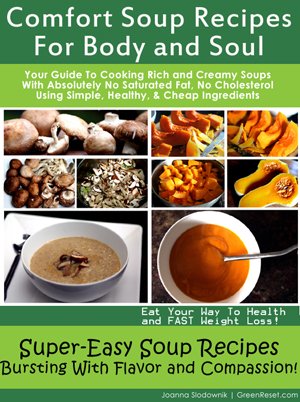
This recipes comes from my recently released ebook:
“Comfort Soup Recipes For Body and Soul”
Easy Soup Recipes Bursting With Flavor and Compassion! Your Guide To Cooking Rich and Decadently Creamy Soups With No Added Saturated Fat, No Cholesterol, and Low in Sodium Using Simple, Healthy & Inexpensive Ingredients”
For less than the price of a few cans of processed organic soup, you can have my collection of the best comfort soup recipes you’ll ever taste. And they’re easy to make, too!

- This ebook is filled with tips and tricks that will make you into a true soup wizard. You’ll be able to impress your family and friends every time you step your foot into the kitchen to make soup.
- Rich, Creamy Soups Guilt FREE. Low in fat, low in cholesterol, low in sodium. I teach you techniques to create super rich soups, without the added fat and cholesterol. No need to deny yourself these comforting creamy soups, if you use the ingredients that are healthy and perfect for weight loss.
- Immunity Boosting, Cholesterol-Lowering and Anti-Inflammatory Benefits. These soups are chock full of healthy ingredients, that have been proven to posses immunity-boosting, cholesterol-lowering and anti-inflammatory properties.
You will find many more recipes there, as well as lots of invaluable tips and strategies to make delicious soups that are also good for your body.
Find out more about the book here.
To your health,
Joanna
Ah, cinnamon… I remember years ago on my trip to Morocco, I went to a restaurant where, for dessert, we were served neatly cut orange circles sprinkled with cinnamon powder. It was a truly elegant and delicious dessert! Plus, it’s a testimonial that simple things are often better…
Anyway, cinnamon can be a great addition to your smoothie. It is not expensive, has no unpleasant side effects, and provides lots of proven health benefits.
Although you can certainly buy cinnamon capsules, a much better way to enjoy the health benefits of cinnamon nutrition, is to add cinnamon to your smoothies and other dishes. While in the US, we use cinnamon mostly as a spice to be used in pies and other sweet-tasting baking recipes, in many parts of the world it is used in savory dishes as well.
What Are the Kinds of Cinnamon?
Cinnamon is the bark of one of a group of trees belonging to the same family. Many related species are marketed as cinnamon.
The two varieties mostly used are: Ceylon cinnamon (also called “true cinnamon”)and cassia cinnamon (or “Chinese cinnamon” is what you’ll typically find in your grocery store’s spice aisle) . Cassia cinnamon is the kind most often used for baking and cooking. It’s also the variety most researchers have used when they’ve studied cinnamon and diabetes.
The two kinds of cinnamon come from different plants. Cinnamomum Cassia, used in curry powder and in Chinese and Korean dishes, is dark brown. The other variety of cinnamon, Cinnamomum Zeylanicum, is a lighter brown or tan.
Cinnamon “sticks” or “quills” are rolls of dried bark, and can be grated into a powder or soaked in liquid. Most people buy cinnamon pre-ground.
Cinnamon Nutrition
Would you believe that a mere teaspoon of cinnamon provides 28 mg of calcium, almost one mg of iron, over a gram of fiber, and quite a lot of vitamins C, K, and manganese? Yep. It also contains about half a gram of “usable” (non-fiber) carbohydrate.
What are the Health Benefits of Cinnamon?
In traditional medicine, cinnamon has been used for digestive ailments such as indigestion, gas and bloating, stomach upset, and diarrhea. It has a mild anti-inflammatory effect, slows down the spoiling of food, and has anti-fungal properties as well.
Health benefits of cinnamon include:
• Supporting digestive function
• Relieving congestion
• Relieving pain and stiffness of muscles and joints
• Reducing inflammation and symptoms of arthritis
• Helping to prevent urinary tract infections, tooth decay and gum disease
• Relieving menstrual discomfort
• Stimulating circulation with blood-thinning compounds
Cinnamon May Help Improve Type 2 Diabetes and Insulin Resistance
The majority of the research seems to be pointing in the direction of cinnamon being beneficial for people with diabetes. Along with the improvement in blood sugar, studies have documented improvements in triglycerides, blood pressure, and LDL cholesterol.
Several studies have shown improved insulin sensitivity and blood glucose control by taking as little as ½ teaspoon of cinnamon per day.
A study published in the December 2003 issue of the journal Diabetes Care, tested daily consumption of 1, 3, or 6 grams (1 gram = 1,000 mg) of cinnamon or a placebo every day for 40 days. The researchers found that among diabetics who used cinnamon:
- Fasting glucose was lowered 18 to 29 per cent.
- LDL, or “bad,” cholesterol fell by 7 to 27 per cent.
- Total cholesterol fell 12 to 26 per cent without any loss of the protective HDL cholesterol.
- Fasting triglycerides fell 23 to 30 per cent.
The benefits of using cinnamon continued even after supplementation was stopped. That means, if you used cinnamon regularly, you do not necessarily need cinnamon every day to receive the full benefits for blood sugar regulation and lowered levels of LDL, cholesterol, and triglycerides. In the interest of full disclosure, however, it is important to note that one recent study did not find the benefits of cinnamon to accrue in just 14 days. It is apparently necessary to use cinnamon in food for at least 40 days before you can “take a day off” and still get the protective benefits. (Source: Natural News)
Clearly, adding ample amounts of cinnamon to your diet is incredibly beneficial. Just remember, unless you are adding it to a proper diet — high in vegetables and especially leafy greens — it is unlikely you will experience any noticeable benefits.
Cinnamon in Smoothies
Cinnamon adds a wonderful flavor to green smoothies. It goes especially well with smoothies using apples, pears, citrus (oranges, tangerines), and bananas. Cinnamon can be used on its own or with other spices like nutmeg, clove, ginger and all spice.
Cinnamon combines best used with mild, less-bitter greens like romaine, leaf lettuce, baby spinach, and celery tops. I would caution against using it with bitter greens like kale and dandelion, or with flavorful berries.
The optimum dose is between 1-3 grams a day. 1 gram is around 1/4 teaspoon of ground cinnamon, about the amount you would use in a single-serving smoothie.
Most smoothie recipes suggest adding cinnamon “to taste,” but a good place to start is with 1/2 teaspoon of ground cinnamon for every 2 cups of smoothie. Adding cinnamon before blending maximizes aroma and flavor. But you can always sprinkle more on top as a garnish.
If you are interested in saving money, I recommend that you buy your cinnamon in bulk amounts. Make sure to store your extra cinnamon in a closed container for optimum freshness.
Note: More cinnamon is not necessarily better. Cinnamon contains a compound called coumarin, a substance that can be toxic to the liver in large amounts. People with liver damage should be careful not to overdo it, however, because large amounts of cinnamon may increase liver problems.
Cinnamon-Apple-Celery Smoothie
Celery Apple Cinnamon Smoothie: A Tasty Way to Stabilize Blood Sugars
Ingredients
- 4 stalks of green celery with or without the leaves
- 1 medium size apple (a green tart apple or a red fuji apple), leave the skin on if organic
- 1 cup baby spinach leaves or other mild leafy greens (optional)
- 1/4 to 1/2 teaspoon ground cinnamon
- 1 1/2 cups of water
Instructions
- Blend all ingredients until smooth. Pour into a glass and drink immediately.
3.1
https://greenreset.com/cinnamon-smoothies/
Orange Cinnamon Smoothie Recipe
Ingredients
- 1 medium orange, peeled and deseeded
- 1 medium very ripe mango, peeled and pitted; or 1 cup frozen mango
- 1/4 cup rolled oats
- 1/2 to 1 teaspoon ground cinnamon
- 2 ounces of filtered water
Instructions
- Start by adding the liquid to your blender (I use a Vitamix), followed by the remaining ingredients. Blend on high until the smoothie is creamy.
- Note: If you don’t have a high-speed blender, you’ll want to grind the oats in a coffee grinder before adding them to your blender.
3.1
https://greenreset.com/cinnamon-smoothies/
Questions? Comments? Suggestions?
If you have a favorite recipe, why not submit it here in the comment section of this smoothie recipes blog for others to enjoy too!
I also welcome any comments, questions and suggestions. Thanks!
After a whole week of drinking cabbage and beet smoothies in various combinations, I’m ready to move on.
I decided to try broccoli rabe in a smoothie.
This is not a green that I use very often, so why not try it with some juicy fruit and see what happens. I’m also experimenting with adding beans to smoothies to create more filling, meal replacement recipes – but if this is too much for you, feel free to skip the chickpeas in the recipe.
Here is a recipe I just tried this morning that turned out quite tasty and filling.
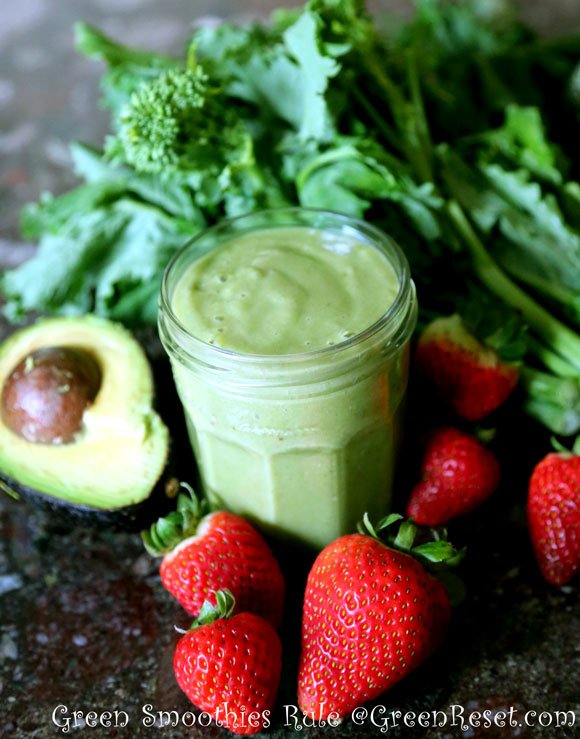
Broccoli Rabe Smoothie with Garbanzo Beans
Ingredients
- 2 cups broccoli rabe
- 2 cups spinach
- 2 very ripe bananas
- 1 cup mango, frozen
- 1 cup strawberries, fresh (or frozen)
- 1/2 cup avocado
- 1 cup garbanzo beans (chickpeas)
- 2 cups water
Optional
- 1 grapefruit - it will add tartness to the smoothie, so skip it if you prefer a sweeter smoothie
- 2 packets of stevia, or other sweetener to taste
Instructions
- Blend all ingredients on high until very smooth.
3.1
https://greenreset.com/broccoli-rabe-smoothie-with-garbanzo-beans/
1 cup of chickpeas (garbanzo beans, bengal gram) add 269 calories to this smoothie, plus 15 grams of protein!
Chickpeas are also a great source of Dietary Fiber, Protein and Copper, and an excellent source of Folate and Manganese. 1 cup of chickpeas satisfies over 70% of daily folate requirement.
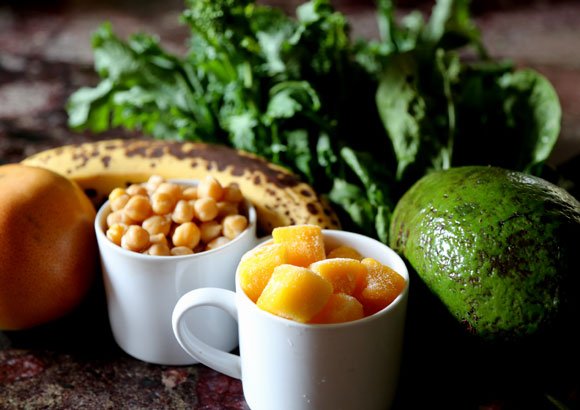
Broccoli Rabe Green Smoothie
For all my blending recipes I use Vitamix. If you don’t already own a VitaMix, I strongly encourage you to check out what this machine is capable of! For more information about VitaMix you can go directly to the VitaMix website. You may also want to read my post about the Best Blender.
I LOVE my VitaMix and highly recommend investing in one if you are ready to make serious changes to your diet. I have had mine for almost 5 years and use it daily!
If you decide to purchase Vitamix – be sure to use Promotional Code 06-004554 to get free shipping.
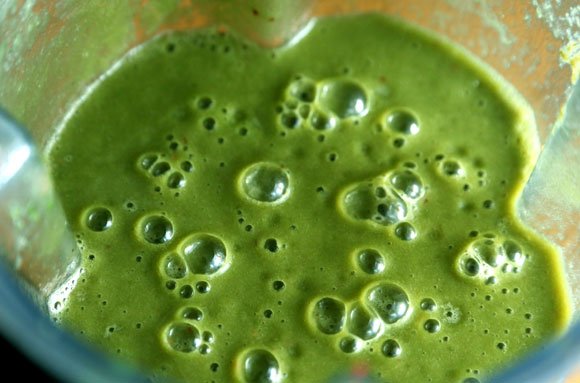
The Making of Green Smoothie: Inside of my Vitamix
Questions? Comments? Suggestions?
If you have a favorite recipe, why not submit it here in the comment section of this smoothie recipes blog for others to enjoy too!
I also welcome any comments, questions and suggestions. Thanks!
This is a question that sometimes comes up on the health and raw food forums, usually causing a lot of heated debate. There are a few experts, with a lot of credibility, who are saying “Don’t drink green smoothies. Green smoothies are not good enough. You need to be eating your greens in salads, eating sprouts, fresh water algae, seaweeds, and/or other “super-foods,” as well as drinking freshly made green juices made from sprouts and organic vegetables using high-quality juicer.”
Some of these people make it sound like blended green smoothies are no better than *junk food*.
One of the experts that has been very outspoken on this topic is Dr. Brian Clement. Dr Clement is the director of the Hippocrates Health Institute, a highly renowned institution, that has been helping people with terminal cancers and other life-threatening diseases for many decades. A disciple of Ann Wigmore, the founder of the wheatgrass movement, Dr. Brian Clement believes in juicing – wheatgrass, sprouts and green vegetables.
Dr. Clement has made several statements online claiming that blending destroys approximately 90% of the nutrients in the fruits and vegetables. According to him, the loss of nutrients is due to oxidation that is happening during blending. As oxygen is being sucked into the blender during a blend cycle, nutrients in the food are being destroyed, and as a result your blended smoothie would only contain about 10% of the nutrients in the fruit and greens that you put in the blender.
Does Blending Destroy 90% Of Nutrients?
According to Dr. Clement, oxidation is the reason that smoothies should not be considered “health food” and should instead be considered “recreational” or “transitional” (“bridge”) food, for people switching from the SAD diet, because the process of blending them for 90-120 seconds destroys 90% of nutrients.
Okay, so let’s look at some facts:
1. There is no denying that some nutrient loss does occur from blending. However, nutrients are lost whenever whole foods are chewed, cut, chopped, juiced, shredded, peeled, dehydrated and otherwise exposed to air. Nutrients in food begin to degrade the instant they are harvested, exposed to UV light and heat. You can’t get 100% of the nutrients in every food unless you eat plants right after they are picked, and even then, you will destroy nutrients just by chewing the food.
However, that doesn’t mean that the kale sitting in your refrigerator right now is devoid of nutrients – or unhealthy. And it certainly doesn’t mean that green smoothies are junk food.
2. A professional blender, such as Vitamix, blends a smoothie in about 10-20 seconds, not 90-120 seconds. I certainly wouldn’t blend a green smoothie for a solid two minutes, but even so, I doubt that it would result in 92% nutrient loss.
3. Secondly, green smoothies are loaded with antioxidants such as vitamin C, vitamin E, flavonoids and carotenoids that help reduce and prevent oxidation.
4. Victoria Boutenko conducted an experiment on potatoes where she juiced one and blended the other. After two days, the blended potato had very little oxidation, most of which was at the top of the glass where the liquid was exposed to air. The juiced potato turned brown and oxidized much more rapidly. She asked two scientists to comment on the results, and they both agreed that her experiment proved that blending may indeed be better than juicing in this respect.
5. Also, the amazing results that people are getting by adding green smoothies to their diet, certainly prove beyond a shadow of a doubt that this is not “junk food.”
And even Dr. Clement admits that smoothies are an excellent bridge food from what people are eating now to what he would call a “healthy” diet. He even goes so far to say that blending is “infinitely better” than what most people are eating.
In fact, the cornerstone of the Living Foods Lifestyle at the Hippocrates institute is the Energy Soup, a blended mixture of greens, sprouts, vegetables, Rejuvelac, and dulse. Energy soup is a complete meal, containing every nutrient in a balanced form that the body needs.
Ann Wigmore, when she developed the Hippocrates diet, advocated juicing fruits and vegetables as a way to obtain optimal nourishment. However, in her later years, she became a proponent of blending foods rather than juicing them. The only juices she used were watermelon and wheatgrass.
Ann Wigmore believed that juices can be too cleansing for most people’s bodies.” Blending helps the body to clean itself and thus it restores health much quicker than just eating the foods as salads, yet it does not overtax the system with the rapid cleansing action of juices,” she wrote. “Also, juices do not contain fiber. Separating the fiber and other elements from the juice results in a food that is not as balanced as Nature would have it.”
The thing you need to consider is this: If you are already eating a big bunch of kale and other greens in your salad, along with other vegetables, as well as drinking freshly made organic juice every day, then you probably don’t need green smoothies, and you will not observe any benefits from adding them to your diet, other than perhaps time that you will save by blending your produce, instead of preparing salads and juices.
However, my guess is that 99% of the people are not there yet.
The forgotten fact is, in ANY form, Americans simply aren’t eating the sufficient quantity of good-quality natural plant foods.
EVEN IF a salad is superior (and I dispute that, even though I love salads too!), guess what? Virtually no one is eating that much salad. If your goal is perfection, then perhaps you need to start growing your own organic vegetables and sprouts, and eat them freshly picked in salads, chewing them to perfection. I choose to operate in facts and realities to come up with solutions that people will actually DO.
Green smoothies are an excellent first step that is easy to take for anybody. It literally doesn’t get any easier than this. It’s the best use of your kitchen time, so even if you only spend 20 minutes in the kitchen right now, you can fit it into your lifestyle.
Plus it’s a sustainable habit. Most people who buy juicers don’t use them every day. My juicer has been sitting unused, collecting dust, for a long time, even before I started blending. Since I purchased my VitaMix four years ago, I’ve been using it almost EVERY SINGLE DAY when I’m home, a few times per day. (I say almost every day, because I don’t take it with me when I travel).
Try putting 2 lbs. of fresh greens and vegetables on a giant platter. Tell someone to eat it in a day. It’s beyond daunting—it’s virtually impossible unless you’re going to spend 30 minutes chopping and 90 minutes chewing. Most people cannot spend hours a day preparing food and trying to get all my food down, so blending is their best option.
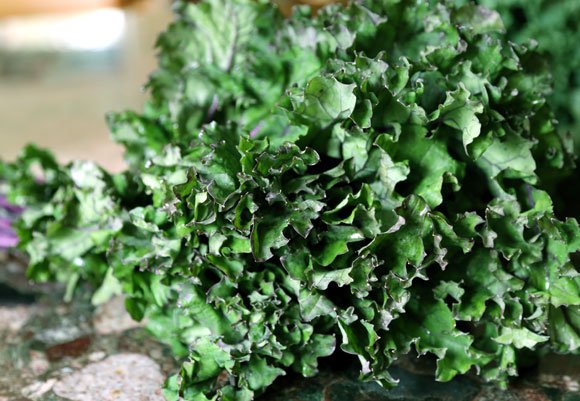
Try putting 2 lbs. of fresh greens and vegetables on a giant platter and eat it in a day. It’s beyond daunting.
Nutrients oxidize a little bit upon blending, but then again, nutrients are also lost when greens are chewed and swallowed. Nutrients are also lost because the narrow modern palate doesn’t break them down well enough to get absorbed fully.
Just think that you’d have to eat a giant platter of plain greens daily that you get in your quart of green smoothie–I doubt that you’d actually do it. Green smoothies are nutritionally superior to 99.9% of what 99.9% of Americans are eating all day.
I obviously feel strongly that green smoothies are a great way to spend 10 minutes to get up to 15 servings of raw fruits and greens in the diet. Don’t forget that a quart will completely fill your stomach, with only 200 calories. You don’t need any dressing to get it down. You don’t have to prep it for 30 minutes and spend another 30 minutes eating it.
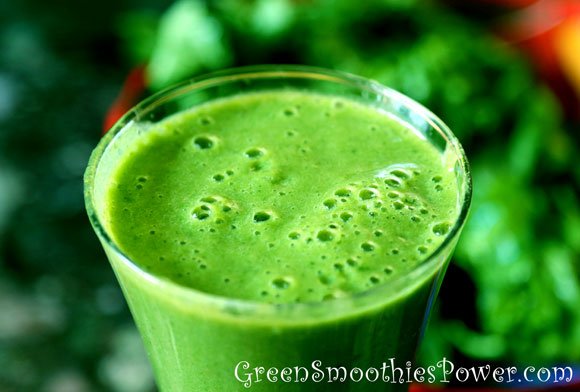
Does blending destroy 90% of nutrients? Are green smoothies junk food?
So, if you ask me, even if green smoothies are not the “Holy Grail” of nutrition (there are many more things that you can and should be doing, such as eating big salads, loaded with greens, sprouts, seaweeds, and other healthy foods :-); you can also add freshly made green juices to your repertoire) — for overall nutrition, made quickly, consumed easily, for high impact on many different health issues, green smoothies win hands down.
Are green smoothies no better than junk food?
What are your thoughts?
This recipe is for cream of asparagus soup. However, it’s very versatile: If you can’t find nice asparagus, use broccoli floretts or broccoli rabe to make cream of broccoli instead.
This simple soup is easy to make, contains only 5 easy-to-find ingredients, and yet has that look of sophisticated elegance that is sure to impress even the most discriminating guests. It can be served during holidays and other special occasions.
It is also a perfect comfort soup for the cold winter days.
You will literally not believe that this soup has no dairy.
It looks rich and creamy, and yet has no saturated fats, no cholesterol, and is low in calories.
Four asparagus spears, cooked, boiled, drained, without salt (60g) have only 13 calories!
Asparagus is also a good source of Vitamin B6, Calcium, Magnesium and Zinc, and a very good source of Dietary Fiber, Protein, Vitamin A, Vitamin C, Vitamin E (Alpha Tocopherol), Vitamin K, Thiamin, Riboflavin, Niacin, Folate, Iron, Phosphorus, Potassium, Copper, Manganese and Selenium.
This recipe is completely dairy free, lactose free, and wheat free. It therefore contains no cholesterol and very little fat.
The secret to the delicious creaminess is…cashews.
Cashew cream stands in for dairy here and makes for an equally rich, delicious dish.
Ingredients
Instructions
- In a large cooking pot, sauté the asparagus, celery, and onion in olive oil until soft. If you want to skip oil, add a few tablespoons water and sauté the vegetables for 5-10 minutes. Add liquid and simmer for 30 minutes. Add beans, if using.
- In a blender, add 1 cup liquid and cashews and blend on high for 30 seconds, until very smooth. Pour into the pot with the soup and simmer for a few more minutes.
- Working in batches, pour the soup into a blender, cover the lid tightly (the hot liquid tends to erupt), and blend on high.
- Add salt and pepper to taste. Pour into soup bowls and decorate greens. Enjoy!
3.1
https://greenreset.com/cream-of-asparagus-soup-recipe/

Calories in Asparagus Soup:
2 bunches asparagus spears (approx. 40 spears) : 130 calories
2 cups spinach (60g): 14 calories
1 large onion (150g) = 60 calories
2 stalks of celery, cooked (74g) = 14 calories
2 ounces cashews (56g): 300 calories
Total Calories: (without cashews) 218/6=37 calories; with cashews: 518 calories total /6 servings = 86 calories per serving
If you’d like to reduce calories even further, while adding more protein to the soup, add 1 cup garbanzo beans or other white beans to the soup.
1 cup garbanzo beans has 269 calories, and 36 calories from fat. It also contains a whopping 15 grams protein. Chickpeas are also an excellent source of Dietary Fiber, Protein and Copper, as well as Folate and Manganese. Read More http://nutritiondata.self.com/facts/legumes-and-legume-products/4326/2#ixzz27mYy2xXB
I used to make this soup with a potato, which is a great way to add some creaminess to the soup. I was never a heavy heavy cream user, so I usually would skip that ingredient or just add a bit of milk.
Since I became vegan, I’m experimenting with various substitutes of animal products and reading tons of cookbooks for inspiration on how to transform conventional dishes that I love into delicious dishes that are also full of compassion.
The Secret to Creamy Soup Without Dairy or Wheat
Most conventional creamy soup recipes call for heavy cream, half-and-half, butter and/or flour.
I first read about using cashews in creamy soups in “The Conscious Cook” by Tal Ronnen. He inspired me to try cashews in creamy soups, instead of dairy, and it really works. Since I read about it a few weeks ago, I’ve been using cashews in various soup recipes, such as this Cream of Celery Root Soup, and they really are a terrific little nuts to have in your kitchen.

Asparagus spears: You can also use broccoli or broccoli rabe in this recipe
For all my blending recipes I use Vitamix. If you don’t already own a VitaMix, I strongly encourage you to check out what this machine is capable of! For more information about VitaMix you can go directly to the VitaMix website. You may also want to read my post about the Best Blender.
I LOVE my VitaMix and highly recommend investing in one if you are ready to make serious changes to your diet. I have had mine for almost 5 years and use it daily!
If you decide to purchase Vitamix – be sure to use Promotional Code 06-004554 to get free shipping.
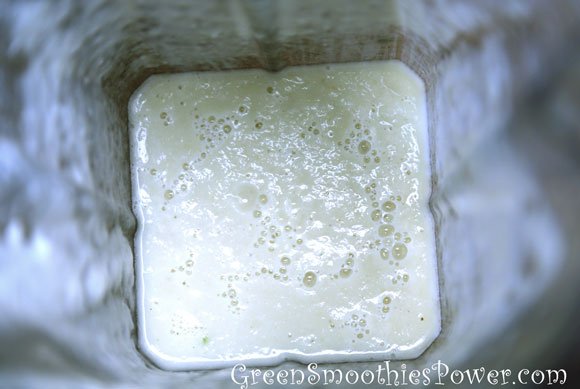
The Making of Cream of Asparagus Soup: Blending Cashews into a cream
Questions? Comments? Suggestions?
If you have a favorite recipe, why not submit it here in the comment section of this smoothie recipes blog for others to enjoy too!
I also welcome any comments, questions and suggestions. Thanks!