Many people have no problem replacing snacks and desserts with green smoothies and other raw dishes. However, when it comes to lunch and dinner, most of us crave something much more substantial and filling.
Although I live mostly on green smoothies during the day, at evening, when the whole family gets home, I’m usually having a cooked dish that I prepared for them.
Still, as the hot summer weather approaches, I’m experimenting more and more with raw main dishes, such as this raw vegan chili.
Unlike the cooked chili recipe that I posted earlier this week, other than having to pre-soak a couple of ingredients, it only takes about five minutes to make!
Un-Cooked Vegan Chili Recipe
Ingredients:
- 2 large juicy tomatoes
- 1/2 cup sun dried tomatoes soaked and rinsed
- 1 -2 large avocado
- 1 tbsp chili powder
- 1 tsp cumin powder
- 1 clove garlic
- 1 large bell pepper – red, green or yellow (diced)
- 1/2 zucchini (diced)
- 1/4 red or yellow onion (diced)
- 1 cup fresh cilantro
- juice from half a fresh lime
- 1/2-1 cup fresh peas, frozen or fresh from the pod (optional)
If you like spicy, add more garlic cloves, or jalapeño pepper, minced.
Place all ingredients, except for peppers, onions, and peas, in the Vitamix or food processor and blend for 30 seconds or so. It may take more or less time depending on the type of food processor you have.
When you’re done, you will have a pureed, chunky mixture!
Mix in your sliced bell pepper, peas and onion.
If you are not following a pure raw diet, then you might toss into the mix some pre-cooked beans.
Serve on a large piece or green or purple cabbage, garnish with freshly chopped green onion!
Optional Topping: Fresh not sour ‘Cashew Kreme’:
- 1/2 cup cashews soaked and rinsed
- 1 tsp salt
- dash of nutritional yeast
- squeeze of 1/2 lemon
Add water as you blend until you reach desired consistency. Pour over the chili when you’re serving. Recipe inspired by RAW Chili Sans Carne.
Questions? Comments? Suggestions?
If you have a favorite recipe, why not submit it here in the comment section of this smoothie recipes blog for others to enjoy too!
I also welcome any comments, questions and suggestions. Thanks!
Many people love chili, and this is a healthy, vegan version of this dish.
Chili is always a great idea to bring to a potluck, since it’s easy to whip up a large batch, plus you can freeze any leftovers. You can make batches of this chili recipe and take it to work for lunch for the week. It’s even better the next day!
If you own a slow cooker (I don’t), then this is a great recipe to use. Slow cookers and chili making just go hand in hand :-).
But even if you don’t have one, it’s easy enough to prepare; although it’s going to take much longer, compared to most recipes you find on this site. It also has a long list of ingredients.
Don’t let that discourage you!
This chili is SO easy to make. You can pretty much throw whatever you have into the pot and it’ll be great. It’s very colorful, filling, not to mention delicious and good-for-you.
Easy Vegetarian Chili Recipe
Makes 6-8 servings
- 1 cup chopped onions
- 4 garlic cloves, finely minced
- 1 cup chopped carrots
- 1 cup chopped celery
- 3 cups cooked beans: e.g, lentils, kidney, lima
- 1 28-ounce can crushed Italian plum tomatoes
- 2 tablespoons chili powder
- 2 teaspoons ground cumin
- 1 teaspoon ground coriander
- 1 teaspoon ground cinnamon
- salt and freshly ground black pepper to taste
- 1 cup water
Optional Ingredients:
- 1 cup chopped fresh mushrooms
- 1/2 cup bulgur wheat
- 1 cup corn kernel
- 1 red pepper, diced
- 1 yellow pepper, diced
- 1 zucchini, diced
- 2 tablespoons cilantro, chopped
- 1 14 oz package of firm or extra firm tofu, crumbled
- If you like sipcy, add 5 garlic cloves, 3 chipotle chiles, a habanero chile, and/or jalapeño, minced
Preparing the beans
For color and variety, add a couple of cans of different beans – chickpea, garbanzo, red kidney, black, adzuki, white cannellini, etc.
You may use canned or precooked beans, or simply prepare the beans the day before.
If using dried beans, rinse all the beans and remove any grit. Place them in a large pot and add enough cold water to cover by 2 inches. Let stand for 6-8 hours. Drain, return the beans to the pan, and cover them with fresh water. Bring to a boil, reduce the heat to a simmer, and cook until the beans are tender but not falling apart, 45-60 minutes. Drain.
Putting It Together
In a thick-bottomed pot, saute the vegetables and garlic with 2-3 tablespoons of water (or a splash of olive oil) over medium heat. Add the chili powder, cumin, coriander, cinnamon, and cayenne pepper. Cook the vegetables in the spices, about 5 minutes. Season with salt and pepper. Add the tomatoes, water, corn, bulgur wheat (if using), and beans. Bring to a simmer and cook until the bulgur is tender—about 10 minutes.
If using slow cooker, you still need to pre-cook the beans. The only drawback with a slow cooker for me is that I don’t get to taste the dish while it’s cooking for seasoning. But, it’s easy enough to check your seasonings after the first hour of cooking and adjust as needed.
Ladle chili into bowls. Top with chopped cilantro, green onions, or diced avocado or whatever else you enjoy.
Why Meat-Less Chili?
Why bother to change a perfectly tasty meat chili recipe to a vegan version?
Better for health is one reason. Eating a diet rich in plant-foods and low in animal products has been proven time and time again to help prevent many diseases, including heart disease and cancer. Throughout the world, consistently, people who eat a vegetarian diet, or a diet with only minimal amount of animal protein, live the longest and are the healthiest.
Better for environment and my conscience. Aside from our own health, there are also other reasons to eat less meat: reducing environmental destruction, using fewer resources, and compassion for sentient creatures that are living and dying in terrible suffering.
Read what finally convinced me – at almost 47, to make the switch to vegan diet, and how much protein do we really need.
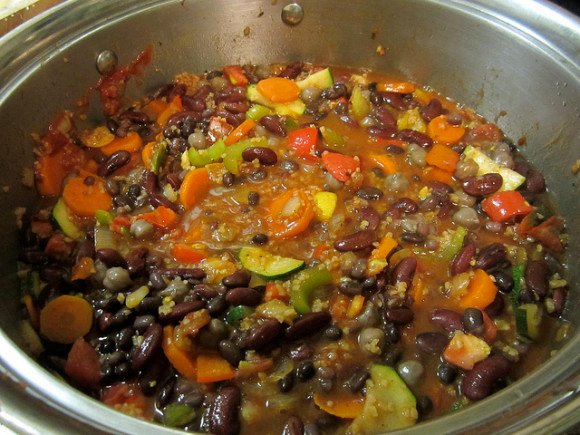
Vegan Chili Recipe: photo http://www.flickr.com/photos/meganpru/6086513398/sizes/z/in/photostream/
Questions? Comments? Suggestions?
If you have a favorite recipe, why not submit it here in the comment section of this smoothie recipes blog for others to enjoy too!
I also welcome any comments, questions and suggestions. Thanks!
Brussels sprouts are related to cabbage, broccoli and kale, and they even look like miniature cabbages. Brussels sprouts, as other brassicas, contains sulforaphane, a chemical believed to have potent anticancer properties.
You might find that you have a certain feeling about Brussels sprouts. In fact, for most of you that feeling might be Ewwwwww!
If so, you may want to reconsider once you try these Brussel sprouts recipes.
Brussels sprouts are rich in many valuable nutrients. They are an excellent source of vitamin C and vitamin K. They are also loaded with vitamin A, folacin, potassium, calcium. They have 3-5 grams of fiber per cup, and at 25 calories per 1/2 cup cooked, they give us a reason to eat them more often. Brussels sprouts are one of those foods that will fill you up, without providing excessive calories.
Brussels sprouts are very high in fiber. They are also rather high in protein, accounting for more than a quarter of their calories.
Although hey are available year round; they are at their best from autumn through early spring when they are at the peak of their growing season.
Brussels Sprout Recipes
I don’t really love Brussels sprouts in green smoothies. You can try tossing one or two into the mix, but anything more than that, is too “cabbagy” to my taste.
Generally, vegetables such as Brussels sprouts, carrots, beets, broccoli, zucchini, daikon radish, cauliflower, cabbage, eggplant, pumpkin, squash, okra, peas, corn, green beans, and others do not combine well with fruit due to their high starch content.
Fortunately, Brussels sprouts are delicious as a raw salad or lightly cooked side dish.
Brussels Sprout Salad Recipe
You can make this salad any way you wish. Try pecans or pine nuts or almonds. You’ll be wanting to eat your sprouts. No kidding.
- 1 pound Brussels sprouts
- 4 ounces walnuts (or hazelnuts), broken into small pieces
- 2 apples, shredded
- 3-4 tablespoons fresh lemon juice
- 2 tablespoons of dried cranberries
- 1 tablespoon of maple syrup, agave or honey
- 2-3 big pinches of salt
- 2 medium cloves garlic, minced
Slice the Brussels sprouts on the slicing disc of the food processor. Alternatively, use a mandoline, or a knife. Ideally, you want the sprouts to be really thin.
In a large mixing bowl and toss gently with the maple syrup, lemon juice, salt, cranberries and nuts. Taste and adjust the seasoning, adding more lemon juice if needed. Add the cheese and toss once or twice to distribute it evenly throughout the salad.
Here is a delicious cooked dish with Brussels sprouts and mushrooms. I just had this dish last night with buckwheat (in the photo below), and it was delicious and very filling.
Brussels Sprouts and Mushrooms
The secret to tasty Brussels sprouts is to not overcook them. Overcooked Brussels sprouts have a pungent, sulfurous odor. Brussels sprouts that have been cooked “just right” have a crisp, dense texture and a slightly nutty taste.
Ingredients:
- 1 pound Brussels sprouts
- 1 small onion, quartered and thinly sliced
- 2-3 cloves garlic, thinly sliced
- 8 ounces mushrooms (baby bella, button, shitake, or portobello), sliced
- 3/4 cup water or vegetable broth
- 1 tablespoon of maple syrup, agave or honey
- a tablespoon of olive oil (optional)
- salt and pepper to taste
Wash the Brussels sprouts well. Cut off the brown ends and pull off any yellow outer leaves. Cut each sprout in half. Prepare the remaining vegetables and heat a non-stick skillet. You may use a tablespoon of olive oil, but for fat-free recipe we’ll use broth or water for cooking.
Put the onions and garlic into the hot non stick skillet. Stirring constantly, add a teaspoon or two of water or broth to the skillet if the onions stick, cook until the onions begin to brown, about 2-3 minutes. Remove onions and garlic to a plate and return the skillet to the heat.
Put the sprouts into the skillet, cut side down. Add maple syrup and cook until they begin to brown. Toss in the mushrooms and cook for another minute or two, stirring frequently. Add about 1/2 cup liquid and the reserved onions, stir, turn down the heat, and cover tightly. Cook until the sprouts are tender and easily pierced with a fork, 3-5 minutes, adding more broth if necessary. Season with salt and pepper to taste and serve immediately.
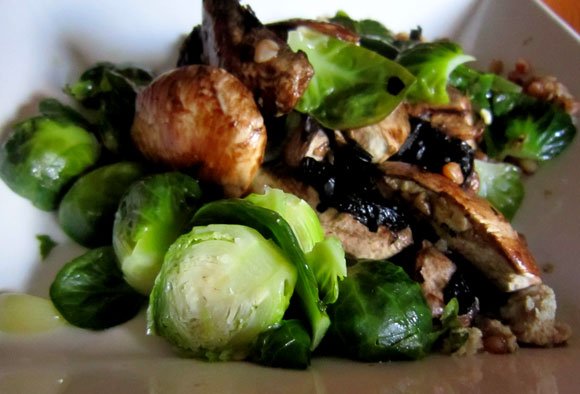
Brussels sprouts, mushrooms with buckwheat. The secret to tasty Brussels sprouts is to not overcook them.
Questions? Comments? Suggestions?
If you have a favorite recipe, why not submit it here in the comment section of this smoothie recipes blog for others to enjoy too!
I also welcome any comments, questions and suggestions. Thanks!
Do you love shrimp? If you do, you are certainly not alone.
I used to love eating them too.
Until I learned about the environmental impact of catching and farming shrimp.
Truth is the impact of bringing shrimp to our tables to satisfy our taste can be horrific.
But most Americans don’t know where their shrimp comes from or what’s in it.
Read this, and your appetite for shrimp (and other seafood) will dwindle.
“Americans love their shrimp. It’s the most popular seafood in the country, but unfortunately much of the shrimp we eat are a cocktail of chemicals, harvested at the expense of one of the world’s productive ecosystems. Worse, guidelines for finding some kind of “sustainable shrimp” are so far nonexistent.
In his book, Bottomfeeder: How to Eat Ethically in a World of Vanishing Seafood, Taras Grescoe paints a repulsive picture of how shrimp are farmed in one region of India. The shrimp pond preparation begins with urea, superphosphate, and diesel, then progresses to the use of piscicides (fish-killing chemicals like chlorine and rotenone), pesticides and antibiotics (including some that are banned in the U.S.), and ends by treating the shrimp with sodium tripolyphosphate (a suspected neurotoxicant), Borax, and occasionally caustic soda.
Upon arrival in the U.S., few if any, are inspected by the FDA, and when researchers have examined imported ready-to-eat shrimp, they found 162 separate species of bacteria with resistance to 10 different antibiotics. And yet, as of 2008, Americans are eating 4.1 pounds of shrimp apiece each year — significantly more than the 2.8 pounds per year we each ate of the second most popular seafood, canned tuna. But what are we actually eating without knowing it? And is it worth the price — both to our health and the environment?
Understanding the shrimp that supplies our nation’s voracious appetite is quite complex. Overall, the shrimp industry represents a dismantling of the marine ecosystem, piece by piece. Farming methods range from those described above to some that are more benign.
Problems with irresponsible methods of farming don’t end at the “yuck,” factor as shrimp farming is credited with destroying 38 percent of the world’s mangroves, some of the most diverse and productive ecosystems on earth. Some compare shrimp farming methods that demolish mangroves to slash-and-burn agriculture. A shrimp farmer will clear a section of mangroves and close it off to ensure that the shrimp cannot escape. Then the farmer relies on the tides to refresh the water, carrying shrimp excrement and disease out to sea. In this scenario, the entire mangrove ecosystem is destroyed and turned into a small dead zone for short-term gain. Even after the shrimp farm leaves, the mangroves do not come back.
A more responsible farming system involves closed, inland ponds that use their wastewater for agricultural irrigation instead of allowing it to pollute oceans or other waterways. According to the Monterey Bay Aquarium’s Seafood Watch program, when a farm has good disease management protocols, it does not need to use so many antibiotics or other chemicals.
One more consideration, even in these cleaner systems, is the wild fish used to feed farmed shrimp. An estimated average of 1.4 pounds of wild fish are used to produce every pound of farmed shrimp. Sometimes the wild fish used is bycatch — fish that would be dumped into the ocean to rot if they weren’t fed to shrimp — but other times farmed shrimp dine on species like anchovies, herring, sardines and menhaden. These fish are important foods for seabirds, big commercial fish and whales, so removing them from the ecosystem to feed farmed shrimp is problematic.
Additionally, some shrimp are wild-caught, and while they aren’t raised in a chemical cocktail, the vast majority is caught using trawling, a highly destructive fishing method. Football field-sized nets are dragged along the ocean floor, scooping up and killing several pounds of marine life for every pound of shrimp they catch and demolishing the ocean floor ecosystem as they go. Where they don’t clear-cut coral reefs or other rich ocean floor habitats, they drag their nets through the mud, leaving plumes of sediment so large they are visible from outer space.
After trawling destroys an ocean floor, the ecosystem often cannot recover for decades, if not centuries or millennia. This is particularly significant because 98 percent of ocean life lives on or around the seabed. Depending on the fishery, the amount of bycatch (the term used for unwanted species scooped up and killed by trawlers) ranges from five to 20 pounds per pound of shrimp. These include sharks, rays, starfish, juvenile red snapper, sea turtles and more. While shrimp trawl fisheries only represent 2 percent of the global fish catch, they are responsible for over one-third of the world’s bycatch.
Trawling is comparable to bulldozing an entire section of rainforest in order to catch one species of bird.”
Via Alternet by Jill Richardson
The article fails to mention shrimp produced in the New Orleans Delta. In addition to the recent oil spill, the whole area is an ecological disaster due to the dead zone. The dead zone is caused primarily by herbicide & fertilizer run off from the Mississippi watershed.
Here is what one fisherman says about fishing in the delta:
“Years ago, to raise money for repairs to my sailboat, I took a job as a deck hand on a shrimp trawler, a North Carolina boat operating out of Key West. Along with about 50 other boats based there, we trawled in the Gulf of Mexico for roughly two week trip periods and two of those trips were all I could stand in realizing the incredible environmental damage being done.
The ratio of what’s euphemistically called “trash” to shrimp when dumped on deck, representing the full spectrum of other marine life, is more like 50 lbs. to 1. Heavy chains weigh the nets to the bottom and drag clearing everything but heavy obstructions. A large following of sharks accompany every trawler lured by a seeping wake of fish oil and feed voraciously when the catch is culled by hand and the “trash” pushed overboard. (One does not want to lose one’s footing on a pitching deck.) This process continues repeatedly all night, every night.
I could go on about how many other environmental abuses occur in this one fishery. Like the hate for sea turtles that foul nets which are frequently killed when extracted if they’re not drowned by the trawl itself, and the bored captains that shoot anything that moves for sport with the automatic armory that each vessel carries in defense of piracy threats, and the violations of trawling through designated fish nurseries, and the dumping of chemicals used in boat maintenance, and more.
It’s a nasty, exploitative, destructive stomach turning process like so many other short sighted, greed driven and poorly regulated industries. Pound of destruction for pound of product it’s about as bad as it gets.”
At one point in the article Jill Richardson asks the question:
“Given this disturbing picture, how can an American know how to find responsibly farmed or fished shrimp?” and responds “Currently, it’s near impossible.”
I disagree.
Just don’t eat shrimp. It’s really that simple.
Read My New Ebook: Truth About Eating Fish and Fish Oil
You may be rolling your eyes at another “truth” being exposed, but I challenge you to read my new ebook and tell me you did not learn something new.

Read the entire book: The Truth About Eating Fish and Fish Oil
Coming soon to Amazon Kindle!
Questions? Comments? Suggestions?
If you have a favorite recipe, why not submit it here in the comment section of this smoothie recipes blog for others to enjoy too!
I also welcome any comments, questions and suggestions. Thanks!
The octopus is an intriguing creature of the seas that derives its name from a Greek word which means eight-footed.
They are found in various parts of the oceans, most commonly in the coral reefs. Octopuses, some 300 species of which inhabit tropical waters around the world, can change colors, squirt out poison, and exert a force greater than their own body weight.
We like to believe that we’re the smartest creatures on the planet. But the more we understand octopuses, the more it seems that we may not be alone in our ability to solve problems, make complex connections between ideas, and survive by wits alone.
Scientists have found that octopuses can navigate their way through mazes, solve problems quickly and remember those solutions, at least for the short term. A growing body of evidence suggests that octopuses show elements of human-like intelligence. But their intelligence has evolved for very different reasons than ours did, which makes them particularly difficult to understand.
Octopuses are preyed upon by sharks, dolphins, morays and conger eels.
But by far the biggest threat to octopuses (as well as other sea creatures) are humans.
All octopus species are suffering from overfishing, with no fishery management and dwindling numbers. They are also caught in large numbers as bykill with long line and other fishing methods.
Bizarre Foods Featuring Octopus
In case you don’t know, Bizarre Foods with Andrew Zimmern is a documentary-styled travel and cuisine television show hosted by Andrew Zimmern on the Travel Channel.
I don’t watch the show, but it does present some truly bizarre food choices “Bizarre Foods focuses on regional cuisine from around the world which is typically perceived by Americans as being disgusting, exotic, or bizarre.
In each episode, Zimmern focuses on the cuisine of a particular country or region. He typically shows how the food is procured, where it is served, and, usually without hesitation, eats it. You can find a whole list of the episodes and foods on wikipedia.
While the chef is enjoying celebrity status and a highly-coveted spot on prime-time television, here is a point of view that describes it for what his show really is: mindless, heartless entertainment “essentially sensationalizing the gruesome, medieval act of torturing, slaughtering, and eating creatures that, if they had a choice, would certainly run, fly, or swim in the other direction—away from this predator.”
Here is the excerpt from the Comfortably Unaware blog:
Andrew begins by walking into a crowded, noisy restaurant in Japan sitting down between two people on a stool at a counter—behind which, the cooking is accomplished for all to see. Zimmern states that this is why he “loves restaurants in Japan” because of “their noise and also freshness of seafood.” The camera then, on cue from the “freshness” comment, turns to capture the chef pulling an octopus out of a pan on the floor.
The octopus was, of course, very “fresh” and very alive as it gracefully and purposefully moved the tips of its eight legs, gently up and down the chef’s hands and arms as the animal tried to assimilate textures, colors, and temperatures, attempting to make sense out of its new surroundings. That’s what octopuses (or octopi) do.
They are quite intelligent beings with a large cognitive brain and complex sensory input mechanisms that researchers have recently found to be able to problem solve. They can gather information, process it, and then implement well thought out functions. Female octopuses are very sensitive with a strong maternal instinct—so strong that they mandatorily give up their life in the process of having offspring and protecting them after birth.
The Bizarre Foods’ camera crew then moved back to Zimmern. The person sitting in the next stool put her hand on his baldhead and said “the octopus has a head like yours”, referring to Zimmern’s shiny, hairless scalp. A good laugh ensued while the camera focused on the chef pushing the octopus down with both his hands into a pot of boiling oil over a red-hot burner in order to kill and cook the poor unsuspecting octopus.
We weren’t allowed to see how the octopus reacted to being held in oil as it was being boiled to death—portions to be then later served for Zimmern to eat. Imagine, for just a moment, what that octopus must have experienced as it went from attempting to carefully feel, see, interpret, and adapt to the chef’s hands with the thousands of sensory receptors on its legs—sending those inputs to an intelligent and quickly processing brain—to the next moment of being forcefully held in boiling oil, scalded to death. Actually, you can’t really imagine it, because you are not an octopus.
Although we are still learning about octopuses, (while killing 2.5 million tons of them and other cephalopods such as squid each year) it is has been quite well established that they are very sentient beings that feel and think in ways we do not understand. It can also be said that like all animals, octopuses only eat what they need to in order to survive. They kill only because they NEED to and without knowing that they are inflicting pain or suffering on any other living thing—quite unlike Andrew Zimmern and 98% of all other humans on this planet who kill because they WANT to kill, and then eat whatever it was that they just killed. All this, for no nutritional reason (there are many plant based foods that are infinitely healthier for us to consume). So, no, the person sitting next to Zimmern was not correct with her comment to him. The octopus does NOT have a “head” like his.
Bizarre Foods, Andrew Zimmern, and the Head of an Octopus

Questions? Comments? Suggestions?
If you have a favorite recipe, why not submit it here in the comment section of this smoothie recipes blog for others to enjoy too!
I also welcome any comments, questions and suggestions. Thanks!
