Pineapple smoothies are delicious, reminding me of hot summer days on a beach and ice-cold pina colada.
Unfortunately, many pineapple smoothie recipes available both online and in cookbooks call for some form of dairy, either yogurt, milk or cream. Fortunately, it’s easy to substitute, by using non-dairy milk, or simply adding very ripe banana and/or avocado to make the smoothie more creamy. (If you are wondering why, read this post and this post).
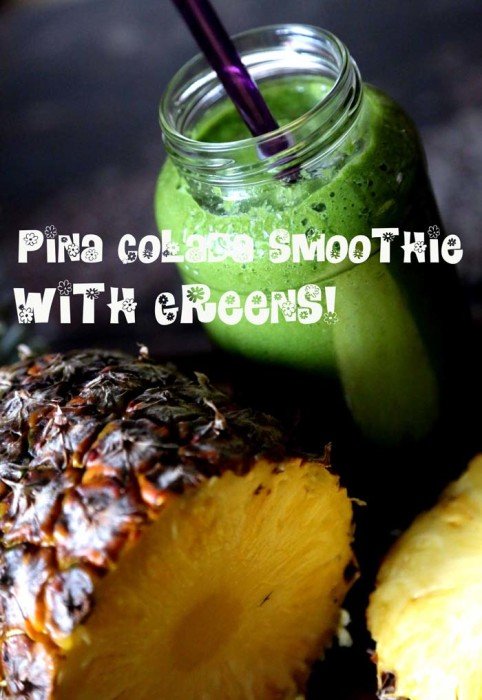
So today I have three pineapple recipes for you. One is a simple version of the classic, and two that are green pineapple smoothies. I call them green pina coladas.
Classic Pineapple Smoothie Recipe
1/4 fresh pineapple – peeled, cored and cubed
1 large ripe banana
1 cup non-dairy milk (such as almond, soy, etc.) or water
4 ice cubes (optional)
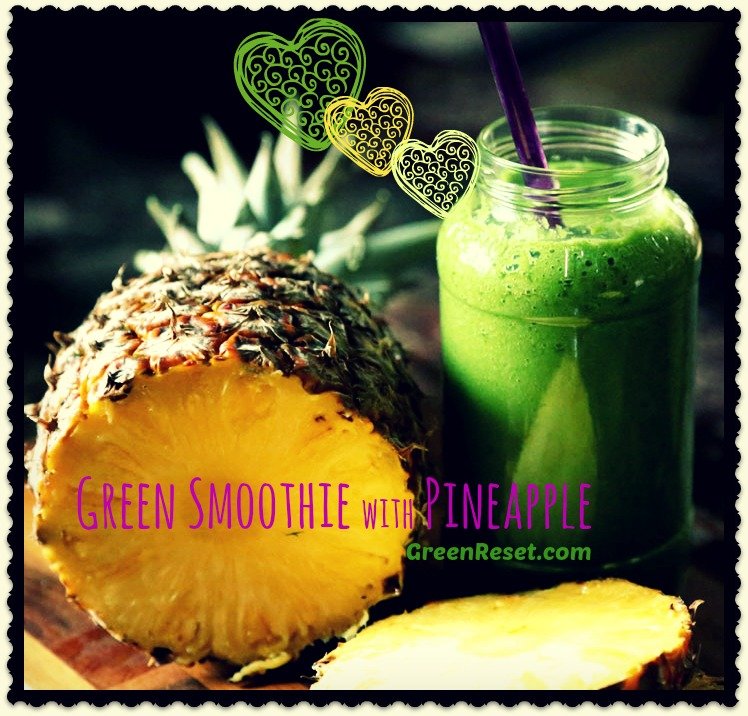
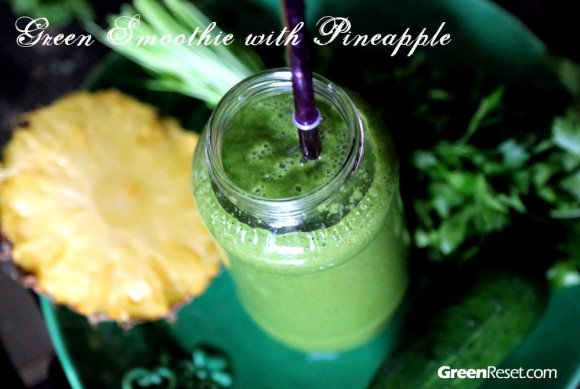
Green Pineapple Smoothie Recipe
As you already know I put greens practically into each recipe, as I don’t want to miss the opportunity to add more healthy nutrients to my drink. So this one is no different. All ingredients in this smoothie, from the bananas to the pineapple to the coconut to the greens provides a healthy source of vitamins and minerals that come together in a smoothie that is as good for you as it tastes.
4 cups fresh pineapple cut into pieces or frozen pineapple chunks (unsweetened)
1/2 bunch of spinach, kale or collard greens, stems removed (4-5 large leaves)
a few pieces of ice, if you want it chilled
Instructions
Blend all ingredients in your blender, beginning with the lowest speed setting and work your way up to the highest setting until the smoothie is creamy. Add more liquid or ice if the mixture is too thick and blend until desired consistency is achieved. Pour into a tall glass, sip and smile!
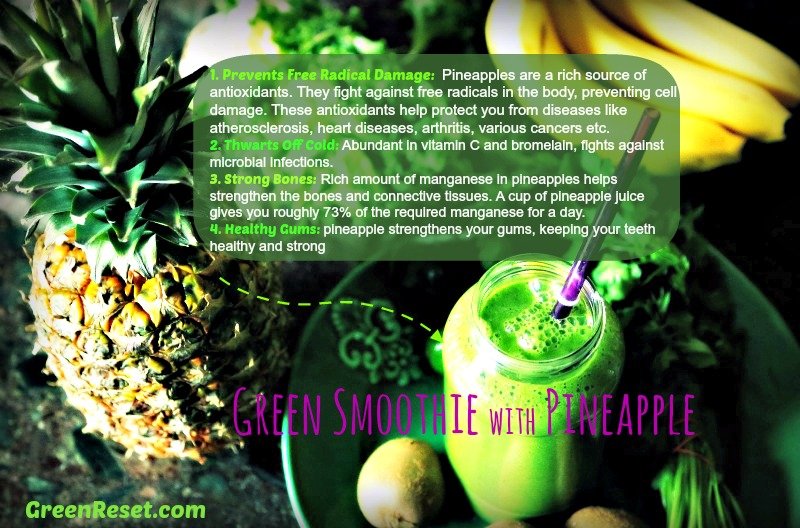
Pineapples are delicious (provided that they are ripe), so you don’t need encouragement to eat them, but here are some of the health benefits:
1. Prevents Free Radical Damage: Pineapples are a rich source of antioxidants. They fight against free radicals in the body, preventing cell damage. These antioxidants help protect you from diseases like atherosclerosis, heart diseases, arthritis, various cancers etc.
2. Thwarts Off Cold: Abundant in vitamin C and bromelain, fights against microbial infections.
3. Help Strengthen Bones: Rich amount of manganese present in pineapples helps in strengthening bones and connective tissues. A cup of pineapple juice gives you roughly 73% of the required manganese for a day.
4. Healthy Gums: Eating pineapple strengthens your gums, keeping your teeth healthy and strong.
5. Help Prevent Cancer: The abundance of antioxidants in pineapples helps fight against free radicals, halting the process of cell damage, preventing cancers.
6. Boost Heart Health: Powerful antioxidants keep free radicals away and lower the cholesterol levels, preventing heart diseases.
7. Boost Immunity: Rich content of vitamin C in pineapples boost your immune system by its strong antioxidant effect.
…and more…
How to Fix A Green Smoothie That You Don’t Love
It happens rarely, but it does happen. You made a smoothie that you don’t really care for. Don’t despair! The advantage of smoothies over other types of recipes, such as baking, is that they can be easily fixed.
“My smoothie is too thick“: Add more liquid. The best liquid for smoothies is water, but any non-dairy milk or fresh juice can be used as well.
“My smoothie is too watery”: Add more fruits and veggies. Bananas and avocados are great for making thick smoothies that are nice and creamy.
“My smoothie is too savory“: Add more sweet fruits. Add a packet of stevia, 1-2 tablespoons agave syrup, or other sweetener. A few dates or other dried fruit will also work, but you’ll have to blend it really well.
“My smoothie is too sweet“: Squeeze some lemon or lime juice into your smoothie. Add more greens and/or celery. Add a tart apple and blend well.
“My smoothie tastes bland”: Perhaps you added too many ingredients that don’t complement each other, or not enough ingredients that have distinct taste. Whatever the reason, I find that adding spices, such as cinnamon, vanilla, a piece fresh ginger, a piece of lemon (or some lemon juice), or a few fresh mint leaves will add some instant zing to any smoothie that is too bland.
“My smoothie is too “green” tasting“: Some greens have very distinct flavor. If you added too much strong tasting greens, such as mustard greens or dandelion, and the taste is too strong, you will have to dilute the smoothie by adding more fruits, mild greens and some condiments, such as ginger or lemon.
“My smoothie has awful color, my child (spouse, etc.) refuses to drink it“. Best way to mask the color is to add some frozen blueberries or cocoa powder to the mix. Another way is to serve it in a non-transparent container with a straw.
Questions? Comments? Suggestions?
If you have a favorite recipe, why not submit it here in the comment section of this smoothie recipes blog for others to enjoy too!
I also welcome any comments, questions and suggestions. Thanks!
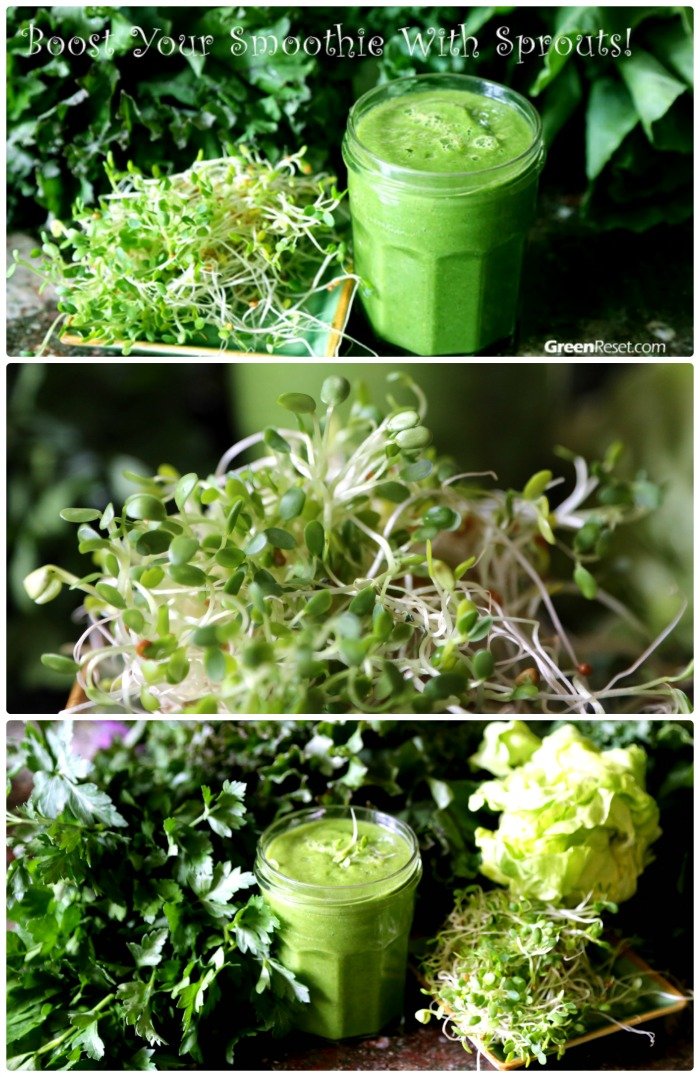
Even though I’ve known about the nutritional benefits of sprouting for quite some time, I’ve only recently started experimenting with growing my own sprouts and adding them to green smoothie recipes and other dishes. So, from now on, I’m determined to not just include more sprouts in my diet, but to learn how to grow them, and start a mini-sprout garden in my kitchen.
Really, when you think about it, it’s probably the most local, freshest, most nutritious food that you can get, especially in the winter. And even in other times of the year – not everyone has a garden – but you can have sprouts growing in your kitchen all year long.
Plus, sprouts are considered a SUPER FOOD – they are probably the most nutrient dense of all foods, while being incredibly affordable and easy to grow.
Sprouts can provide you with a steady year-round source of vitamins, minerals, trace minerals, enzymes, antioxidants, chlorophyll and protein, as well as a high concentration of health and youth-supporting enzymes.
To boot, they are low calorie and contain little or no fat. The fat they do contain is the healthy fat that your body needs. As some of the most nutritious foods that exist, they make a great addition to any healthy eating plan.
You can have them fresh all year round, even when fresh vegetables are hard to find. It’s easier than planting a garden outside and they’re ready much quicker. And the best part is that you can grow fresh sprouts right in the comfort of your own kitchen. It takes less than 2 minutes a day and they are ready in 3 to 7 days, depending on the variety. You can sprout seeds, beans, grains and nuts. Some of the most popular varieties are alfalfa, broccoli, red clover, radish, mung beans, lentils, garbanzo beans and peas.
So What Are the Health Benefits of Sprouts?
The essential requirement for health and healthy weight loss is a diet that is high in nutrients and low in calories.
Doctor Fuhrman calls it a Nutritarian diet. (You shouldn’t really be thinking of it as a diet in a sense that you do it for a few weeks and then go back to your old ways. It should become your lifestyle.)
Problem is many of the foods we buy at the supermarkets today are not as fresh and nutrient rich as we believe. Many items have to travel across the country (or across the world) to get to where we live. They have to be treated with various life-extending substances and procedures.
And buying supplements can get very costly.
Obviously the best solution would be to grow your own food, but that’s not for everyone…
Sprouting is something that anyone can do that is easy to do and will provide tremendous benefits to your health, helping you lose weight, reverse disease, increase energy, or whatever your goal.
Apparently, sprouting magnifies the nutritional value of the seed and makes the nutrition more bio-available to the body. It boosts the B-vitamin content, triples the amount of vitamin A and increases vitamin C by a factor of 5 to 6 times. Starches are converted to simple sugars, making sprouts very easily digestible.
Have you heard about the Hippocrates diet? In the renowned Hippocrates Institute, where they regularly cure terminally ill people using only nutrition and other lifestyle modifications, sprouts are one of the key ingredients on their menu.
Sprout Smoothie Recipe
Sprouts are really versatile. You can use them in smoothies, blended soups and salads, as well as regular salads, on sandwiches, stir fried with vegetables, or enjoy these nutrient-packed delicacies as a snack all by themselves or added as a garnish to a main dish.
To make a smoothie, add about 1/4 to 1/2 cup of sprouts to any smoothie recipe. Don’t put too many sprouts in your smoothie, and it will take on an overwhelmingly grassy flavor. Used in moderation, however, and sprouts are an absolute delight.
You can grown them yourself (see the instructions below), or simply buy them in a grocery store (that’s what I did for this recipe). If you don’t like the effort that growing your own sprouts takes, many health stores and farmers market have sprouts – but the selection may not be impressive and it will cost much more than if you grown them yourself.
Green Smoothie with Sprouts
Ingredients
1/4 cup alfalfa sprouts
1 cup baby spinach
1 cup pineapple, frozen
1/2 banana, frozen
1 cup water
1/4″ – 1/2″ fresh ginger, minced
1/16 teaspoon of Stevia (or agave nectar)
1-2 ice cubes, to thicken
Instructions
Blend ingredients in a powerful blender until smooth and creamy. Thin with water or thicken with ice if desired. Enjoy!
How to Grow Your Own Sprouts
Sprouts are easy to grow and take a minimum of effort. You probably already have everything you need to start your own kitchen garden. Once you’ve gone through the process once or twice, it will become easy.
To grow sprouts in jars on your kitchen sink, you will need:
a wide-mouth jar
screen or netting
a rubber band
a bowl to drain the jar
fresh water
sprouting seeds
Choose organic sprouting seeds whenever possible. The problem is that seeds that are not specifically sprouting seeds and not organic may be chemically treated with pesticides.
You’ll find lots of sprouting supplies and books on Amazon.
Two ounces of seeds will yield 1-2 pounds of sprouts, and 8 ounces of beans will yield 1 pound of sprouts.
Your sprouts will grow best when the temperature is between 65F and 75F (18C and 25C).
Put 1 to 2 tablespoons of seeds or 3 to 4 tablespoons of beans in a wide mouth jar.
Cover with netting or cheesecloth and secure with a rubber band.
Rinse a couple times, then fill the jar 3/4 full with pure water, room temperature, and soak 6-8 hours or overnight.
Drain soak water. Rinse 2 or 3 times in cool water.
Invert jar and prop at angle in sink or bowl to drain.
Rinse 2 or 3 times twice a day in cool water.
Place sprouting jar in bright light, but not direct sunlight, last sprouting day to allow chlorophyll to form.
Sprouts will grow three to seven days. Seed sprouts, like alfalfa or red clover are 1″ (2.5 cm) to 2″ (5 cm) long when ready. Bean sprouts, like lentils or peas are 1/4″ (.5 cm) to 1/2″ (1 cm) long when ready. These are more tender when small. Mung beans are 1″ (2.5 cm) to 2″ (5 cm) long when ready. They are best grown in the dark to prevent bitterness. They should be rinsed 3-4 times a day. Taste the sprouts as they are growing to see when you like them best.
Drain well. Cover the jar with a lid, or transfer to a covered container. Refrigerate to store.
Soaking times and amounts of seeds for sprouting in a quart jar:
Alfalfa seeds: 4 to 8 hours
Clover seeds: 4 to 8 hours
Broccoli seeds: 8 to 12 hours
Whole lentils: 8 to 12 hours, then eat
Fenugreek seeds: 4 to 8 hours
Radish seeds: 4 to 8 hours
Raw hulled sunflower seeds: 6 to 8 hours, then eat
Chia seeds: 6 to 8 hours, then eat
Sesame seeds: 6 to 8 hours, then eat
Wheat berries: 8 to 12 hours
Rye berries: 8 to 12 hours
More Great Ways to User Sprouts
Once you get your sprout garden going, you can use the sprouts in a variety of ways, not just in smoothies.
Add to tossed salads
Use in coleslaw (cabbage, clover, radish)
Add to potato salad (mung bean, lentil)
Use in wraps and roll-ups (alfalfa, sunflower, radish)
Stir-fry with other vegetables (alfalfa, clover, radish, mung bean, lentil)
Replace celery in sandwich spreads (lentil, radish)
Grind up and use in sandwich spreads (lentil, radish)
Stir into soups or stews when serving (mung bean, lentil)
Mix into pancake or waffle batter (buckwheat)
Eat them fresh and uncooked in a sprout salad (salad mixes)
Combine in rice dishes (fenugreek, lentil, mung bean)
Add to vegetable sushi (radish, sunflower)
Saute with onions (mung bean, clover, radish)
Puree with peas or beans (mung bean, lentil)
Add to baked beans (lentil)
Steam and serve with butter (mung bean, lentil)
Use in sandwiches instead of lettuce (alfalfa, clover, radish)
P.S. There have been some articles in the press about sprouts not being a safe food to eat. Read my article about the safety of sprouts.
Questions? Comments? Suggestions?
If you have a favorite recipe, why not submit it here in the comment section of this smoothie recipes blog for others to enjoy too!
I also welcome any comments, questions and suggestions. Thanks!
I know the story of Sergei Boutenko because of his mother, Victoria Boutenko of the “Raw Family.” Victoria is known in the raw food community as the woman who made green smoothies so popular. She is truly the “Queen of Green Smoothies.”
Sergei Boutenko is Victoria’s son. When he was nine years old he was diagnosed with diabetes. His family doctor told his parents he had to go on insulin immediately. His mother refused the conventional treatment of synthetic insulin and set off to search for an alternative solution. During her research, she stumbled onto the raw food diet and decided to switch her whole family to raw foods.
The results were remarkable for the whole family, including Sergei, who overcame his diabetes and is now living disease-free.
But not just that: he became an athlete, an avid promoter of green smoothies – or as he sings in his music video clip – green smoothie hustla, and a film maker.
Check out his website and support his latest project, “Powered by Green Smoothies“, a full length documentary about how hardcore, endurance athletes perform when given regular doses of fresh, organic green smoothie.
Interview with Sergei Boutenko
BEFORE WE BEGIN, I just want to be clear that I am not a medical doctor and thus cannot give any sort of medical advice. When asked questions, I share my own experience. It is up to you whether you choose to implement what I say or not. If you have diabetes, I recommend finding a doctor who is willing to monitor your health and work with you on changing your diet / lifestyle.
1. When people hear the diagnosis of diabetes they are usually told that this condition can be “managed” with proper diet and lifestyle, and – of course – medication. In the mainstream media, you rarely (if ever) hear stories like yours, of people completely overcoming this condition, without medication, and living disease-free. Did you talk to any doctors about what happened to you and what was their reaction?
I have talked to thousands of people over the years, many of whom have been doctors. People’s reactions are as different as the people themselves. Many of my followers are grateful for making them aware of an alternative to the conventional medical route. Some people seem to get offended by my story and call me a snake oil salesman. Having been at this for over 19 years, I am beginning to understand that stories like mine are not unique, they just get suppressed and never make it into the mainstream media.
Since my own diagnoses, I have met hundreds of diabetics (both type 1 and type 2) who have successfully reversed their diabetes. Because I have seen this over and over again with my own eyes, I am a firm believer in what I advocate. As green smoothies and raw food become more popular, I am beginning to meet more doctors who endorse a healthy diet. And this to me is encouraging.
2. I think one of the reasons no one is promoting raw diet or high-raw vegan diet as a solution to diabetes (besides the fact that there is no money in promoting it) is that it requires such a drastic change to one’s eating habits that people will not be willing or able to make the switch. What are your thoughts on that? How hard was it for you and what advice do you have for people facing the diagnosis who don’t know where to start?
You are absolutely correct. Switching to an all-raw diet is very difficult if not impossible.
Presently, I recommend green smoothies as a first step towards excellent health. If I may quote my own rap song: “Greens are incredible, they’re healthy and they’re edible.”
When you make a green smoothie, you unleash all the vitamins, minerals, chlorophyll, etc into the smoothie. You then drink the smoothie and transfer all that goodness into your body. This is easy and painless. If you do it regularly (about a quart every single day) you will notice miraculously positive changes occurring in your body.
Even if you continue eating and drinking “normal food” as you always have, the green smoothie will benefit you and your health. Eventually after you do it for awhile (approximately one month) you will find that you are naturally starting to crave more fresh organic foods. When this happens, it will be much easier to eat healthy because that is what your body will request.
3. People with diabetes are told to avoid foods that contain sugar. Are green smoothies that contain sweet fruits, such as bananas, suitable for people with diabetes? Or should people with blood-sugar problems be sticking to the low-glycemic fruits only, such as berries?
It is commonly thought that fruits are bad for diabetics. If you are concerned about this, I invite you to use low-glycemic fruits in your green smoothies. You can also make a savory green smoothie, which resemble a delicious soup.
That said it is important to make a distinction that fruit sugars do not affect diabetics in that same way as processed sugars. Sugar within fruit comes with fiber, which naturally regulates how fast the body is able to absorb it. Since whole fruit and smoothies contain lots of fiber, your blood sugar should not spike too much from consumption.
At our retreats we often have a diabetic or two concerned with the amount of fruit intake. By the end of the retreat, after they’ve affirmed that fruit does not affect them negatively, they are not longer afraid to eat it.
That said, every person and body is different and it is good to approach all new practices cautiously so as not to shock your body. If you’re not used to eating whole fruit, experiment on yourself in small doses and monitor your blood sugar simultaneously.
4. What were you and your family eating before your diagnosis? Was your diet what we consider a typical diet or SAD (Standard American Diet)?
My diet was absolutely terrible! It was SAD and ARD (Average Russian Diet). Just made the up BTW. We pretty much ate everything and anything.
5. There are some variations of raw food diets. Can you tell us what were the main foods you eating when you switched to raw food diet that helped you overcome diabetes?
I ate fruits, seeds, nuts, soaked grains, and lots and lots of greens. I should also mention that in addition to changing my diet, I began a vigorous exercise regime. For diabetics it is a must to run, bike, dance, and do anything to burn off excess sugar. The whole thing was really a lifestyle shift.
6. What are you eating today? Are you 100% raw? What are some of your favorite foods/dishes? Do you drink green smoothies regularly?
Today I am not 100 % raw. After 14 years on a strict raw diet I decided to relax a little bit and now incorporate some cooked food in life. I don’t go too big though. No hamburgers or pizza’s. On occasion, I cook quinoa, steams yams, squash, and the like. I find that eating a little bit of cooked food prevents me from overeating nuts and seeds and I feel better because of it.
7. I know that you live an extremely active lifestyle and love hiking, biking, snowboarding, running, and dancing. How important is physical activity to staying healthy and diabetes-free?
Over the years I’ve learned that health is a puzzle comprised of many different pieces. I think I’ve figured out many of those pieces, but I may never know all of them. Being physically active has not only helped me overcome my diabetes, but has consistently brought a sense of accomplishment and happiness into my life. There is so much written about the healthy benefits of exercise that there is very little I can add to the subject. I will say that if you’re not exercising regularly, you are TOTALLY missing out!
8. Is there anything else that you would like to share?
YES! I am excited to announce that will be filming a feature length documentary about the affect that green smoothies have on endurance athletes.
I’ve launched a Kickerstater project to help me fund this huge endeavor. If you would like to contribute to this film, please click on the link: http://kck.st/11g6hL4 your donation gets you cool rewards, supports a good cause, and is tax deductible!
Watch the trailer and support the project here:
/>
Listen to Sergei as he talks about overcoming diabetes:
http://www.youtube.com/watch?v=WPPGpVobyNo
Check out the “Green Smoothie Hustla” Music Video – if it doesn’t make you run to the kitchen to get your “fix”, I don’t know what will 😉
Many people who are thinking about starting their juicing or blending routine to improve their health and/or lose weight, are trying to weigh in all the pros and cons of juicing versus blending.
Both juicing and blending are very popular these days. Many people making fresh juices and smoothies at home. And thanks in part to people like Joe Cross, director of the documentary Fat Sick & Nearly Dead, juicing has become more mainstream.
So, which is better for you? Which is easier to do? Cheaper? More effective?
Fortunately, whichever option you choose, you cannot go wrong. Whether you are making vegetable juices or blending green smoothies, you are doing your body a huge favor.
Let’s look at some benefits of juicing versus blending.
Benefits of Juicing and Blending
Both methods provide an easy way to incorporate lots of vegetables into your menu. Both blended and juiced vegetables pack a mighty nutritional punch. Both are an extremely good way to get a large quantity and variety of fruits, vegetables and greens (at minimum your recommended 6 to 8 servings) that otherwise would be hard to consume regularly.
Nutrients in juices and blended drinks are easy for your body to absorb. Juicers and high-speed blenders essentially “pre-digest” the produce for you. This is beneficial for those of us who as a result of years of sub-optimal food choices have less-than-optimal digestion.
Both methods help reduce your appetite and cravings for sugar and processed foods. You will be craving less junk food, and you will be satisfied with less food, because your body will be nourished better. When you consume fresh produce in any form, are getting the real nutrition that your body craves. Blended drinks tend to make you feel fuller, since they contain all the fiber. For everyday consumption (i.e. if not doing a juice cleanse), consider having two green juices or green smoothies a day on an empty stomach approximately 30 minutes before lunch and dinner.
Cost-effective. Making juices or shakes at home is less costly than buying your juices or smoothies.
The Pros of Blending
Blending is actually consuming the whole food, including the fiber.
Quicker to do and clean up. Smoothies are faster to make and a blender is a little easier to clean up than a juicer in my opinion. There’s only one piece to rinse out or throw in the dishwasher.
Cost of produce. Blending your juice requires fewer veggies and fruits, even though they’re more filling.
Fiber helps to fill you up. Smoothies can have a high yield in terms of bang-for-your-buck fullness, since the fiber is left in.
You can mix in various ingredients. For example, nuts, seeds, oatmeal, tofu, etc. to make them even more nutritious and more like a meal.
The Pros of Juicing
The body works less to digest the nutrients. Juice, the liquid without the fiber, allows your digestive system to work less to extract the benefits. Fiber is indeed great and an important part of your regular diet. However, for people who want to really re-set their system, taking a finite break from fiber has the benefit of allowing your digestive system to have a bit of a rest.
More vegetables per glass. You can consume more vegetables and greens into a single glass of green juice than you would in a smoothie serving.
Some produce is much better for juicing, than blending. For example, root vegetables, such as sweet potatoes, carrots or parsnips, are better for juicing. Cabbage, broccoli, and other really dense veggies—are great in juices. They may be added to smoothies, but in small quantities only.
The Cons of Juicing
Longer clean up time. The main disadvantage of juicing in my opinion, is the time it takes to clean up after juicing. It helps to clean your equipment immediately after you juice to prevent any remnants from contaminating the juicer with mold.If you buy a high-quality juicer, the whole process should only take about 5 minutes.
Another con is that I feel a lot of produce is wasted. If you wish, you can use the pulp for other recipes, in baking (such as this carrot cake), or soups, or simply composting the remains and using it in your garden.
Also, juicing sweet fruits and vegetables can result in a drink that has lots of sugar. Limit using fruits or buying juices made with mostly beets, carrot, and/or fruits, as the sugar can sneak up on you. Make sure you mix in some low sugar ingredients, such as celery, cucumbers, and leafy greens.
More tips for cleansing juices and smoothies
Use organic produce or ask where your produce is coming from and is produced without pesticides.
Use citrus to your advantage. Lemons and limes are amazing at eliminating the bitter taste of the dark deep leafy green vegetables that provide most of the benefits of juicing. If your juice is too bitter, add more lemon.
Add ginger to your advantage. I use ginger in most of my juices and smoothies, and I like to run it through the machine first and then push other things—greens, apples, etc.—behind it to maximize the flavor.
Have fun. Don’t be afraid to be playful and experiment. Throw in a handful of berries, or nuts, or some extra greens to really supercharge your recipes.
Cleansing Greens Smoothie Recipe
This is a very simple, cleansing, easy-to-drink, easy-to-digest smoothie and is especially good for beginners who are not used to the darker, more bitter greens. For a lighter, lower calorie juice, make it without the avocado.
1/2 bunch cilantro or parsley
2 celery sticks
2 leaves of romaine or 1 cup of leafy greens, such as baby spinach
1/3 cucumber, cut into 2-inch pieces (skin on)
1/2 lemon, without the skin
1/2 avocado
1-inch piece of ginger
8 to 12 ounces filtered water (adjust the amount to your taste and consistency preferences)
1/2 cup ice (optional)
Place all the ingredients in the blender. Denser items—like the lemon, cucumber, and ginger—should go in first. Blend on high until smooth.
Cleansing Lemonade Smoothie
This is my fave all-day cleansing drink based on the Master Cleanse drink.
1 peeled lemon
1 bunch of parsley or cilantro
1 tbs (or less) pure maple syrup
A dash of cayenne
full blender of water or use less water for a more potent drink
1/2 cup ice
Place all the ingredients in the blender. Denser items—like the lemon, cucumber, and ginger—should go in first. Blend on high until smooth.
How to Do a Detox Cleanse
Going on a sixty day juice diet (as in Fat Sick & Nearly Dead) is quite extreme and it isn’t necessarily the easiest, most practical or even the healthiest way to lose weight and regain health for most people, in my opinion.
By juicing fruit and veggies you are losing virtually all of the beneficial fibers, unless of course you eat the pulp – or drink green smoothies.
What I would recommend instead, is simply to add freshly made vegetable/green/fruit juices (and, of course, lots of green smoothies) to your diet.
Don’t go cold turkey; just ADD the juice and smoothies.
As the days go by, drink more and more of it, until you find yourself eating less and less of everything else.
Next start replacing your “meat and potato” type meals with more fruit, vegetables, as well as some whole grains and beans.
Taking cold turkey plunge into the juice fast is challenging to say the least, and you might just fold and abandon the fast too quickly, and never return to the wonders of juicing. That’s why it’s better to ease into this gradually.
Also, you need to be aware of the detox effect – with some unpleasant side effects – that will kick in if you go into this too quickly. As you detox you might feel mild flu-like symptoms for a few days as your body discharges the toxins.
Also, buy a good quality juicer or blender. If it’s not easy to do the cleanse, it will become the excuse to quit.
Also it’s important to remember that not everyone is a candidate for fasting or juicing. People with hypoglycemia, for instance, would do really poorly on a juice or water cleanse. So if you’re fasting and feeling really horrible, lightheaded, sweaty, nauseous, dizzy, faint, etc., you need to eat something! Be sure to consult a nutritionist before embarking on one of the more rigorous programs.
Which Juicers and Blenders are Recommended?
You don’t need to spend more than $99 for a good blender or $149 for a good juicer. But if you want, they go up to several thousands of dollars.
Breville Juicer: Price: $149
Omega Juicer Low Stream Vert 350: If you want a machine that presses rather than grinds or cuts your fruits and veggies, this is one of your better options. Price: $380
NutriBullet blender: A top-notch high-powered blender on the market. Price: $99
VitaMix blender: This is the blending machine that I use. Price: Starts at $329
Do you want to make juice but all you have is a blender? You can still make clear juice with a blender, by straining out the pulp from the blended drink.
Questions? Comments? Suggestions?
If you have a favorite recipe, why not submit it here in the comment section of this smoothie recipes blog for others to enjoy too!
I also welcome any comments, questions and suggestions. Thanks!
(Guest Post) Eating your veggies is easy with green smoothies. Green smoothies are full of fiber, and as they are smashed up already, your body has no trouble absorbing them.
Green smoothies provide you a rich, concentrated form of nutrients that help in enhancing your health. Most people think that as these smoothies do not contain dairy products, they are devoid of creaminess and richness. However, that is not true. By choosing the ingredients wisely, you can get the same rich frothiness without adding milk or cream. Check the below given green smoothie recipe and find it out by yourself.
To prepare a green smoothie, you will require:
Greens (Select any one from Kale, lettuce, broccoli, cabbage, celery, turnip greens)
Fruits (Select two to three fruits- apples, pears, bananas, pineapple, kiwi, blueberries and papaya)
Orange juice
Non dairy milk or water
Watery vegetable (cucumber, squash or celery)
I usually experiment with different fruits and leafy greens to explore unique flavors and taste. I recommend go with what your taste buds prefer.
Preparation
My all time favorite smoothie is Classic green smoothie. If you are new to green smoothies, pick this one. Take two to three fruits and blend them in a good, high power blender. Start with fewer amounts of fruit and then add more for thickening or sweetening purpose. Make sure you use ripe fruits. Bananas are preferred choice as they add richness and creaminess to green smoothie. Now add watery vegetable and your choice of greens. Put two to three tablespoons of orange juice in to it. This will give tanginess to the smoothie. Blend it well by adding some ice in it.
This green smoothie recipe is fruity, delicious and loaded with goodness.
Juicing and smoothies seem to be the latest health craze. It is a great way to tap the healing power of raw foods that are loaded with power-boosting nutrients. Fresh fruits and veggies get easily digested by the body and provide instant vitamins, minerals and other nutrients.
My Omega BL390R Smoothie Blender
For a perfectly made smoothie, you need a good blender that can provide same consistency to the liquid. It should be convenient to use and easy to clean. I used Omega BL390R to prepare my smoothie. Whether you want to prepare smoothies from fresh fruits, turn ice in to snow or pulverize hard grains, this powerful blender can handle everything in your kitchen in less time and effort. My Omega blender comes with several user friendly features that make the whole process of blending convenient and easy. As there is limited number of buttons, you can operate it easily without any confusion. It comes with a stainless steel container that is perfectly suitable for milk shakes and smoothies.
About the author
Rachael Smith is a full-time mom and loves to write about women’s lifestyle, fashion, diet charts and vegan recipes on different women’s lifestyle websites on her free time. She uses her knowledge and experience in creating unique, delicious recipes that are loaded with nutrients.
I made this beautiful mixed berry smoothie this morning that I’d like to share with you.
I was going to add kale, but after I rinsed it, I set it aside and completely forgot to put it in my Vitamix. The color of the smoothie was stunning, so I just couldn’t help myself not to take a few photos. I also snapped a picture of my son as he devoured the smoothie (he usually squirms when I try to take a photo of him).
So the smoothie in the picture is without kale – that’s why it has this deep, intense color. Kale would make it more greenish in color, and even more nutritious. Without kale, it’s a perfect smoothie for even the most green-phobic kids and adults.
To make it into a beginner or kid-friendly smoothie, then skip the kale just like I did, and add only two stalks of celery. My son loves to drink a big glass smoothie once or twice a day. If your child refuses to drink smoothies (which is really hard to imagine, because they taste delicious), you can try various trick to encourage him or her to try them. For my tips on making smoothies for kids, read this post.
You can also use any green in the smoothie, such as spinach , collards, green lettuce, arugula or parsley. Just keep in mind that some greens have very distinct taste, so if experimenting with a new ingredient, start with a little, and add more gradually.
Berries are truly nutritional powerhouses. What makes berries so special is their high levels of phytochemicals — those naturally occurring nutrients that help protect cells from damage.
Strong scientific evidence exists that eating blueberries, blackberries, strawberries and other berry fruits has beneficial effects on the brain and may help prevent age-related memory loss and other changes, scientists report. So snag some blueberries, strawberries, raspberries, and blackberries and start munching or add them to your smoothie.
Questions? Comments? Suggestions?
If you have a favorite recipe, why not submit it here in the comment section of this smoothie recipes blog for others to enjoy too!
I also welcome any comments, questions and suggestions. Thanks!

 supplies and books on Amazon.