After my article about sprouts in smoothies, I received this question via email:
Question
“I no longer eat sprouts of any kind. There have been incidences of people becoming ill from their ingestion. Even sprouting your own can carry a risk as the bacteria can be in the seeds. Can you check into this issue an perhaps address it in a future e-mail. I will make the green smoothie minus the sprouts. “
My Response: Are Sprouts Safe to Eat?
My short answer to this question is: Absolutely yes.
But let me explain….
Note: The decision what to include in your diet and what to exclude is entirely yours, and I’m not going to try to influence anyone. What I want is to present a few facts, statistics, and my personal opinion that put these concerns into proper context and perspective.
Worrying about food safety is a valid concern. No one wants to get sick from bacteria in the food that they eat.
After receiving the email, I searched the Internet and indeed found a few articles about sprouts being contaminated and causing outbreaks. For example, a few years ago stories about alfalfa sprouts contaminated with salmonella bacteria have made the news.
Salmonella is bad news, but no food is immune to it. All food eaten raw carry that risk including fresh fruits and vegetables, which have more pathogen outbreaks than sprouts.
Does this mean you should not eat sprouts or raw produce, and go on a 100% cooked food diet???
So I went to a few government websites, did some more research and digging, and here is what I learned.
There are 76 million cases of food borne illnesses each year; 4 million caused by salmonella, 93% of which are caused by meat, poultry, milk and eggs. The remaining 7% of cases are from shellfish, fresh fruits and vegetables. (Data according to : CDC – Center for Disease Control, and Foodsafety.com)
Since 1996, there have been at least 30 reported outbreaks of foodborne illness associated with different types of raw and lightly cooked sprouts. Most of these outbreaks were caused by Salmonella and E. coli. For all outbreaks over their entire 40 year history, U.S. sprout industry has had a total of 2,000 cases. There has never been a case of salmonella from home-grown sprouts.
So, let’s compare:
- 76 million cases of food borne illnesses each year from all sources
versus
- 2,000 cases over the 40 years (about 50 per year), 30 outbreaks over the last 16 years (fewer than 2 per year) from sprouts
- 0 (zero) reported cases of salmonella from home grown sprouts
Every food has some risks, but this one looks like one that I’m quite comfortable taking.
Especially considering the benefits of eating sprouts, leafy greens and other raw fruits and vegetables. (Let’s not forget their immune-system boosting qualities!) At the renowned Hippocrates Institute, where they routinely cure various serious diseases (including cancer), raw and living foods are the core of the program and sprouts make up 50% of the diet(!).
More Food for Thought: What’s the REAL source of contaminated food outbreaks
Each year there are millions of cases of reported sicknesses and hundreds of deaths due to food-borne pathogens such as E. coli, salmonella, and Campylobacter.
What the media never reveal is the REAL source of the contamination, and therefore, the reason for the outbreaks. In all reports, the illnesses are blamed on the specific foods.
The vital piece of information that is routinely omitted is that all these pathogens that cause sickness actually come from animal sources.
For instance, salmonella grows abundantly on chickens and other animals, so when they are killed and eaten for food, there is a high likelihood that salmonella may find its way to humans. This also occurs with E. coli, which is found in all animals. It should be no surprise that because it is found in all animals, there is a probability it will show up somewhere down the line if you eat those animals.
Pumping livestock full of antibiotics has become so commonplace that we almost take it for granted. Animals are routinely kept on low doses of antibiotics, such as penicillin, tetracycline and streptomycin, to neutralize the repercussions of filthy living conditions of thousands of animals into pens with only a few square feet of living area for each. Waste is supposed to be carried away by drainage systems operations beneath the animals, but the systems don’t always work. The end result is a cramped, dirty, stressed-out animal that often needs drugs to stay healthy or even alive. Scientists believe that this rampant overuse of antibiotic is causing the DNA of infectious pathogens like salmonella, E. coli and campylobacter to change and make the diseases resistant to the drugs that traditionally wiped them out. Once resistant, the deadly bacteria can easily survive in the animals and be transmitted to humans.
Then what causes salmonella, E. coli, and other food-borne diseases in vegetables, fruits, nuts, grains, and seeds?
Plants can only be contaminated by coming into contact with polluted water through irrigation, animal fertilizers, and using animal or human feces.
Vegetables and fruits can also become contaminated if placed in close proximity to or mixed with raw poultry, meat, or eggs, and unpasteurized milk, as all of these products have supply bacteria contaminants on them naturally.
Animal flesh and secretions used for food have a high propensity for distribution of pathogens, because they are found naturally on and within the animal itself during its life, as well as during the slaughtering process. This applies to all animal products, whether it is from livestock, dairy, or fish. This just adds to the ways that eating animals creates a depletion of our health. (Source: Comfortably Unaware, by Richard Oppenlander)
What about warnings not to consume raw sprouts?
On several pages I’ve seen warnings not to consume raw sprouts. Wow, really? This seems like an extreme measure, if you ask me. Why sprouts have been singled out, I have no idea. Nobody is telling us not to eat chicken, eggs, or sushi, which carry a much greater risk, in my opinion.
7 Ways to Minimize the Risk of Consuming a Contaminated Food
1. In case of seeds, in order to minimize risk, purchase seeds from a trusted source. The company that I buy them from has all seeds spot tested for Salmonella and E-coli. While this is not a fool-proof guarantee, it has a 99% potential to catch contaminated seed.
2. If buying at a grocery store and you want to be extra-cautious, try giving them a hot bath before you eat them: Research has shown that you can kill salmonella by immersing contaminated sprouts in boiling water for five seconds.
3. Wash all your raw fruits, vegetables and greens that you purchased from a store thoroughly.
4. Don’t be a source of foodborne illness yourself. Wash your hands with soap and water before preparing food. Avoid preparing food for others if you yourself have a diarrheal illness.
5. Ban all animal products from your kitchen and switch to plant-based (vegan) diet. I know this may sound radical to many people, but all animal products, and especially raw animal flesh and secretions is a high risk food and can be a source of contamination in your own kitchen.
For example, A 2009 USDA study found that 87 percent of chicken carcasses tested positive for E. coli after chilling and just prior to packaging. One study found that 48 percent of all chicken samples tested positive for feces. Chicken feces may also contain roundworms, hair worms, tapeworms, insect larvae, fecally-excreted drugs and other chemicals, as well as the more normal constituents of feces — bile, undigested food, etc.
6. If you are unwilling to eliminate meat and dairy, make sure you separate your plant foods from animal flesh and secretions in your kitchen (using separate utensils, cutting board, etc; and washing these thoroughly in hot water or dishwasher), and cook these foods to the recommended temperature. The Centers for Disease Control and Prevention (CDC) recommends extreme caution and care when handling raw chicken, which includes meticulously cleaning and sterilizing kitchen surfaces that are exposed to the meat. And skip sushi. Let’s not forget about parasites and amoebas that are commonly found in fish (yikes!). In fact, seafood is one of the top causes of food-borne illness in the U.S.
7. If you are a gardener and grow your own fruits and vegetables, switch to organic, manure-free gardening methods. Fertilizers such as blood and bone meal, slaughterhouse sludge, fish emulsion, and manures may carry dangerous diseases that breed in intensive animal production operations. Vegan-organic gardening is a safer, healthier way to grow our food, whereby soil fertility is maintained using vegetable compost, green manures, crop rotation, mulching, and other sustainable, ecological methods.
Resources:
To learn more about various diseases that come from animal agriculture, I highly recommend listening to this podcast: The “Lethal Gifts of Livestock” podcast. You can also find it on iTunes, episode 39.
Foodborne Illness FAQ CDC – Center for Disease Control
Fecal Contamination in Retail Chicken Products A Report from the Physicians Committee for Responsible Medicine
There’s Poop in Our Chicken Meat! Huffington Post.
Questions? Comments? Suggestions?
If you have a favorite recipe, why not submit it here in the comment section of this smoothie recipes blog for others to enjoy too!
I also welcome any comments, questions and suggestions. Thanks!
When I found Dontfearthevegan.com and I asked Steffi for an interview, I’m sure she was surprised, especially since (as I found out later) she doesn’t really like smoothies (?!?) and I’m the owner of a green smoothie recipe site, GreenReset.com.
Well, my interest in her certainly wasn’t because I was trying to expand my smoothie making skills.
So, let me explain…
You see, I’m a new vegan and (although it now seems incredible to me) until about a year ago, I had never personally met a vegan – not until I became one myself, and began seeking them out. I met a few vegetarians – but they were not close to me – just people I came across once or twice, never to see them again. For most part my family and friends are very meat oriented in their food choices, and when I tried eliminating meat from my diet (while experimenting with raw foods) – I was met with harsh criticism, and failed miserably.
I feel that part of this failure was the fact that I haven’t had any support or role models. Being vegan (or even vegetarian) seemed so difficult and unattainable for regular people, with kids and family, like myself.
Now, I’m really passionate about this lifestyle. It took me 46 years to get to this point, and I wish I could help others “see the light” sooner. So that’s why I decided to create a series of interviews with people who have been vegan for a while, and post it on my website, with the goal of sharing these experiences with non-vegans, and perhaps compiling their wisdom later on into an ebook or other resource. I want to show different profiles of people living a vegan lifestyle, so that people who are hesitant or doubtful could see that it’s not only doable, but also a very rewarding choice.
But back to smoothies…
I think smoothies can be a great help when someone is just transitioning to plant-based diet–they make consuming large amounts of fruits, veggies and greens really easy and delicious.
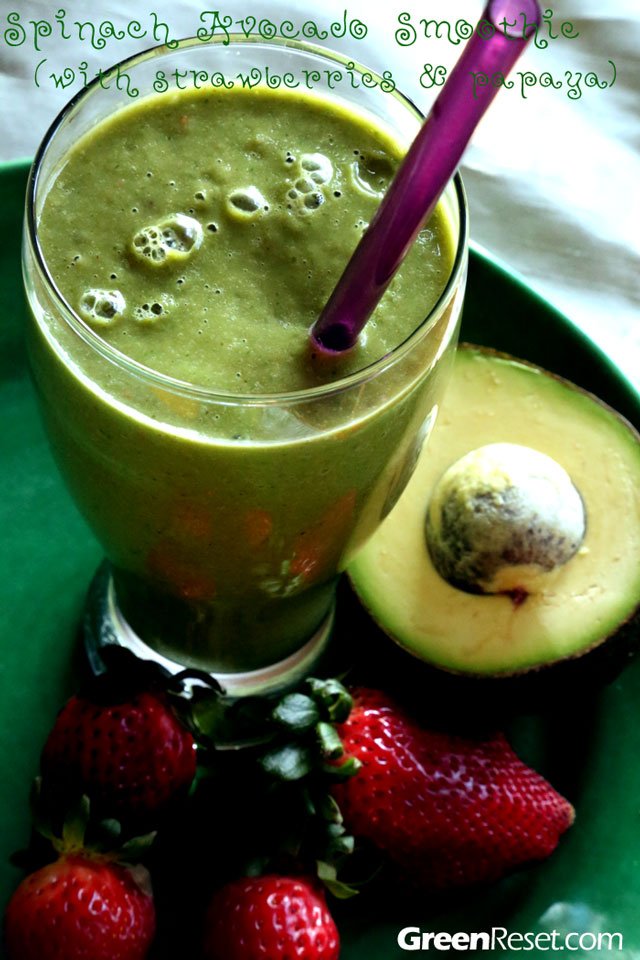
The recipe I want to share with you calls for strawberries, avocado, papaya, and greens. It doesn’t include a banana, but you can certainly add one (it will make the smoothie sweeter). There is really no reason to avoid adding bananas to your smoothies, unless you are one of the people who just dislike the taste and texture that they add to a smoothie (my husband is one of them). I like banana-free smoothies, from time to time, when I feel a bit stuck in a rut with my recipes.
So, here is a simple recipe that I made this morning with ingredients I had in my kitchen.
Avocado-Papaya-Strawberry Smoothie
- 2 handfuls spinach or other leafy greens (I like to use organic Spring Mix)
- 1 cup strawberries
- 1 cup papaya, peeled and deseeded
- 1/2 avocado (makes the smoothie creamy)
- 1 celery stalk (optional)
- sweetener of choice (optional)
- about 2 cups water (adjust the amount depending on how thick you want it)
Blend all ingredients until smooth.
Note: This smoothie will not be very sweet, which I like, so if you want more sweetness you may decide to add a bit of agave syrup, stevia or a few dates to make it sweeter.
Enjoy!
More Banana-Free Smoothie Recipes
So, here are three simple recipes for you with easy-to-find ingredients, which are really delicious: sweet and creamy, just as they should be.
Avocado-Papaya-Strawberry Smoothie
2 handfuls spinach
1 cup strawberries (frozen or fresh)
1 avocado
2 cups water or non dairy milk (such as coconut milk)
Avocado-Apple Smoothie
1 green apple (for example, Granny Smith)
1/2 avocado
1 tablespoon of lemon or lime juice
1/2 – 1 cup water
Pear-Strawberry
2 pears
1 cup whole strawberries
2 cups baby spinach (or other leafy green)
1 celery stalk
1 cup of water
Mango-Strawberry Green Smoothie
1 mango
1 cup whole strawberries
2 cups fresh baby spinach (or other leafy green)
1/2 – 1 cup water
Papaya-Orange Smoothie
2 and 1/2 cups papaya, peeled and deseeded
1 orange, peeled
1 pear, cored
1 celery stalk
2 cups fresh baby spinach (or other leafy green)
1/2 – 1 cup water
Papaya-Apple Smoothie
2 and 1/2 cups papaya, peeled and deseeded
1 apple, cored
2 cups fresh baby spinach (or other leafy green)
1 whole carrot (optional)
Pear-Blueberry
2 pear
1 cup blueberries
2 cups fresh baby spinach (or other leafy green)
¼ avocado
1 cup water
Pear-Apple
2 pear
1 apple
¼ teaspoon cinnamon
2 cups fresh baby spinach (or other leafy green)
½ cup water
Questions? Comments? Suggestions?
If you have a favorite recipe, why not submit it here in the comment section of this smoothie recipes blog for others to enjoy too!
I also welcome any comments, questions and suggestions. Thanks!
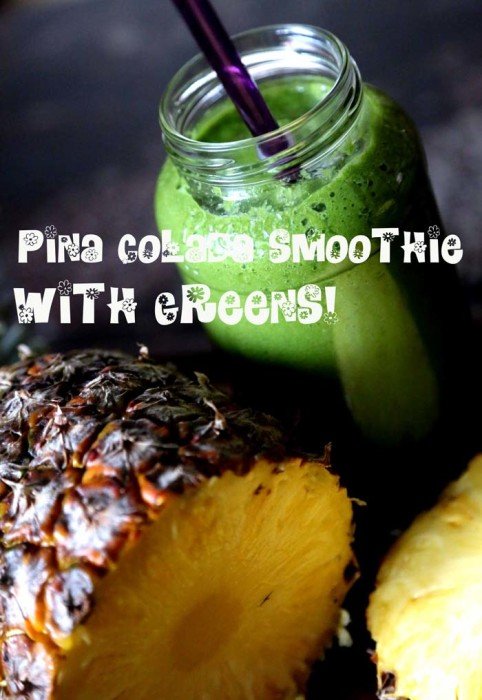
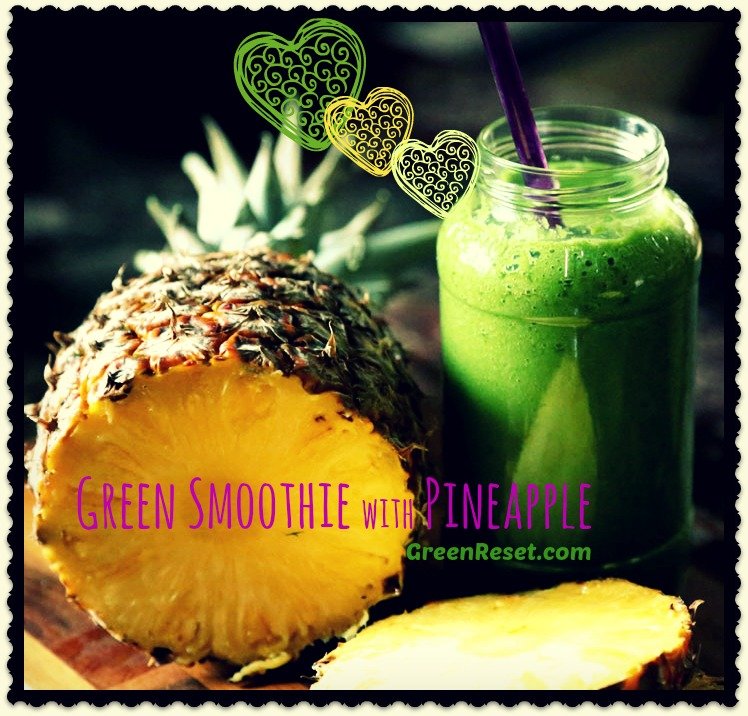
Pineapple smoothies are delicious, reminding me of hot summer days on a beach and ice-cold pina colada.
Unfortunately, many pineapple smoothie recipes available both online and in cookbooks call for some form of dairy, either yogurt, milk or cream. Fortunately, it’s easy to substitute, by using non-dairy milk, or simply adding very ripe banana and/or avocado to make the smoothie more creamy. (If you are wondering why, read this post and this post).
So today I have three pineapple recipes for you. One is a simple version of the classic, and two that are green pineapple smoothies. I call them green pina coladas.
Classic Pineapple Smoothie Recipe
1/4 fresh pineapple – peeled, cored and cubed
1 large ripe banana
1 cup non-dairy milk (such as almond, soy, etc.) or water
4 ice cubes (optional)
Green Pineapple Smoothie Recipe
As you already know I put greens practically into each recipe, as I don’t want to miss the opportunity to add more healthy nutrients to my drink. So this one is no different. All ingredients in this smoothie, from the bananas to the pineapple to the coconut to the greens provides a healthy source of vitamins and minerals that come together in a smoothie that is as good for you as it tastes.
Green Piña Colada Pineapple Smoothie
Ingredients
- a 13.5-oz can of coconut milk
- 1 banana
- 4 cups fresh pineapple cut into pieces or frozen pineapple chunks (unsweetened)
- 1/2 bunch of spinach, kale or collard greens, stems removed (4-5 large leaves)
- a few pieces of ice, if you want it chilled
-
-
Instructions
- Blend all ingredients in your blender, beginning with the lowest speed setting and work your way up to the highest setting until the smoothie is creamy. Add more liquid or ice if the mixture is too thick and blend until desired consistency is achieved. Pour into a tall glass, sip and smile!
3.1
https://greenreset.com/pineapple-smoothie/
Pineapple-Strawberry Smoothie Recipe That Will Make You Smile!
Ingredients
Instructions
- Blend everything on high. A high power blender is best to blend tough greens, such as kale or collard greens (I use Vitamix).
- Add more water if needed to get things moving around in the blender.
- Pour into a pretty glass, drink, and smile!
3.1
https://greenreset.com/pineapple-smoothie/
Benefits of Pineapples
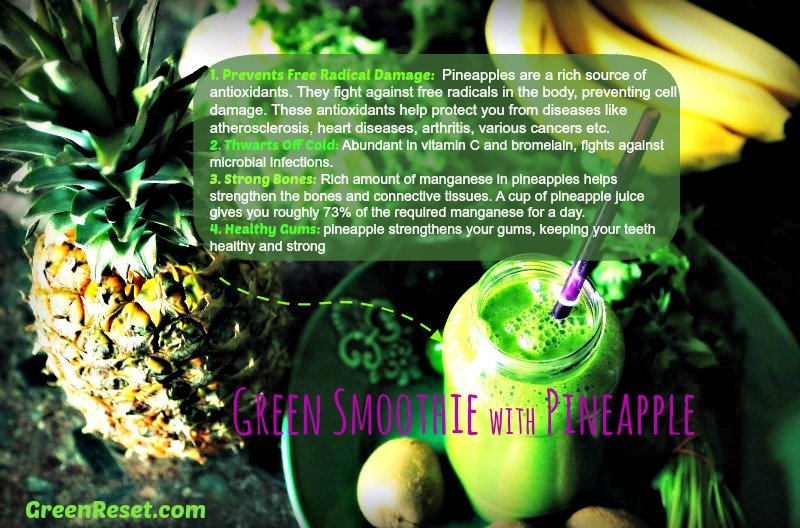
Pineapples are delicious (provided that they are ripe), so you don’t need encouragement to eat them, but here are some of the health benefits:
1. Prevents Free Radical Damage: Pineapples are a rich source of antioxidants. They fight against free radicals in the body, preventing cell damage. These antioxidants help protect you from diseases like atherosclerosis, heart diseases, arthritis, various cancers etc.
2. Thwarts Off Cold: Abundant in vitamin C and bromelain, fights against microbial infections.
3. Help Strengthen Bones: Rich amount of manganese present in pineapples helps in strengthening bones and connective tissues. A cup of pineapple juice gives you roughly 73% of the required manganese for a day.
4. Healthy Gums: Eating pineapple strengthens your gums, keeping your teeth healthy and strong.
5. Help Prevent Cancer: The abundance of antioxidants in pineapples helps fight against free radicals, halting the process of cell damage, preventing cancers.
6. Boost Heart Health: Powerful antioxidants keep free radicals away and lower the cholesterol levels, preventing heart diseases.
7. Boost Immunity: Rich content of vitamin C in pineapples boost your immune system by its strong antioxidant effect.
…and more…
How to Fix A Green Smoothie That You Don’t Love
It happens rarely, but it does happen. You made a smoothie that you don’t really care for. Don’t despair! The advantage of smoothies over other types of recipes, such as baking, is that they can be easily fixed.
- “My smoothie is too thick“: Add more liquid. The best liquid for smoothies is water, but any non-dairy milk or fresh juice can be used as well.
- “My smoothie is too watery”: Add more fruits and veggies. Bananas and avocados are great for making thick smoothies that are nice and creamy.
- “My smoothie is too savory“: Add more sweet fruits. Add a packet of stevia, 1-2 tablespoons agave syrup, or other sweetener. A few dates or other dried fruit will also work, but you’ll have to blend it really well.
- “My smoothie is too sweet“: Squeeze some lemon or lime juice into your smoothie. Add more greens and/or celery. Add a tart apple and blend well.
- “My smoothie tastes bland”: Perhaps you added too many ingredients that don’t complement each other, or not enough ingredients that have distinct taste. Whatever the reason, I find that adding spices, such as cinnamon, vanilla, a piece fresh ginger, a piece of lemon (or some lemon juice), or a few fresh mint leaves will add some instant zing to any smoothie that is too bland.
- “My smoothie is too “green” tasting“: Some greens have very distinct flavor. If you added too much strong tasting greens, such as mustard greens or dandelion, and the taste is too strong, you will have to dilute the smoothie by adding more fruits, mild greens and some condiments, such as ginger or lemon.
- “My smoothie has awful color, my child (spouse, etc.) refuses to drink it“. Best way to mask the color is to add some frozen blueberries or cocoa powder to the mix. Another way is to serve it in a non-transparent container with a straw.
Questions? Comments? Suggestions?
If you have a favorite recipe, why not submit it here in the comment section of this smoothie recipes blog for others to enjoy too!
I also welcome any comments, questions and suggestions. Thanks!
Even though I’ve known about the nutritional benefits of sprouting for quite some time, I’ve only recently started experimenting with growing my own sprouts and adding them to green smoothie recipes and other dishes. So, from now on, I’m determined to not just include more sprouts in my diet, but to learn how to grow them, and start a mini-sprout garden in my kitchen.
Really, when you think about it, it’s probably the most local, freshest, most nutritious food that you can get, especially in the winter. And even in other times of the year – not everyone has a garden – but you can have sprouts growing in your kitchen all year long.
Plus, sprouts are considered a SUPER FOOD – they are probably the most nutrient dense of all foods, while being incredibly affordable and easy to grow.
Sprouts can provide you with a steady year-round source of vitamins, minerals, trace minerals, enzymes, antioxidants, chlorophyll and protein, as well as a high concentration of health and youth-supporting enzymes.
To boot, they are low calorie and contain little or no fat. The fat they do contain is the healthy fat that your body needs. As some of the most nutritious foods that exist, they make a great addition to any healthy eating plan.
You can have them fresh all year round, even when fresh vegetables are hard to find. It’s easier than planting a garden outside and they’re ready much quicker. And the best part is that you can grow fresh sprouts right in the comfort of your own kitchen. It takes less than 2 minutes a day and they are ready in 3 to 7 days, depending on the variety. You can sprout seeds, beans, grains and nuts. Some of the most popular varieties are alfalfa, broccoli, red clover, radish, mung beans, lentils, garbanzo beans and peas.
So What Are the Health Benefits of Sprouts?
The essential requirement for health and healthy weight loss is a diet that is high in nutrients and low in calories.
Doctor Fuhrman calls it a Nutritarian diet. (You shouldn’t really be thinking of it as a diet in a sense that you do it for a few weeks and then go back to your old ways. It should become your lifestyle.)
Problem is many of the foods we buy at the supermarkets today are not as fresh and nutrient rich as we believe. Many items have to travel across the country (or across the world) to get to where we live. They have to be treated with various life-extending substances and procedures.
And buying supplements can get very costly.
Obviously the best solution would be to grow your own food, but that’s not for everyone…
Sprouting is something that anyone can do that is easy to do and will provide tremendous benefits to your health, helping you lose weight, reverse disease, increase energy, or whatever your goal.
Apparently, sprouting magnifies the nutritional value of the seed and makes the nutrition more bio-available to the body. It boosts the B-vitamin content, triples the amount of vitamin A and increases vitamin C by a factor of 5 to 6 times. Starches are converted to simple sugars, making sprouts very easily digestible.
Have you heard about the Hippocrates diet? In the renowned Hippocrates Institute, where they regularly cure terminally ill people using only nutrition and other lifestyle modifications, sprouts are one of the key ingredients on their menu.
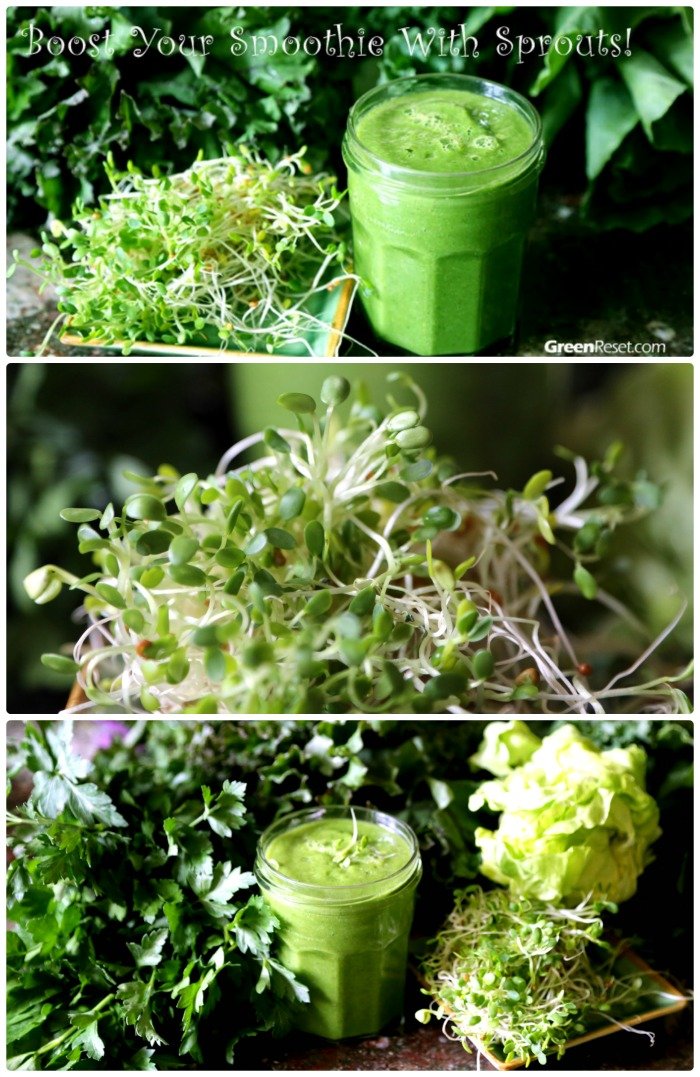
Sprout Smoothie Recipe
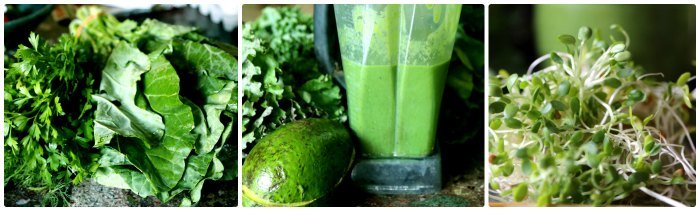
Sprouts are really versatile. You can use them in smoothies, blended soups and salads, as well as regular salads, on sandwiches, stir fried with vegetables, or enjoy these nutrient-packed delicacies as a snack all by themselves or added as a garnish to a main dish.
To make a smoothie, add about 1/4 to 1/2 cup of sprouts to any smoothie recipe. Don’t put too many sprouts in your smoothie, and it will take on an overwhelmingly grassy flavor. Used in moderation, however, and sprouts are an absolute delight.
You can grown them yourself (see the instructions below), or simply buy them in a grocery store (that’s what I did for this recipe). If you don’t like the effort that growing your own sprouts takes, many health stores and farmers market have sprouts – but the selection may not be impressive and it will cost much more than if you grown them yourself.
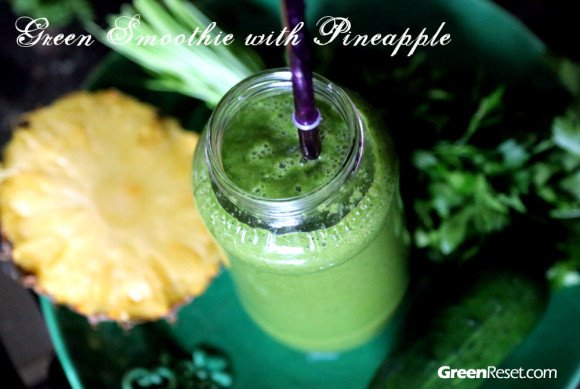
Green Smoothie with Sprouts
Ingredients
- 1/4 cup alfalfa sprouts
- 1 cup baby spinach
- 1 cup pineapple, frozen
- 1/2 banana, frozen
- 1 cup water
- 1/4″ – 1/2″ fresh ginger, minced
- 1/16 teaspoon of Stevia (or agave nectar)
- 1-2 ice cubes, to thicken
Instructions
- Blend ingredients in a powerful blender until smooth and creamy. Thin with water or thicken with ice if desired. Enjoy!
How to Grow Your Own Sprouts
Sprouts are easy to grow and take a minimum of effort. You probably already have everything you need to start your own kitchen garden. Once you’ve gone through the process once or twice, it will become easy.
To grow sprouts in jars on your kitchen sink, you will need:
- a wide-mouth jar
- screen or netting
- a rubber band
- a bowl to drain the jar
- fresh water
- sprouting seeds
Choose organic sprouting seeds whenever possible. The problem is that seeds that are not specifically sprouting seeds and not organic may be chemically treated with pesticides.
You’ll find lots of sprouting supplies and books on Amazon.
Two ounces of seeds will yield 1-2 pounds of sprouts, and 8 ounces of beans will yield 1 pound of sprouts.
Your sprouts will grow best when the temperature is between 65F and 75F (18C and 25C).
- Put 1 to 2 tablespoons of seeds or 3 to 4 tablespoons of beans in a wide mouth jar.
- Cover with netting or cheesecloth and secure with a rubber band.
- Rinse a couple times, then fill the jar 3/4 full with pure water, room temperature, and soak 6-8 hours or overnight.
- Drain soak water. Rinse 2 or 3 times in cool water.
- Invert jar and prop at angle in sink or bowl to drain.
- Rinse 2 or 3 times twice a day in cool water.
- Place sprouting jar in bright light, but not direct sunlight, last sprouting day to allow chlorophyll to form.
- Sprouts will grow three to seven days. Seed sprouts, like alfalfa or red clover are 1″ (2.5 cm) to 2″ (5 cm) long when ready. Bean sprouts, like lentils or peas are 1/4″ (.5 cm) to 1/2″ (1 cm) long when ready. These are more tender when small. Mung beans are 1″ (2.5 cm) to 2″ (5 cm) long when ready. They are best grown in the dark to prevent bitterness. They should be rinsed 3-4 times a day. Taste the sprouts as they are growing to see when you like them best.
- Drain well. Cover the jar with a lid, or transfer to a covered container. Refrigerate to store.
Soaking times and amounts of seeds for sprouting in a quart jar:
- Alfalfa seeds: 4 to 8 hours
- Clover seeds: 4 to 8 hours
- Broccoli seeds: 8 to 12 hours
- Whole lentils: 8 to 12 hours, then eat
- Fenugreek seeds: 4 to 8 hours
- Radish seeds: 4 to 8 hours
- Raw hulled sunflower seeds: 6 to 8 hours, then eat
- Chia seeds: 6 to 8 hours, then eat
- Sesame seeds: 6 to 8 hours, then eat
- Wheat berries: 8 to 12 hours
- Rye berries: 8 to 12 hours
More Great Ways to User Sprouts
Once you get your sprout garden going, you can use the sprouts in a variety of ways, not just in smoothies.
- Add to tossed salads
- Use in coleslaw (cabbage, clover, radish)
- Add to potato salad (mung bean, lentil)
- Use in wraps and roll-ups (alfalfa, sunflower, radish)
- Stir-fry with other vegetables (alfalfa, clover, radish, mung bean, lentil)
- Replace celery in sandwich spreads (lentil, radish)
- Grind up and use in sandwich spreads (lentil, radish)
- Stir into soups or stews when serving (mung bean, lentil)
- Mix into pancake or waffle batter (buckwheat)
- Eat them fresh and uncooked in a sprout salad (salad mixes)
- Combine in rice dishes (fenugreek, lentil, mung bean)
- Add to vegetable sushi (radish, sunflower)
- Saute with onions (mung bean, clover, radish)
- Puree with peas or beans (mung bean, lentil)
- Add to baked beans (lentil)
- Steam and serve with butter (mung bean, lentil)
- Use in sandwiches instead of lettuce (alfalfa, clover, radish)
P.S. There have been some articles in the press about sprouts not being a safe food to eat. Read my article about the safety of sprouts.
Questions? Comments? Suggestions?
If you have a favorite recipe, why not submit it here in the comment section of this smoothie recipes blog for others to enjoy too!
I also welcome any comments, questions and suggestions. Thanks!
Chocolate mousse is a great dessert that doesn’t take a long time to prepare (this version, literally takes less than 5 minutes). Plus it’s great for entertaining because 1) it looks pretty, 2) it’s delicious, and 3) you can make it ahead of time.
The recipe that I’m about to share with you has to be one of the easiest and most satisfying desserts around.
How to make the easiest ever chocolate mousse
This Creamy Chocolate Avocado Mousse is rich and decadent. Silky texture and deep chocolate flavor in every spoonful. And you won’t believe how easy it is to make, with just two base ingredients, plus a few optional to be added as you wish.

Now, when most people think of avocado, a sweet desert will most likely be the last dish to spring to my mind.
So, if you are skeptical about putting avocados and chocolate together, it’s understandable. However, no worries! One spoonful and you will understand why many people rave about chocolate avocado mousse recipes.
When I made this recipe and dressed it up for the picture, my son wanted to try it immediately. After he did, he said: “You made this? You should be working in a restaurant!” :-).

As I said, avocado-based mousse is guilt-free because because it only contains healthy ingredients.
However, it doesn’t mean it’s calorie-free or fat-free, since avocados are quite high in calories and fat (I said guilt-free, not calorie-free ;-)).
Easiest Ever Chocolate Mousse Recipe
Easiest Ever Chocolate Mousse
Ingredients
- 1 large avocado (3/4 - 1 cup mashed)
- 1/4 - 1/3 cup vegan hot cocoa mix (sweetened)
-
Optionally add:
- a pinch of salt
- a few drops of vanilla extract
-
You may keep it super simple and just serve the mousse as is. Or build a mousse parfait!
Here are your optional ingredients:
-
- dark chocolate chips or chocolate shavings
- shredded coconut
- pecans, walnuts, or other nuts, chopped or whole
- freshly grated orange zest
- cinnamon or nutmeg
- sliced banana
- sliced strawberries
- whole blueberries or other berries
- crushed vegan cookies or grahams
- brown sugar
- drizzle of agave or maple syrup
- cashew cream, soy or coconut whip on top
Instructions
- Mash up avocado with hot cocoa mix. Process in a food processor until smooth with a pinch of salt and a few drops of vanilla.
- Serve in pretty glass containers decorated with slices of banana, chocolate chips, coconut flakes, or whatever else you have in your pantry!
3.1
https://greenreset.com/chocolate-mousse/

I hope you enjoy it as much as we did!
Try it on Sunday, Monday, Thursday or Friday :-). (Or any other day, really). It’s completely up to you!
Now, there are people who insist that avocados have no place in the dessert; they claim that they can still taste it no matter how much chocolate and other ingredients they add, and that this is not acceptable. If that’s you, I have another version of chocolate mousse recipe, with another surprise ingredient….
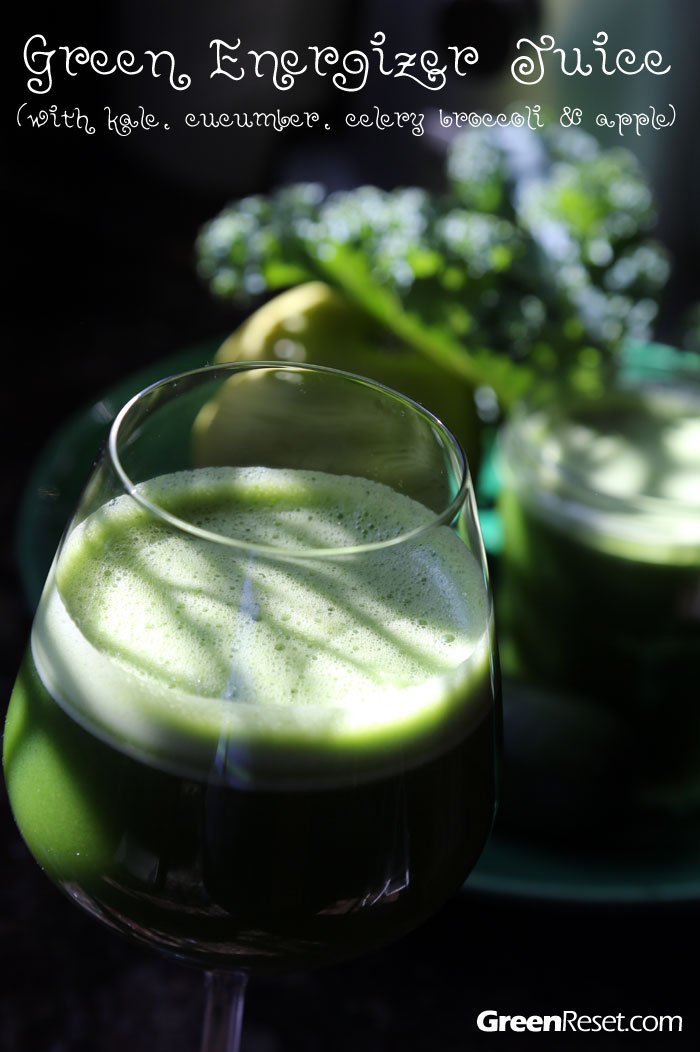
After long winter (and gallons and gallons of green smoothies), I’m craving juices. Today, I’ve made some green juice – just looking at it makes you feel energized!
Green juice packed with vegetables is all the rage these days. It can be prepared with a variety of ingredients, such as kale, celery, broccoli, cabbage, cucumber, apple, kiwi, parsley and/or cilantro.
Juicing kale, broccoli, celery or parsley adds that green color and a multitude of health benefits. Throw in a sweet element to keep the juice palatable, but going too sweet may result in a dessert juice rather than a drinkable vitamin.
For beginners, I’d advise to steer clear of adding too much cabbage, cilantro or parsley (only because you may find the flavors too strong), and add more cucumbers, apples, a pear or a kiwi – to make it sweeter.
Green Juice Recipes
So, if you are willing to try a great juicing recipe for green vegetables and kale that will give you lots of energy, here it is.
Basic version:
4-5 celery sticks
5-6 leaves of kale (or other leafy greens)
1-2 apples or pears (green apples are less sweet, more tart)
1 lemon (if not organic, then the lemon should be peeled)
Additional/optional ingredients:
1 cucumber
1/4 of a small cabbage
1/4 to 1/2 ripe papaya (1/2 results in a sweeter juice)
1 handful of parsley or cilantro
1 thumb-sized nob of ginger
You may also like to add some beets or carrots, but then of course it will no longer be a green juice. Some people like to add small slice of garlic and/or ginger.
Drink to your health and boost your immune system!
Other Juice Recipes to Try
Super Red Beta Carrot Juice

Questions? Comments? Suggestions?
If you have a favorite recipe, why not submit it here in the comment section of this smoothie recipes blog for others to enjoy too!
I also welcome any comments, questions and suggestions. Thanks!
Should I blend or should I juice? – that seems to be the question recently…
Sometimes it’s tough to decide 😉
It’s been a while since I purchased my new Breville juicer to join my kitchen appliance team (and replace the old one, which was long-ago ready to leave its post), and we continue our mini Juice Reboot morning routine (or mini-detox-cleanse) with my husband (who is the main reason I bought the juicer in the first place, as I could not get him to drink enough smoothies, and I think may be more inclined to drink juices).
I have to say it’s been working really well so far, even though it does make the mornings a bit more busy and it takes a bit more time to get everyone out of the house. We’ll continue it for just a couple of days more, until my husband leaves on a trip, and then resume when he comes back in almost three weeks.
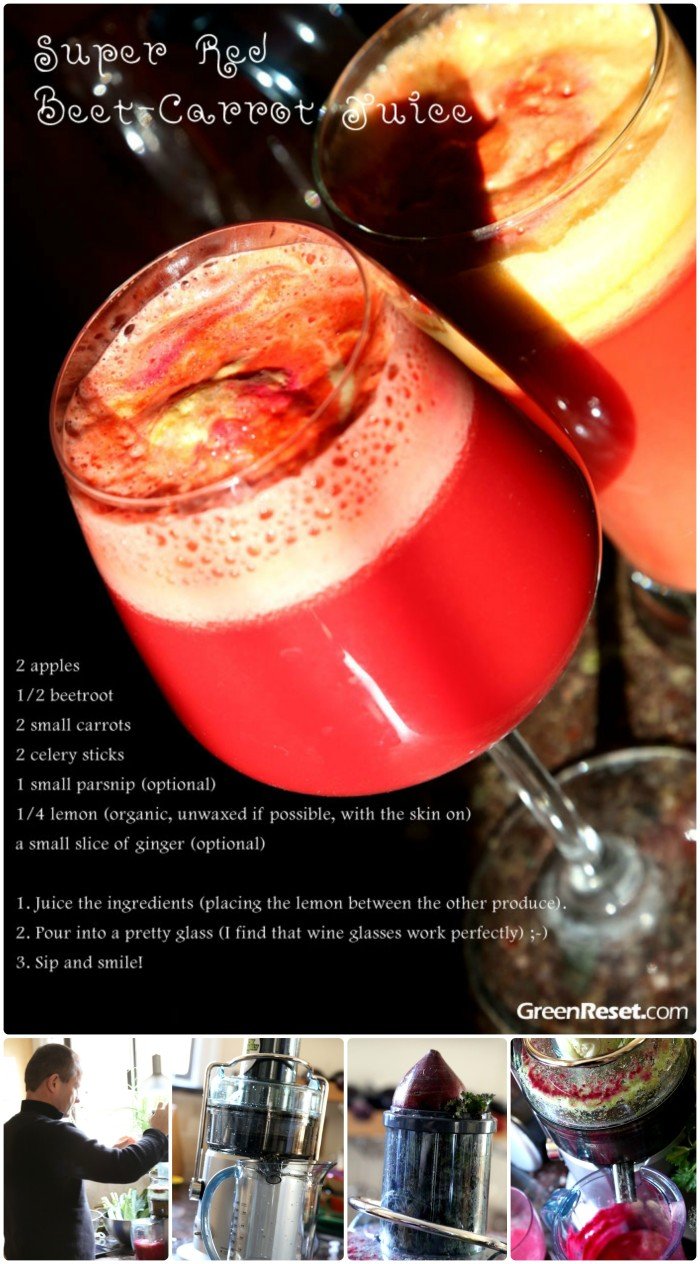
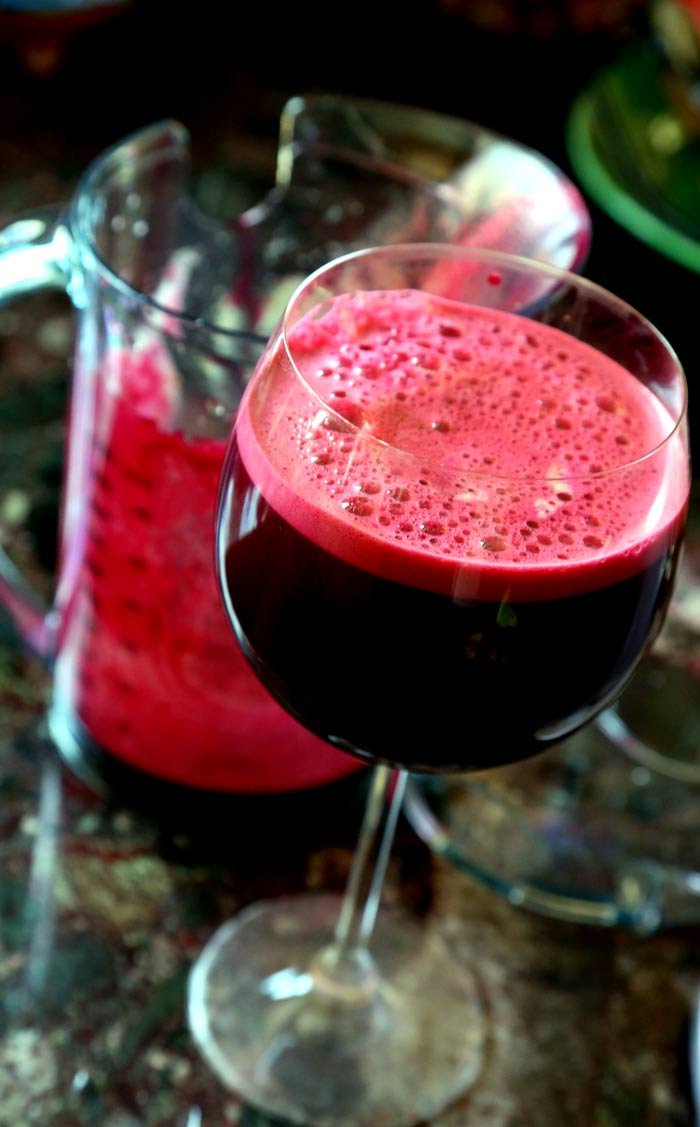
So today, we made this rich vibrant beetroot juice with carrots, celery and apple.
I also found a recipe that uses parsnips – which I have to say – I never juiced before. I didn’t have parsnips, so I’ll try it next time and let you know how it tastes. What I can tell you right now, that the combination below (without parsnip), creates a truly delicious nutrient packed juice.
Super Red Beta-Carrot Juice Recipe
Super Red Beta-Carrot Juice
Ingredients
- 1 apple (or use two for a sweeter juice)
- 1 beetroot
- 2 small carrots
- 2 celery sticks
- 1 small parsnip (optional)
- 1/4 lemon (organic, unwaxed if possible, with the skin on)
- a small slice of ginger (optional)
Instructions
- Juice the apples, beetroot, carrots, celery, parsnip and lemon (pack the lemon between the other produce).
- Pour into a pretty glass (I find that wine glasses work perfectly), sip and smile!
3.1
https://greenreset.com/super-red-beta-carrot-juice/
Despite some of the ‘earthy’ ingredients, the apple, beetroot and carrots actually have a sweet flavor, which work together to create a delicious juice. Ginger and lemon will give this juice a nice tangy kick.
The use of carrots in the fight against cancer has been well-documented due to their high beta carotene content and the presence of the natural fungicide falcarinol. Beetroot is a great source of iron, which means it helps purify the blood. This juice is superb for helping to build the blood and is great for fighting infections – juice just what the doctor ordered!
Questions? Comments? Suggestions?
If you have a favorite recipe, why not submit it here in the comment section of this smoothie recipes blog for others to enjoy too!
I also welcome any comments, questions and suggestions. Thanks!
Eating fish may be a considered by many a vast improvement over the Standard American diet (SAD), but most people fail to realize that the consumption of aquatic animals comes with its own set of issues.
Truth is the promise of fish-eating being healthier, more sustainable, better for the environment and more ethical than the consumption of land animals is nothing more than a “fishy” propaganda.
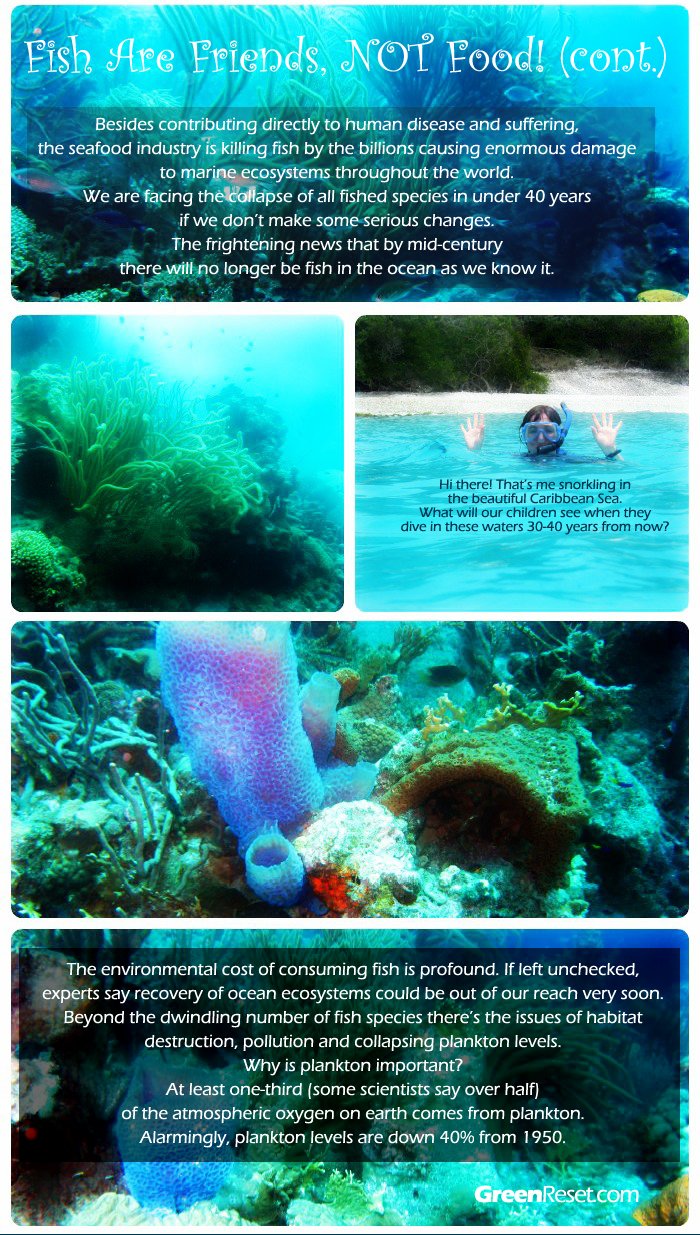
Besides contributing directly to human disease through the toxicity of its products, the seafood industry is killing fish by the billions causing enormous damage to marine ecosystems throughout the world.
We are facing the collapse of all fished species in under 40 years if we don’t make some serious changes. The frightening news that by mid-century there will no longer be fish in the ocean as we know it.
Since the mid-1980s, the international fishing industry’s capacity has increased every year, and yet over the same period, the amount of fish actually caught and killed for food has decreased every year.
The reason is obvious: we have overfished the oceans to such an extreme extent that we have forced all the world’s fisheries into collapse or near collapse. Overfishing of large fish like tuna, cod, swordfish, and salmon, as well as mid-sized fish and small sea animals like shrimp and krill, is having devastating consequences on marine ecology, and driving many aquatic animals into extinction and near-extinction.
What about “Sustainable” Fisheries? Is “Sustainable Fishing” an Answer?
Over the past few years, “sustainable fishing” has become a buzzword and the fishing industry.
While it may be considered a step in the right direction in terms of rectifying the damage to marine ecosystems, it’s hardly a solution to the problem. The question remains: Can “sustainable fishing” exist for a population of over seven billion people?
Considering that the global fishing intake is estimated to be 2.5 times what fish populations could feasibly support, it’s obvious the only truly sustainable way to buy seafood is not to buy it at all.
No large-scale fishing operation can truly be “environmentally friendly.” They put profit above the health of our oceans. Besides, the “smart seafood” diet, also has its limitations. It is tricky to figure out how your fish has been caught; and it’s just difficult to follow this type of selective eating. It has the potential of transforming a person into an irritating dinner guest, along the lines of “Yes, dear hosts, I do love salmon – but only wild Alaskan salmon, please, because I don’t eat other types.”
It is so much simpler to cut fish out altogether. You may be surprised, but people who make that choice feel no particular deprivation. The black and white, yes-or-no categories can make things a great deal easier. And much more sustainable.
Read The Whole Ebook: Truth About Eating Fish and Fish Oil
You may be rolling your eyes at another “truth” being exposed, but I challenge you to read my new ebook and tell me you did not learn something new.

Download the ebook on Amazon (coming soon)
“Exposed: The Truth About Eating Fish What Your Doctor Never Told You About Eating Fish & Fish Oil Supplements”
Questions? Comments? Suggestions?
If you have a favorite recipe, why not submit it here in the comment section of this smoothie recipes blog for others to enjoy too!
I also welcome any comments, questions and suggestions. Thanks!
The beginning of the day may feel the most rushed, but is also one of the most important times for your body and your health. As you wake up in the morning and continue to push the snooze button for that final five minutes of added sleep you may be sleeping away the most important meal of the day. Instead, you can start your day off right with super food smoothies as a healthy breakfast.
The benefits of a smoothie in the morning include:
- The benefit of having a balanced breakfast to jump start your day. For many people, breakfast is the most important meal of the day. Not only does a good breakfast provide needed nutrition for your body, it can actually jump start it by increasing your energy level and increasing your metabolism to encourage it to work more effectively. Ironically, for those trying to lose weight skipping breakfast may be the most damaging thing they are doing. Studies show that having a quality meal at breakfast time can actually help to encourage weight loss. A super food smoothie for breakfast includes essential vitamins and mineral that will not only satisfy hunger but provide the needed elements to encourage your body’s systems to work efficiently.
- Super quick and easy to make. With the needed ingredients on hand you simply need to add them to a blender in the morning and within only a few minutes you’ll have a nutritious smoothie full of essential vitamins and minerals as well as full of flavor.
- In addition to being fast and easy to make, a smoothie is very portable. Simply pour the smoothie into a travel save mug or container and drink it on your way to work. For those who spend the last minutes of the morning sleeping you’ll find that smoothies are a great way to reclaim breakfast.
- Smoothies fill you up. Because super food smoothies have high quality ingredients you will find that beginning your morning with one will make you feel fuller longer. You’ll be providing your body with all of the nutrients it needs to have the energy to make it through the morning.
With the variety of super foods available it is quick and easy to start your day off right with a super food smoothie. Simply keep a supply of these fresh foods available, throw those you want each morning in the blender, and enjoy a quick and simple breakfast at home or on your way out the door. A super food smoothie will help to boost your metabolism, provide needed energy, and encourage a healthy weight. You’ll find that mornings start better with a delicious morning smoothie.

About the Author: For other healthy lifestyle tips, click here for more information.
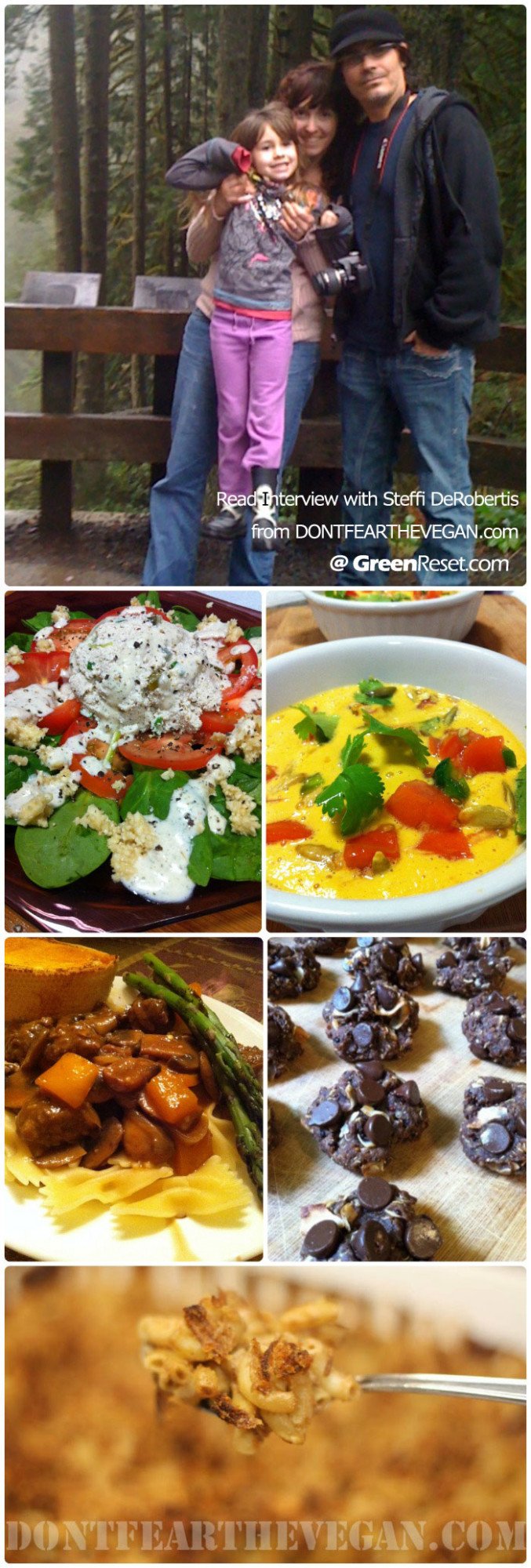
I found Steffi’s website while browsing online for vegan recipe sites. She has many amazing recipes on her blog that I are completely new territory for me, inlcluding Mom’s Goulash, Chocolate Coconut Quinoa Gluten Free Cookies, and Mac-and-Cheese (I never make mac and cheese at home, not even in pre-vegan days, but this one includes cashews and walnuts, so I’m going to try it! I’m sure my son will enjoy it.)
Name: Steffi Derobertis
Location: Southern California
Occupation: Full time working mom
Blog Name: Don’t Fear the Vegan
Facebook: Don’t Fear The Vegan
Twitter: @dontfearvegan
1. First off, please tell us a bit about yourself (where are you from, what do you do, etc.)
I am originally from Southern California. The town of Diamond Bar, 45 miles east of Los Angeles. I am a full time working mom of an energetic 9 year old girl, Anzia. My husband and I share the responsibility of home schooling Anzia and are both active in her social extra curricular activities like soccer and Girl Scouts. My outlet for stress has always been cooking which lead to starting Don’t Fear the Vegan.
2. How long have you been vegan and what was your motivation for going vegan?
Hubby and I went vegetarian in 2000. When Anzia was born with a dairy allergy in 2004 I began eating a plant-based diet, though when I was done nursing I went back to eating dairy. It made me extremely ill. The more reading I did, the more I realized I did not want to support the dairy industry. I have lived a complete vegan lifestyle for 5 years or so. Anzia has been vegan from day one.
3. What was the transition to all plant-based diet like? Was it long and difficult, or quick and easy? What was your greatest challenge? Do you have any advice for people who are considering making the switch or who are still going through a transition?
Our house became completely vegan in 2004. The most difficult part for me was visiting places like my elderly grandparents, having them try their hardest to make me something I could eat, to find out that they added sour cream or mayonnaise. I didn’t have the heart to tell them I couldn’t eat it. Until I was able to get over this hurdle I did not call myself vegan. The food itself was pretty easy. Plus, it made coking an entirely new adventure.
4. Is your family vegan? If yes, how did that happen? If not, what are they eating and how do your food choices affect them?
Yes, fortunately they are. I often wonder how people manage in households with different eating habits.
5. Do you have to deal with picky eaters?
Anzia is extremely picky. She prefers things raw and not mixed. A veggie tray and sliced uncooked tofu is her ideal meal. Though her favorite food is a somewhat odd choice… hearts of palm. I have learned to leave a little of all the elements of my creations out for her plates. If I am making a nut loaf, i give her the same nuts or bean by themselves, etc. Then she has to try a small portion of the finished meal. It works for us and it gives me the piece of mind that she is getting the nutrition she needs.
6. What are some of your – and your family’s – favorite foods/dishes?
My families favorite is Mac n “Cheese” and pea salad. Anzia can now prepare this on her own.
7. Can you perhaps share your favorite recipe, if it’s not a secret :-)?
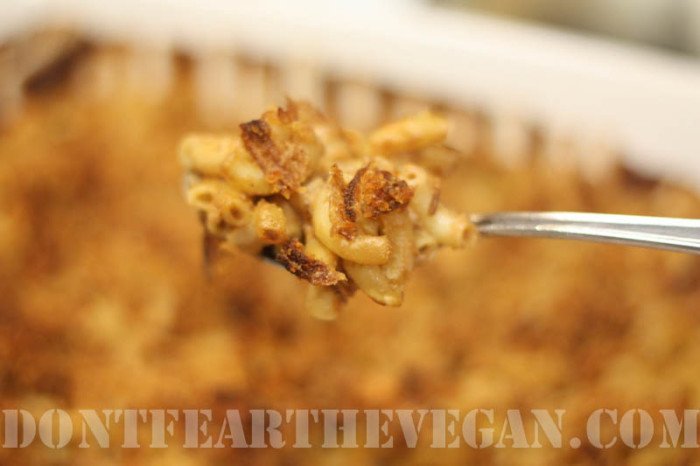
Vegan Mac n “Cheese” – find it here.
8. Do you drink green smoothies or green juices?
No matter how I try them I am not a fan. It may be psychological though. If I add beets or other things that change the color I am able to tolerate them much better. I definitely prefer juice over smoothies, the pulp in a smoothie makes it difficult to swallow.
9. People switching to mostly plant-based or vegan diet are often concerned about getting enough nutrients. How are you making sure that you and your family stay healthy and get all the nutrition you need?
We have spent a lot of time reading over the years and have learned a lot from Dr. McDougall. I take a D vitamin and mostly use nutritional yeast for my B vitamin. I give Anzia a vegan multi-vitamin for kids, just to make sure we aren’t missing anything.
10. What are your strategies and tips for eating out and dealing with social situations? Do you have any advice for new vegans?
We are extremely lucky living in Seattle and run into very few situations. When traveling Anzia and I are pretty adaptable and can usually make it work. When we are in unfamiliar territory I tend to look at the menu ahead of time and make sure it is going to work for him. If not, we eat ahead and enjoy the company. I carry a back pack of food when exploring new places.
11. Since I became vegan about a year ago, I found that this switch is about so much more than simply eliminating a few ingredients from your diet. I found that it affected so many other areas of my life, including social and professional. How does being vegan affect other areas of your life?
Social experience have become more stressful since Anzia has acquired more friends her age, which include more social functions. There have been some places that despite the fact that we have been attending functions since she was 4, still never accommodate her and even though we are paying for the pizza party we have to bring our own. That is not the norm though. Most of the people in our lives are super accommodating. Sometimes to the point where I feel bad that they have gone so far out of their way. The last three birthday parties she has attended the parents have made sure she was taken care of.
As far as professional, I work around a lot of foodies, and though I may have to endure some of the typical vegan jokes, I am always thought of at food gatherings. It is also odd that when people find out that I am vegan, they feel the need to explain why the participate in certain things, like why they are vegetarian and haven’t made the leap to being vegan. I just keep bringing them food to show how good it is.
12. Is there anything else that you would like to share?
This was awesome. It can be really difficult in the beginning, especially in areas where there are no other vegans around. I think people need to know that though some vegans just woke up one day and said “I am vegan,” there are just as many who struggled, but had their heart in the right place and eventually found their way. Telling our stories gives different people something to relate to and possibly find comfort in.
Questions? Comments? Suggestions?
If you have a favorite recipe, why not submit it here in the comment section of this smoothie recipes blog for others to enjoy too!
I also welcome any comments, questions and suggestions. Thanks!
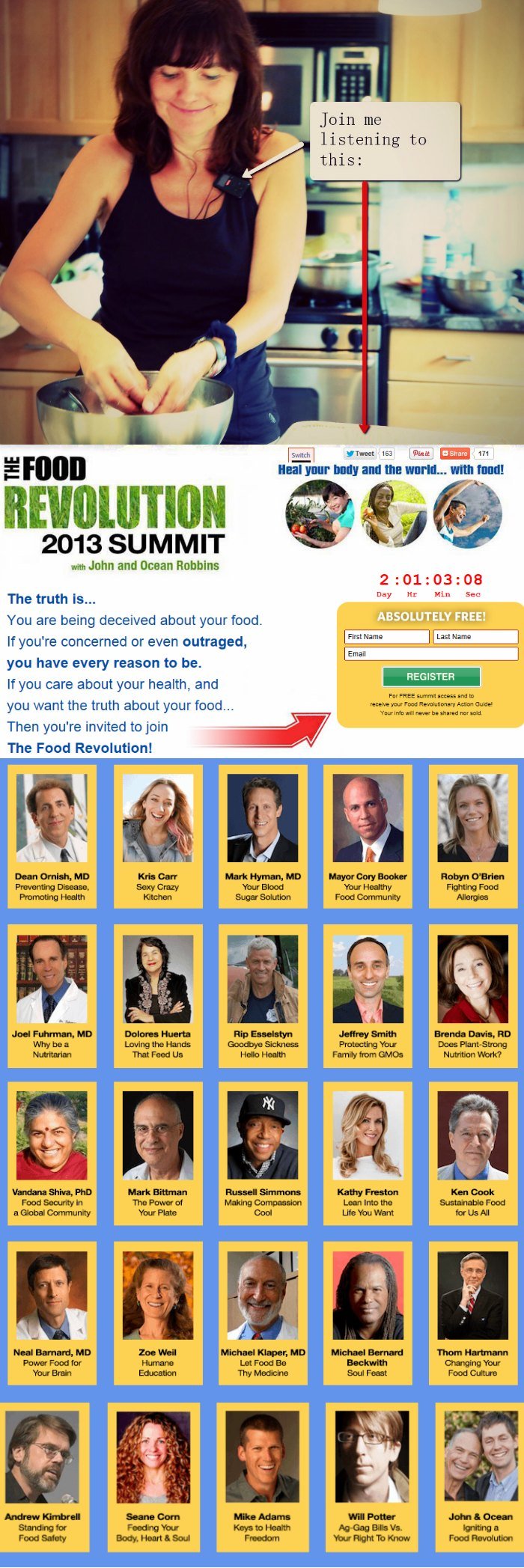
I’m inviting you to join me in the Food Revolution.
I participated in this event last year, and I learned soooo much, as well as got incredibly inspired by all the amazing people and the information.
(In fact I was so inspired, that I decided to use a similar slogan for my website: “Heal the body, heal the planet…beginning with food”. I also became an affiliate for the event.)
Bestselling author, John Robbins is sharing personal interviews of 23 people who are leaders in movements for healthy, sustainable, humane and delicious food. And you can join in — for free!
(If you don’t know who John Robbins (the host) is, you’ll be so inspired by his story. John Robbins could have inherited the Baskin-Robbins empire. But he walked away from the money and the power. Why? He simply didn’t want to devote his life to selling ice cream after realizing it makes people unhealthy. So he decided to make a change. Over the last 25 years, his books about healthy eating and healthy living (including bestsellers Diet for a New America and The Food Revolution) have sold millions of copies and been translated into more than 30 languages.)
Here is how it works. Every week, the Food Revolution Network hosts three interviews, and sends out a letter with a wealth of up-to-the-minute tools and resources. These tools can help you and your family to thrive and to make a difference in the world.
Get more info on the amazing speakers, and register here:
Food Revolution Network
You’ll get up-to-date information from an amazing array of visionary leaders and experts, including:
Expert doctors and acclaimed researchers such as Dean Ornish, MD (Preventive Medicine Research Institute) and T. Colin Cambell, Ph.D (The China Study);
Natural health pioneers such as Joseph Mercola (Mercola.com) and David Wolfe (Radiant Health Now) and Food system innovators such as Vandana Shiva (How to Stop Big Ag) and Ronnie Cummins (Organic Consumers Association), and many more inspiring visionaries.
NY Times best-selling authors Marianne Williamson (Spiritual Principles for Weight Loss) and Kathy Freston (Quantum Wellness);
Culture-changers and icons such as Morgan Spurlock (Supersize Me) and Rory Freedman (Skinny Bitch);
You’ll get the latest thinking on preventing and reversing heart disease, cancer and diabetes; the truth about GMOs, soy, raw foods, and grass-fed beef; the social, ethical and environmental impact of what you eat; and how to inspire your family to join you in making healthy choices.
All of this is FREE. Register Here
Happy Listening!
Joanna
Although I’m a great believer in green smoothies and I pretty much gave up on juicing the last couple of years, I decided to give juicing another try.
Just a few days ago I purchased a brand new Breville juicer (which, by the way, came with a free DVD “Fat, Sick and Nearly Dead” movie), brought a few bags of produce from a farmers market, and set of to make some colorful juice.
So I made a few quarts of vegetable juice and we sat down with my husband (who, incidentally, came down with a fever and a nasty virus infection) to watch the Joe Cross documentary of his 60 juicing reboot.
Here is why.

The Benefits of Juicing: My Top 4 reasons why you may want to give juicing a chance
There are probably many more convincing arguments for juicing, but let’s just start with these four:
Juicing Benefit # 1. Certain vegetables are simply better suited for juicing than blending.
I mean, I’m pretty open minded, and I have tried my share of beet smoothies, carrot smoothies and cabbage smoothies (and I wrote about them on this blog), but let’s face it – for most people these smoothies won’t be palatable, unless you only include a tiny amount of these vegetables and cover the taste with lots of sweet fruits, herbs, lemon and/or ginger – which is still beneficial, but considering the enormous nutritional power that they contain, it’s a shame not to consume more of them regularly.
These vegetables include already mentioned roots, such as beets, sweet potatoes, carrots or parsnips; as well as cabbage, broccoli, and other.
They work great in juices, whereas in smoothies they will only work in small quantities. So, if you are like me, not eating enough of these veggies, then juicing will let you add more variety to your diet.
Juicing Benefit # 2. When we drink juices, the body works less to digest the nutrients.
I love how filling green smoothies are, but sometimes you want to give your body a break from even the healthy fibers. Juice, the liquid without the fiber, allows your digestive system to work less to extract the benefits.
For people who want to really re-set their system (as in the juice reboot “Fat, Sick, and Nearly Dead“), taking a finite break from fiber has the benefit of allowing your digestive system to have a bit of a rest.
Juicing Benefit #3. More vegetables per glass.
You can consume more vegetables and greens into a single glass of green juice than you would in a smoothie serving.
Juicing Benefit #4. The “Fat, Sick, and Nearly Dead” documentary
I wish someone made a documentary about green smoothies, but for now we have Joe Cross’ film about a juice detox cleanse. Here why I love it so much.
I don’t need to be persuaded of the benefits of plant based nutrition. However, whenever I talk to my husband about it, he replies that he needs his meat and dairy for protein and other nutrients; that he feels week without them, that he needs animal foods to build muscle, etc.
Don’t get me wrong. He is not a meat-and-potato kind of guy and he does like his veggies; but he doesn’t eat nearly enough of them.
So, what I love about the movie is that it’s about a regular guy in his forties (my husband is a few years older, but generally close enough in age to be able to relate to him), who gets sick and tired of feeling sick and tired, and goes on a juice cleanse, and switches to a 100% plant-based nutrition, no fish, meat or dairy whatsoever; and looks and feels GREAT as a result.
Not weak, or overly thin, but very strong and athletic. Plus he seems about 10 years younger.
He also cures his diseases and goes completely off of all medications he’d been taking for years.
All this definitely got my husband’s attention, and – although I don’t expect him to become vegan or go on a 60 day juice cleanse – I do think that the movie shook a bit his deep-belief on the necessity of animal products to keep healthy and strong – a belief that has been holding him from achieving better health and losing weight.
So he finally agreed to make some substantial changes to his diet, which makes me very happy.
You can find “Fat, Sick, and Nearly Dead” documentary on Amazon and Netflix).
The juicer that Joe has been using (BTW it’s the one that I bought too) is Breville Juice Fountain, which you can find on Amazon or in any store that carries kitchen appliances.
Juicing or blending, which is better?
Whether you choose blending or juicing, you are gifting your body improved health by using these nutrient packed drinks. Regularly drinking smoothies or fresh, veggie-based juice will:
- increase your veggie intake dramatically
- make it easier and quicker for your body to absorb nutrients because the blending and juicing allows the foods to become somewhat “pre-digested”
- curb appetite and reduce cravings for sugar and processed foods because you are nourishing your cells with what they are asking for – micronutrients. You body no longer craves the “carbs” (macronutrient).
So, it’s a win-win-win!

Questions? Comments? Suggestions?
If you have a favorite recipe, why not submit it here in the comment section of this smoothie recipes blog for others to enjoy too!
I also welcome any comments, questions and suggestions. Thanks!