A chilled variation of a basic tomato soup originating in Spain, gazpacho is a refreshing soup that’s perfect for hot weather-months.
Frequently described as a “liquid salad,” gazpacho descends from ancient Roman concoction based on a combination of stale bread, garlic, olive oil, salt, and vinegar. Some versions feature chopped veggies, some feature minced, and some are pureed completely.
There are many different versions of it. You don’t even need a blender to prepare it, as the most basic version is almost like a tasty ice cold water with lots of pieces of vegetables and stale bread on top. There is also a version in which whole red grapes are added in the end. In fact it’s a perfect recipe for experimentation with raw, ripe ingredients and your blender.
This adaptation of the classic Spanish cold tomato soup deliciously combines some of the best of summer vegetables. Make sure you use the freshest, highest quality, organically grown ingredients for this soup.
During the hot weather, do what the Spaniards do: Prepare a batch of gazpacho and keep it in a glass pitcher in the refrigerator for whenever you get hungry.
Don’t be discouraged by the long list of ingredients for this recipe. I usually don’t like recipes that have 5+ ingredients, because there is always something that I’m missing in my kitchen. Just skip the ingredient or try to substitute with something else (e.g., fresh garlic with garlic powder). Except for tomatoes, probably you can skip pretty much any ingredient without sacrificing the taste too much. Plus, you may discover your own, superior version, of this recipe.
Low glycemic load, dairy-free, gluten free recipe.
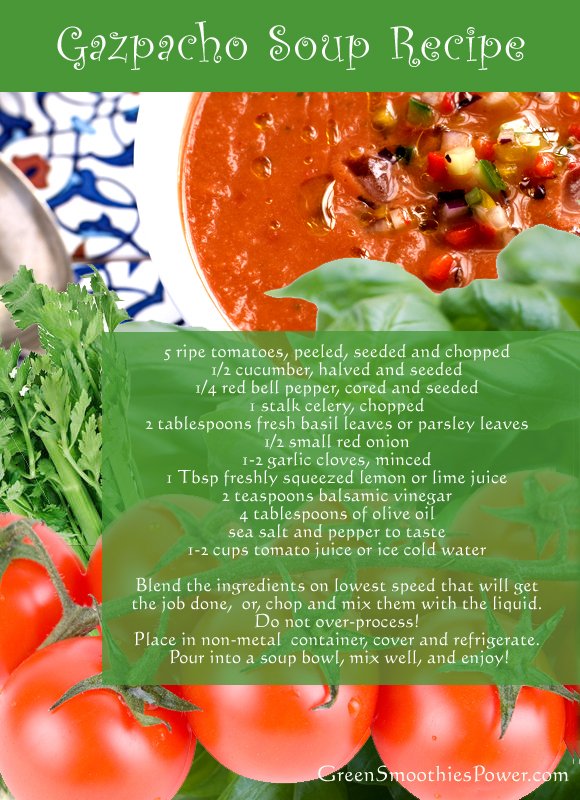
Gazpacho Soup Recipe
Ingredients
5 vine-ripened tomatoes, peeled, seeded and chopped
1/2 cucumber, halved and seeded
1/4 red bell pepper, cored and seeded
1 stalk celery, chopped
2-3 tablespoons fresh basil leaves, parsley and/or cilantro
1/2 small red onion
1-2 garlic cloves, minced
1 Tbsp freshly squeezed lemon or lime juice
2 teaspoons balsamic vinegar
4 tablespoons of olive oil
sea salt and pepper to taste
1-2 cups tomato juice or ice cold water – adjust the quantity to desired consistency
Preparation
Blend about 1/3 of the ingredients on higher speed and then chop the rest (or blend on very low speed). Keep adding juice or water, to desired consistency. The blended vegetables would create a base and avoid the watery base. It should not be too thin. If using a food processor, pulse until it is coarsely chopped. Do not over-process!
Place in non-metal, non-reactive storage container, cover tightly and refrigerate for at least one hour or overnight, allowing flavors to blend. The longer gazpacho sits, the more the flavors develop.
Mix well and serve chilled. Garnish with the chopped vegetables and croutons, if desired.
Shortcut to chilling the soup: Place ice and water in a large bowl or pot and place in sink. Put the bowl or glass blender containing gazpacho into the ice water. Stir the gazpacho to ensure it cools evenly.
Some people like to use a lot of spices, including salt, pepper, thyme, oregano, marjoram, basil, tarragon and celery seed. For even more kick, add a piece of jalapeno pepper, Tabasco sauce, Worcestershire sauce, etc.
If you don’t already own a VitaMix, I strongly encourage you to check out what this machine is capable of! For more information about VitaMix you can go directly to the VitaMix website. You may also want to read my post about the Best Blender.
I LOVE my VitaMix and highly recommend investing in one if you are ready to make serious changes to your diet. I have had mine for almost 5 years and use it daily!
If you decide to purchase Vitamix – be sure to use Promotional Code 06-004554 to get free shipping.
Questions? Comments? Suggestions?
If you have a favorite recipe, why not submit it here in the comment section of this smoothie recipes blog for others to enjoy too!
I also welcome any comments, questions and suggestions. Thanks!
One of the questions I most often get is “Are green smoothies good for diabetics?”
The main concern is, of course, the high fruit content of the smoothie – and the resulting sweetness of the drink causing blood sugar problems.
This is an important topic, so I’m going to address it in a series of posts, providing you with the information that I have on this topic, as well as giving you some low-fruit or no-fruit recipes. But first, I want to talk about two important concepts for people with blood sugar problems, the glycemic index of foods versus glycemic load.
There is a widespread misconception that all foods that have a high glycemic index should be eliminated from the diet because of their ability to cause a rapid spike in blood glucose levels. Common theory supposes that a low glycemic index makes a food good for you, and a high glycemic index makes a food unhealthy. Many over-zealous anti-carbers have turned fruit and starchy vegetables into demon foods to be avoided at all costs.
This causes many people to avoid eating fruits & many of the sweeter/starchier vegetables.
This is a mistake.
The glycemic index (GI) ranks foods based on how fast they break down during digestion and thus how quickly their sugars enter the blood. So, in other words, the glycemic index tells you how fast carbohydrates turn into blood sugar. What the GI does not tell you is how much of that carbohydrate is in a serving of any food. Having both pieces of information is critical to correctly assess a food’s effect on blood sugar levels.
That is where the concept of “Glycemic Load” (GL) comes in.
Glycemic Index Versus Glycemic Load
While the Glycemic Index is most commonly known as an indicator to how healthy or unhealthy a food is, it is actually the Glycemic Load that you should pay attention to, not just the GI.
The Glycemic Index measures the speed at which a certain food raises blood sugar in relation to a control food. Glycemic Index uses a scale of 0 to 100, with higher values given to foods that cause the most rapid rise in blood sugar. Pure glucose serves as a reference point, and is given a Glycemic Index (GI) of 100. GI’s of 55 or below are considered low, and 70 or above are considered high. However, GI alone is NOT an accurate measure of how much of a certain food raises blood sugar.
The Glycemic Load, on the other hand, ranks foods based on portion size and grams of carbohydrates per portion. This gives a much more accurate view of how foods might affect blood sugar. To calculate the Glycemic Load of a food, take the number of grams of carbohydrates in a serving, multiply it by it’s Glycemic Index, then divide it by 100. GL’s of 10 or below are considered low, GL of 11 to 19 inclusive is medium, and 20 or above are considered high. Foods that have a low GL almost always have a low GI. Foods with an intermediate or high GL range from very low to very high GI.
The glycemic load is a relatively new way to assess the impact of carbohydrate consumption, giving a fuller picture than glycemic index alone. A GI value tells you only how rapidly a particular carbohydrate turns into sugar. It doesn’t tell you how much of that carbohydrate is in a serving of a particular food. You need to know both things to understand a food’s effect on blood sugar levels.
To give you an example, the carbohydrate in watermelon has a high glycemic index, but there isn’t a lot of it, so watermelon’s glycemic load is extremely low.
Glycemic Index and Glycemic Load of Fruits
| FRUITS |
Serving size (grams) |
Glycemic index (glucose = 100) |
Glycemic load per serving |
| Apple, average |
38±2
|
120
|
6
|
| Banana, ripe |
51
|
120
|
13
|
| Dates, dried |
103±21
|
60
|
42
|
| Grapefruit |
25
|
120
|
3
|
| Grapes, average |
46±3
|
120
|
8
|
| Orange, average |
42±3
|
120
|
5
|
| Peach, average |
42±14
|
120
|
5
|
| Peach, canned in light syrup |
52
|
120
|
9
|
| Pear, average |
38±2
|
120
|
4
|
| Pear, canned in pear juice |
44
|
120
|
5
|
| Prunes, pitted |
29±4
|
60
|
10
|
| Raisins |
64±11
|
60
|
28
|
| Watermelon |
72±13
|
120
|
4
|
Via http://www.health.harvard.edu/
This table demonstrates that all fruit has a low glycemic load, except dried dates and raisins. It is best to eat fruit fresh, as drying and dehydrating concentrate fruit sugars to an unnatural level that the body is not designed to handle well. It is also important to eat fruit whole, not juiced, as the fiber in fruit slows sugar absorption to its natural speed.
When you eat fruit whole and raw, it is hard to get excess sugar from fruit. Fruit isn’t in the same category of foods as table sugar, high fructose corn syrup, maple syrup or candy. Fruit contains vitamins, minerals and antioxidants that counter-balance the potential harmful effects of the sugars in fruit. The fiber in fruit slows down the release of sugars, reducing the speed at which fruit may raise your blood sugar.
Glycemic Load of Vegetables
All vegetables are super-low on the glycemic load scale. They are basically glycemic-free (and guilt-free) foods!
The numbers are the grams of available carbohydrate (that is, carbohydrate minus dietary fiber) in 100 grams of the portion of the food):
VEGETABLES:
Alfalfa seeds, sprouted 1.28
Arugula 2.05
Asparagus, cooked 2.63
Bamboo shoots, cooked 0.92
Beans, green, cooked 4.69
Beans, snap, green, cooked 4.68
Beet greens, cooked 2.56
Broccoli, cooked 2.16
Brussels sprouts, cooked 4.5
Cabbage, cooked 2.16
Cauliflower, cooked 1.41
Celeriac (celery root), cooked 4.7
Celery 1.95
Chard, swiss, cooked 2.04
Collards, cooked 2.1
Cucumber 1.8
Dandelion greens, cooked 3.5
Eggplant, cooked 4.14
Endive 0.25
Fennel, bulb 4.19
Green onions, young, tops only 3.94
Hearts of palm, canned 2.22
Jicama 3.92
Kale 3.63
Lettuce, butterhead 1.32
Lettuce, cos or romaine 0.67
Lettuce, iceberg 0.69
Mustard greens, cooked 0.1
Mushrooms 2.94-3.57 (except shitake)
Nopales, cooked 1.27
Okra, cooked 4.71
Olives, canned ripe 3.06
Parsley 3.03
Peppers, serano 3.00
Peppers, jalapeno 3.11
Peppers, sweet green 4.63
Peppers, sweet red 4.43
Purslane 3.43
Radicchio 3.58
Radishes 1.99
Rhubarb 2.74
Sauerkraut 1.78
Scallions (green onions) 4.74
Spinach, cooked 1.35
Squash, zucchini, cooked 2.53
Tomatillos 3.93
Tomatoes 3.54
Tomato juice 3.83
Turnips, cooked 2.9
Turnip greens, cooked 0.86
Watercress 0.79
Source: http://www.mendosa.com/freefoods.htm
Glycemic Load of Green Smoothies
The bottom line is that even if you include fruits in the smoothie, the overall Glycemic Load of the smoothie will still remain VERY LOW thanks to the low glycemic index of fruits and super-low (almost negligible) glycemic load of raw vegetables and greens.
For non-diabetic people, it is not needed to restrict consumption of fruit or green smoothies in order to prevent the disease, as there is no evidence that drinking green smoothies, or increasing fruit intake causes diabetes.
Limitations of the Glycemic Index and the Glycemic Load
Some proponents of the Glycemic Index (including many diet books authors) would like you to believe that GI and GL are all that matters when selecting which foods to eat. In reality, diet is a more complex issue than that.
Many other factors influence individual glycemic response, including preparation method, combination with other foods, as well as individual differences in glycemic response.
How the Glycemic Index can lead to overeating
Using the Glycemic Index and Glycemic Load can be misleading and lead to overeating.
Apples have a GI of 38, and a medium-size apple, contains about 18 grams of net carbohydrates and provides a Glycemic Load of 5. This is a low GL, and most would consider the apple to be a very appropriate snack. But now look at peanuts. A 4-oz serving not only weighs less than the apple, but has a much lower GI (14), and provides an even lower GL of 2. Based on Glycemic Load alone, you would have to believe that the peanuts were a better dietary choice than the apple. But if you take a look at the total Calories contained in these two foods, you’ll see that the apple contains approximately 77 Calories, while the peanuts contain more than 500! Those 400+ extra Calories are NOT going to help you lose weight.
The Conclusion?
Eat your fruits and vegetables! All of them! Any kind you like! And do it without guilt.
Instead of worrying about glycemic index of foods, make sure you consume lots of unprocessed, preferably raw plant foods: leafy greens, celery, cucumbers, tomatoes, peppers, etc., as well as raw fruits.
It would really be a major challenge to overeat vegetables and fruits. The average woman who needs at least 1500 calories per day would likely find it very difficult to eat 15 large potatoes or bananas. In general, vegetables and fruits fill you up long before you can eat enough to fill you out.
If you’re really worried about blood sugar levels or trying to lose weight, you may want to lay off the bananas, starchier tubers and root vegetables to speed up the process. But from a strict maintenance or health point of view, you should embrace all the vegetables and fruits you feel like eating.
The American Diabetes Association (ADA) says, “Therefore, the use of added fructose as a sweetening agent is not recommended; however, there is no reason to recommend that people with diabetes avoid naturally occurring fructose in fruits, vegetables, and other foods.”
Questions? Comments? Suggestions?
If you have a favorite recipe, why not submit it here in the comment section of this smoothie recipes blog for others to enjoy too!
I also welcome any comments, questions and suggestions. Thanks!
GreenSmoothiesPower.com is not just about greening your diet.
It’s about greening your entire life and the planet.
The number and enormity of problems facing us today seems insurmountable: sharp health decline of the entire population, lack of money for healthy school lunch programs, broken health care system, environmental destruction, social injustice, upcoming energy crisis, and high unemployment.
These issues are pressing, and yet it seems that there is never enough money to fix any of them.
So, if you had a trillion dollars, what would YOU spend it on?
Does this chart represent YOUR priorities?

(Discretionary Spending FY 2013 – National Priorities Project.)
Sadly, this chart does represent our current reality. But it can change. After all, it’s our money!
If not, raise your voice today!
The current debate in Congress and throughout our nation offer us the best opportunity in years to make progress on this vital issue which impacts everything that we care about. People all over the U.S. are slowly waking up to the reality that we are not broke. Instead, our budget choices reflect our priorities. To make sure we are building a safe, clean, peaceful future we must raise our voices to shift our spending priorities.
You can take action by going to the Physicians for Social Responsibility site.
Did you know the green you see in nature – called chlorophyll – is the most powerful healer on earth?
For millions of years before we humans discovered fire, we had been eating lots of green leaves. It’s the perfect food for humans, rich in vital nutrients necessary for health and disease prevention. Research shows the more leafy greens you eat, the longer you live!
Unfortunately, today, most people eat very little greens, if at all.
Let’s face it, for most people, leafy greens are not the most desirable or palatable foods that exist.
That’s one more reason to make drinking green smoothies a habit. Green smoothies are one of the easiest, most efficient ways to get those greens in every day in the raw state – plus, they’re DELICIOUS!
By drinking 2 or 3 cups of green smoothies daily you will consume enough greens for the day to nourish your body, and all of the beneficial nutrients will be well assimilated.
Chlorophyll: The Miracle of Nature
What is Chlorophyll?
Chlorophyll (also chlorophyl) is a green pigment found in almost all plants, algae, and cyanobacteria. Its name is derived from the Greek words χλωρος, chloros (“green”) and φύλλον, phyllon (“leaf”). Chlorophyll is an extremely important biomolecule, critical in photosynthesis, which allows plants to absorb energy from light.
Chlorophyll is actually very similar to human blood, to the hema in human hemoglobin. It helps us rebuild our blood, and it goes without saying that healthy blood is critical to being healthy. Hemoglobin is the component of the blood that carries oxygen. It contains a single molecule of iron, as does chlorophyll. That’s one of the reasons why chlorophyll is so beneficial to the body. It can help to oxygenate the blood in a similar way to hemoglobin.
Research shows the more leafy greens you eat, the longer you live!
10+ Benefits of Chlorophyll
Most people know about the benefits of vitamins and minerals, and the benefits of antioxidants, but to many the benefits of chlorophyll remain unknown.
Chlorophyll has numerous health benefits. Here are some of the known chlorophyll benefits that I found just by doing a quick research online. If you want scientific studies to support those claims, you will have to do the research yourself, sorry.
- Chlorophyll cleanses and oxygenates the blood. It helps the blood carry oxygen to all cells and tissues.
- Having more oxygen available in the blood translates to better endurance and an overall reduction in fatigue.
- Chlorophyll is important in offsetting stress and alkalizing the body.
- Chlorophyll blocks absorption of toxic carcinogens. It helps neutralize free radicals that do damage to healthy cells. it is helpful in protecting the body against toxins and in reducing drug side effects
- Chlorophyll has been seen to help in the growth and repair of tissues.
- Chlorophyll is a natural deodorant. I reduces bad breath, urine, fecal, and body odor.
- Chlorophyll helps to treat infected wounds naturally.
- Chlorophyll has anti-carcinogenic properties.
- Chlorophyll cleanses the liver and digestive tract, boosts blood with iron, vitamin C and folic acid.
- Chlorophyll supports the respiratory system and our moods.
- Chlorophyll is sometimes recommended for anemia, atherosclerosis, wound healing, bad breath, body odor, detoxification, diabetes, high cholesterol, rheumatoid arthritis and herpes infections.
Despite all these benefits, chlorophyll is not considered an essential nutrient, so there are no official daily recommendations for its use, and you will not find it on nutritional fact labels.
Best Natural Sources of Chlorophyll
It’s usually easy to tell when a food has significant amounts of chlorophyll, because chlorophyll provides the green color that is found in grasses, leaves, and many of the vegetables that we eat.
Leafy greens are the main food sources that are rich in chlorophyll content. The amount of chlorophyll found in each plant varies. In spinach, for example, chlorophyll is present by as high as 1% based on dry weight estimation.
Chlorophyll-rich leafy greens include:
Green vegetables that contain lots of chlorophyll include asparagus, bell peppers, broccoli, Brussels sprouts, green cabbage, celery, green beans, green peas, leeks, and green olives.
Sea vegetables and blue-green algae, chlorella, and spirulina are also super-concentrated sources of chlorophyll. Chlorella is a single celled algae that is by far the richest source of chlorophyll in the world. It has 10 times more chlorophyll than alfalfa, which is where most commercial chlorophyll comes from.
Raw Versus Cooked Greens
Cooking destroys much of the chlorophyll, which is why consumption of these green leaves and vegetables RAW is the best way to obtain the health benefits of chlorophyll.
Although cooking makes food softer and easier to digest for people with digestive problems, however, in the process of heating, most essential vitamins and enzymes in the food get destroyed. In this respect, blending is a lot less harmful than cooking because it saves all the vital nutrients in the food.
When cooking leafy greens and green vegetables, very short steaming is best. Short steaming may actually help absorb more chlorophyll from the plant, especially for people with weakened digestion. However, overcooking should definitely be avoided!
Practical Tips
1. Blend well for optimum absorption. Even though raw green vegetables are full of chlorophyll, many people, especially those who are really sick – do not absorb this chlorophyll due to the poor shape their colon is in. Blending on high speeds with a power-blender such as Vitamix or Blendtec, is a must. During blending, the cells of the greens and the fruits are ruptured, making the valuable nutrients easy for the body to assimilate. Digestion starts in the mouth and these tiny particles then become so easy for the body to digest that they are bio-available as soon as you start drinking them.
Juicing is also a good option as juicing green foods eliminates the fiber, making the juice and the chlorophyll easy to be absorbed by your body in a few minutes. Steaming is another option for people with weakened digestive systems.
2. Pace yourself to avoid unpleasant detox side effects. Chlorophyll, because it is such a powerful detoxifying agent, can affect a body very strongly. A person who has a lot of stored toxins in their system can experience side effects from the detoxification process. When toxins are released into the bloodstream for processing, it can have many unpleasant detox symptoms, so if your diet has been extremely chlorophyll-deficient, you may want to start slowly.
3. Rotate your greens. Also, please remember that it is very important to rotate the greens you consume, so that you are not eating the same greens all the time.
4. Use organic produce, or – better yet – grow your own.
Liquid Chlorophyll Products Vs Green Smoothies
OK, so maybe I’m biased, but in my humble opinion eating or drinking your chlorophyll in salads and green smoothies is far superior to any liquid chlorophyll extract. Extracting a single compound, such as chlorophyll, from plants and drinking it, rather than consuming the whole leaves, whether that’s lettuce, cabbage, spinach or carrot tops, will remove beneficial co-nutrients and so could have less benefit than eating whole fresh leafy greens.
Green smoothies are one of the easiest, most efficient ways to get those greens in every day in the raw state – plus, they’re DELICIOUS!
Can You Take Too Much Chlorophyll?
There are differences of opinions about this question. The good news is that if you are eating whole foods, it’s practically impossible to overdose on chlorophyll!
Take a Chlorophyll Challenge
Every day, pick two foods rich in chlorophyll and have a big serving – in a green smoothie, raw green juice, raw salad, raw soup, or other; and take note what is happening in your body.

Take a Chlorophyll Challenge: Every day, pick two foods rich in chlorophyll and have a big serving – in a green smoothie, salad, raw soup, or other.
Questions? Comments? Suggestions?
If you have a favorite recipe, why not submit it here in the comment section of this smoothie recipes blog for others to enjoy too!
I also welcome any comments, questions and suggestions. Thanks!
I don’t recommend using beet roots, carrots, or radishes for your green smoothies, however when it comes to the greens, it’s an entirely different story.
Beautiful green tops from beets are sometimes valued as edible, but green tops from radishes and carrots are more often than not considered in-edible, and rarely – if ever – make it to the plate. If you are like most people, you’ve been throwing away these greens without even realizing that you are discarding a very nutrient dense part of the vegetable.
Not only are these greens edible, the leaves are the most nutritious part of the plant!
So, instead of wasting those precious greens, why not use them to make delicious green smoothies?
You can blend up a delicious carrot, beet, or radish tops recipe that the whole family will enjoy.
Radish Top Green Smoothie
1 cup radish leaves
1 ripe banana, peeled
1 cup mango
1 cup pineapple
1 1/2 cup pure water
Blend until smooth. Serves 1-2.
Tropical Beet Top Green Smoothie Recipe
Did you know that there are more nutrients in beet tops than the actual root? Most people cut the beet tops off and discard them or maybe use them for cooking, destroying vital nutrients out of the leaves.
Beet greens are a little milder than the radish greens. If you like a super green smoothie, you can add more greens, like spinach or lettuce.
1 cup beet tops
1 orange, peeled and seeded
1 ripe banana
1/2 cup blueberries, fresh or frozen
1 cup water
Blend until completely smooth. Serves 1-2.
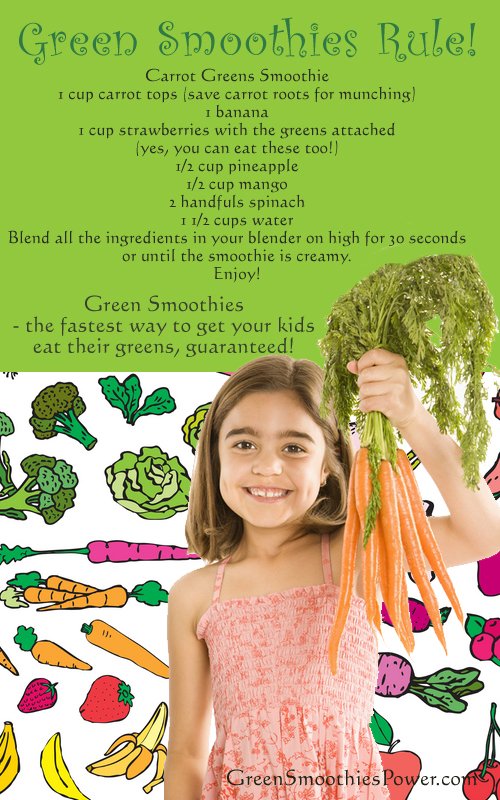
Carrot Greens Smoothie
1 packed cup carrot tops
1 banana
1 cup strawberries with the greens attached (yes, you can eat these too!)
1/2 cup pineapple
1/2 cup mango
2 handfuls spinach
1 1/2 cups water
Blend until everything in completely smooth. Serves 1-3.
Okay, so maybe you are not quite convinced yet, but all I ask is to try them with an open mind :-).
Granted, when these tops are bought when the tops are older and wilted, the look, texture and bitter taste can be a turn-off. However, when they come fresh from the garden, carrot, radish and beet greens are really tender and flavorful in their raw state. Besides using these greens in smoothies, you can use them in tossed salads, blended raw soups and salads, sandwiches or any other recipe that calls for greens.
So look for fresh looking greens. Straight from the garden, organic are best – if you can find them.
As always, remember that these recipes are only a starting point to the exciting explorations of various possibilities. Green smoothies rock!
Carrot Greens Smoothie Recipe: NOT your ordinary smoothie!
Questions? Comments? Suggestions?
If you have a favorite recipe, why not submit it here in the comment section of this smoothie recipes blog for others to enjoy too!
I also welcome any comments, questions and suggestions. Thanks!
