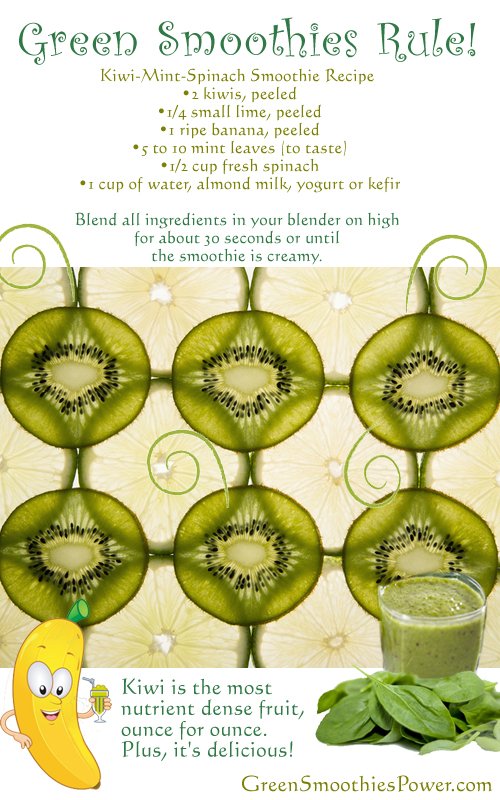
Kiwis are cute little green fruits encased in somewhat off putting fuzzy brown skins. If you get past the unattractive exterior, you are rewarded with a bright green piece of fruit that is delicious and packed with nutrients. Kiwis are higher in vitamin C than oranges (they have almost twice as much), and they’re a good source of potassium and magnesium and fiber for a healthy stomach and digestive system.
These tart fruits pair well with many other fruits and will make a healthy addition to your favorite smoothies.
For your kiwi smoothies, make sure you use kiwis that are really ripe — it should give when you press the sides. The flax seeds contribute omega-3’s; you won’t be hungry anytime soon if you add them.
Kiwi provides a wide array of nutrition benefits. According to a study at Rutgers University, kiwi is the most nutrient dense fruit, ounce for ounce.
Kiwi provides 16% of the RDA for fiber and 10% of the RDA for folic acid. Kiwis have phytonutrients, which repair DNA, act as the body’s protection against some cancers, and function as antioxidants.
Studies in Italy performed on 18,000 6-7 year old children have demonstrated health benefits of kiwis to the respiratory tract. The study found that children eating the 5-7 servings of citrus and kiwifruit per week had 44 percent less incidence of wheezing compared to children eating less than once a week.
According to another study, eating kiwi fruit every morning has the same effect as aspirin for heart health (reduces blood clotting), but without the side effects.
Plus, they are so delicious in green smoothies!
And did you know that there are over 400 varieties of this fuzzy fruit, which grows off of vines on a trellis, similar to grapes?
Kiwi Smoothie Recipes
Many kiwi smoothie recipes available both online and in recipe books call for dairy, such as yogurt or cream. One way to make a non-dairy version, is by simply adding banana, and maybe some sweetener and/or non-dairy milk or yogurt. (If you are wondering why I’m against adding dairy to smoothies, read this post and this post). Adding a cup of orange juice to the blend will do the job too.
So, here are a few kiwi smoothie recipes for ya. They contain no dairy, and are deliciously green, not just because of kiwi, but also because they contain GREENS.
Why add greens to a perfectly delicious kiwi smoothie?
The Harvard School of Public Health recommends at least nine servings, or four cups, of fruits and vegetables daily. Most of us don’t even come close.
So there you go! Delicious green smoothie recipes with kiwi!
Kiwi--Lime-Mint Green Smoothie Recipe
Ingredients
-
- 2 kiwis, peeled
-
- 1/4 small lime, peeled
-
- 1 ripe banana, peeled
-
- 5 to 10 mint leaves (to taste)
-
- 1/2 cup fresh spinach
-
- 1 cup of water, almond milk, or other non-dairy milk (adjust the quantity to reach the desired consistency)
Instructions
- Blend all the ingredients (I use a Vitamix) on high for 30 seconds or until the smoothie is creamy.
3.1
https://greenreset.com/kiwi-smoothie-recipes/
Kiwi-Avocado Smoothie
2 kiwi fruits
1 ripe banana
2 cups fresh baby spinach (or other leafy green)
¼ avocado
¼ cup cranberries (optional)
1/2 cup water or fresh orange juice
Blend the ingredients until smooth. Enjoy!
Kiwi Pineapple Smoothie
Kiwis are native to New Zealand so they pair well with other tropical fruits, such as pineapple. A smoothie that blends kiwi and pineapple will supply a large dose of vitamin C as well as fiber, potassium and several antioxidants.
2 kiwis
1/4 cup of chopped fresh pineapple
2 cups fresh baby spinach (or other leafy green)
1/2avocado
1/2 cup of 100 percent pineapple juice
Blend until smooth and garnish with chopped kiwi.
Also check out this Kiwi-Strawberry Smoothie Recipe

Picture of two cute kiwi fruit

Kiwi smoothie: getting the ingredients ready. Instead of baby spinach I used kale.
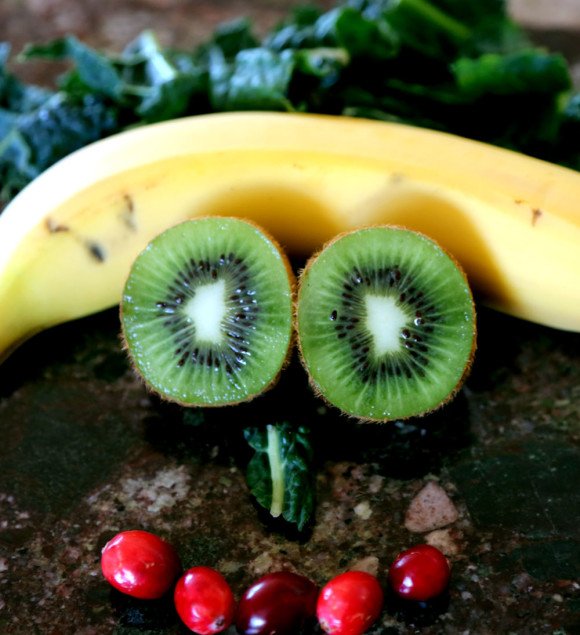
It’s practically smiling at you now!
Note: Be careful if you have an actinidin allergy, as it contains a healthy dose, though most people should be completely fine.
How do I choose a kiwi?
Select fruit that is plump and fragrant with no visible bruising and a slightly firm feel. Unripe kiwi fruits ripen faster when stored in a paper or plastic bag with a ripe banana.
Once they are ripened, store them away from other fruit or they will decompose more quickly! Ripe kiwi can last in the refrigerator for 1-2 weeks.
Can I eat the skin?
You can, but buy organic and/or wash carefully to remove unwanted pesticides! Even though kiwis rank low in potential pesticide residue (13 out of 100) according to study conducted by the Environmental Working Group. Also, rub it a bit to minimize the fuzz. The skin will provide more fiber to your sweet snack. If you’re not fond of the fuzzy exterior, simply “sloop” it out by slicing the kiwi in half horizontally and spooning out each end to enjoy.
For all my blending recipes I use Vitamix. If you don’t already own a VitaMix, I strongly encourage you to check out what this machine is capable of! For more information about VitaMix you can go directly to the VitaMix website. You may also want to read my post about the Best Blender.
I LOVE my VitaMix and highly recommend investing in one if you are ready to make serious changes to your diet. I have had mine for almost 5 years and use it daily!
If you decide to purchase Vitamix – be sure to use Promotional Code 06-004554 to get free shipping.
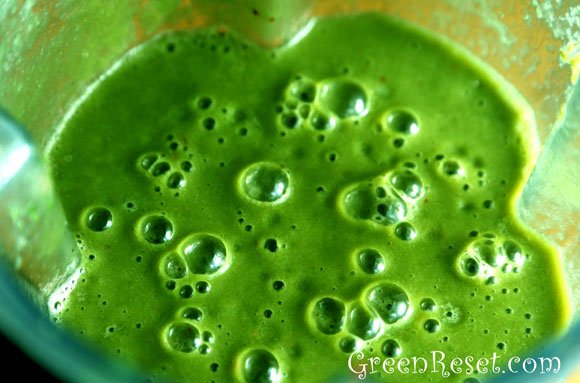
green smoothie still in Vitamix
Questions? Comments? Suggestions?
If you have a favorite recipe, why not submit it here in the comment section of this smoothie recipes blog for others to enjoy too!
I also welcome any comments, questions and suggestions. Thanks!
If you are already drinking lots of green smoothies and eating blended salads, loaded with healthy greens, you may feel like you want to skip the salad. And if that’s the case, it’s OK.
However, you may still enjoy eating a crunchy salad from time to time (or even every day) – that’s why I want you to give you these recipes, so you don’t soak your greens in store-bought dressings loaded with undesirable ingredients and toppings that are not so good for you (plus your salad can be delicious without them, too, trust me on that!).
Fact is the typical commercial dressing available in stores contains the following main ingredients: fat (usually low quality oil), sugar (usually corn syrup or other artificial sweetener), salt (processed table salt), and vinegar. It is flavored with spices and artificial agents, and contains preservatives that make this factory-made concoction very unhealthy.
Fortunately it’s easy, using your blender or Vita-Mix, to create delicious salad dressings that will taste much better than any store-bought dressings.
Healthy, Low Fat Salad Dressing Recipes
To prepare a delicious dressing for your salads, you will use low speed or pulse settings and do not blend too long – this will leave the dressing slightly chunky. Alternatively, you may just use a fork to mash the ingredients.
I love fruit-based salad dressings on my salads. They are really tasty and easy to make and can be used for a salad dressing, or in raw collard or romaine wraps.

Sweet & Sour, Low-Fat Strawberry Salad Dressing
- 1 medium apple, cored
- 1 cup fresh whole strawberries
- 1/2 to 1 teaspoon apple cider vinegar (start with less, you can always add more)
- Dash of sea salt and fresh pepper (optional)
- 1/2 teaspoon lime juice (optional/recommended if you are saving some of this dressing for later)
In a blender or food processor, mix all of the ingredients until they are smooth and creamy. Squeezing just a little lime adds a delightful tartness to the dressing.
Cranberry Salad Dressing Recipe
I came up with this recipe in right before Thanksgiving, when I had plenty of cranberries in my kitchen. It was a hit!
- 1 medium apple, cored
- 1 cup fresh whole cranberries
- 2 tablespoons freshly squeezed orange juice
- 1/2 to 1 teaspoon apple cider vinegar (start with less, you can always add more)
- Agave or maple syrup, to taste (if you find the dressing too sour)
- A few pecans (optional)
- 1/2 teaspoon lime juice (optional/recommended if you are saving some of this dressing for later)
In a blender or food processor, mix all of the ingredients until they are smooth and creamy. Squeezing just a little lime adds a delightful tartness to the dressing.
Amazing Low Fat Mango Dressing Recipe
- 1 cup mango (flesh only)
- 1 cup cherry tomatoes (or other tomatoes)
- 1 tablespoon balsamic vinegar
Blend all ingredients together and prepare to be blown away by this very simple and tasty fat-free dressing!
Pomegranate Citrus Dressing
- 1 orange, juiced on a citrus press
- 1 lime, juiced on a citrus press
- ½ pomegranate, juiced on a citrus press
- ¼ cup chopped pecans
Blend the juices together with the pecans until smooth. Toss with the salad just before serving.
Creating Your Own Salad Dressing Recipes
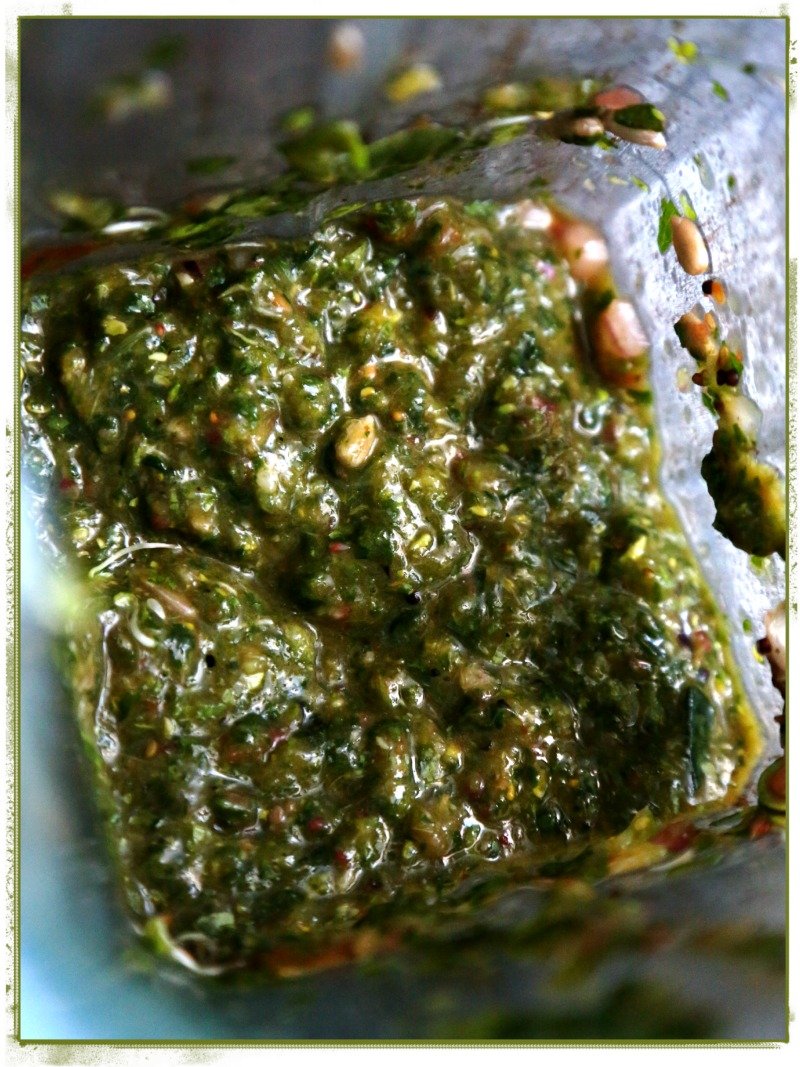
I love experimenting with various ingredients and coming up with new combinations and recipes. The rule of thumb I use is to include something sour, something sweet, and something savory. I usually just blend the ingredients on low for a few seconds to leave the crunchy ingredients (nuts and seeds) not completely smooth. Sometimes I just blend whatever I have available or whatever sounds good, for example:
- Tomato, avocado with cilantro
- Strawberries and parsley
- Orange juice with pecans
- Apricots with celery
- Mango with raspberries
- Cucumber with pistachios
- Kiwi with strawberries
- Oranges, bell pepper, and Brazilian nuts
- Pineapple and macadamia nuts
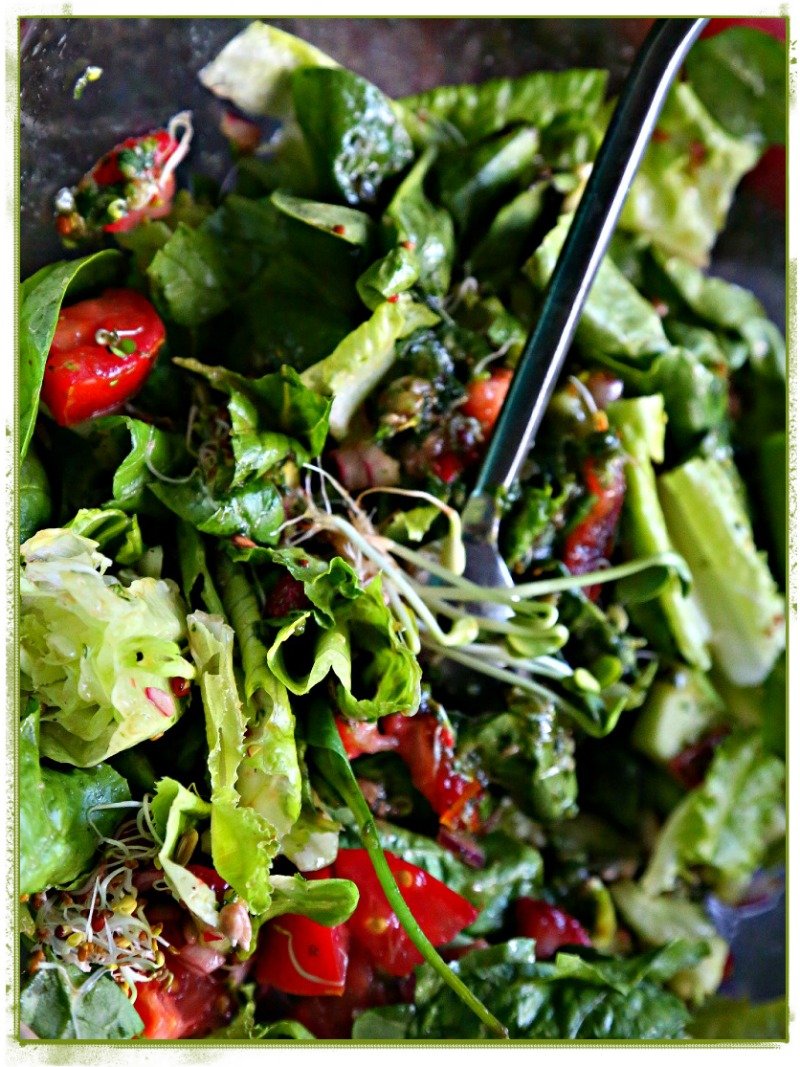
You can add these to any green salad you make.
Questions? Comments? Suggestions?
If you have a favorite recipe, why not submit it here in the comment section of this blog for others to enjoy too!
I also welcome any comments, questions and suggestions. Thanks!
In the first part of Why Buy Organic? I talked about the pesticides, herbicides, and other toxic substances that are used to grow conventional produce.
However, toxins in conventional produce is only part of the story. The other important piece, is the amount of nutrients in conventional vs organic produce.
Many people purchase organic food because they believe it is healthier than conventionally grown food. Yet, the organic industry is constantly told that there is no evidence to support these claims. I’ve read on more than one occasion about “research” that “proved” the equal nutritional value of conventional produce when compared with organic.
I don’t believe that at all.
While certainly eating conventional produce is better than not eating plant foods at all, organically produced fruits and vegetables contain much higher amounts of nutrients, and therefore are more nutrition-rich and health promoting, than their conventional counterparts.
And there are numerous studies that prove that.
“Research published in 2001 showed that the current fruit and vegetables in the USA have about half the vitamin content of their counterparts in 1963. This study was based on comparing published US Department of Agriculture (USDA) figures.
A scientific study published in the Journal of Applied Nutrition in 1993 clearly showed that organic food is more nutritious than conventional food.
Organically and conventionally grown apples, potatoes, pears, wheat, and sweet corn were purchased in the western suburbs of Chicago, over two years, and analyzed for mineral content. The organically grown food averaged 63% higher in calcium, 73% higher in iron, 118% higher in magnesium, 178% higher in molybdenum, 91% higher in phosphorus, 125% higher in potassium and 60% higher in zinc. The organic food averaged 29% lower in mercury than the conventionally raised food.
A peer reviewed scientific article published in the February 2003 edition of the Journal of Agricultural and Food Chemistry stated that organically grown corn, strawberries and marionberries have significantly higher levels of cancer fighting antioxidants than conventionally grown foods. Some of these compounds, such as Flavonoids, are phenolic compounds that have potent antioxidant activities. Many are produced in plants in response to environmental stresses, such as insects or competing plants. They are protective compounds that act as a plant’s natural defense and also have protective properties in human and animal health.
The research suggested that pesticides and herbicides disrupt the production of these protective compounds. Good soil nutrition appears to increase the levels of these natural compounds that have anti cancer, immune boosting and anti aging properties.” via http://www.permaculture.com/drupal/node/144
It’s All In the Soil
The main reason for this is the quality of the soil.
If we care about the nutrition that we receive from our food, we absolutely must not ignore the quality of nutrients plants receive from the soil because the quality of the soil in which the plants grow has a huge influence on our health and on the health of the animals that eat those plants.
The soil plants grow in are as important to our health as plants themselves, if not more!
Conventional agriculture ignores the complex ecosystems of the soil and focuses their efforts at supplying potassium, nitrogen and other chemicals to the plants.
Organic farmers, on the other hand, make sure they are feeding the living microorganisms in the soil, which are essential for growing plants that are rich in nutrients and health promoting minerals.

Organic vs conventional produce: Nutrients come from the the soil
Microorganisms in the soil cannot survive when fed artificial fertilizers, and when all microorganisms die because of the overuse of chemicals, the soil turns into dust.
Here is an interesting fact: “the combined weight of all the microbial cells on earth is twenty-five times that of its animal life; every acre of well-cultivated land contains up to a half a ton of thriving microorganisms, and a ton of earthworms which can daily excrete a ton of humic casting.” (Peter Tompins and Christopher Bird “Secrets of the Soil.)
Most of the soil of agricultural farms in the USA contains less than 2% of organic matter, while originally, before the era of chemistry, it was 60-100%.
According to David Blume, an ecological biologist and permaculture expert, “Most Class I agricultural soil is lucky to hit 2% organic matter – the dividing line between a living and dead soil”. By applying permaculture gardening techniques to a field of extremely depleted soil, which consisted of cement-hard adobe clay, David Blume was able to bring the organic matter to the 25% level within just a couple of years. From this field he harvested the crops “8 times what the USDA claims are possible per square foot” via “Green For Life” by Victoria Boutenko
Organic Vs Conventional Nutrition

Organic vs conventional produce nutrition
Solutions are available, and decisions are being made now. I will write about the in the next installment of “Why buy organic?”.
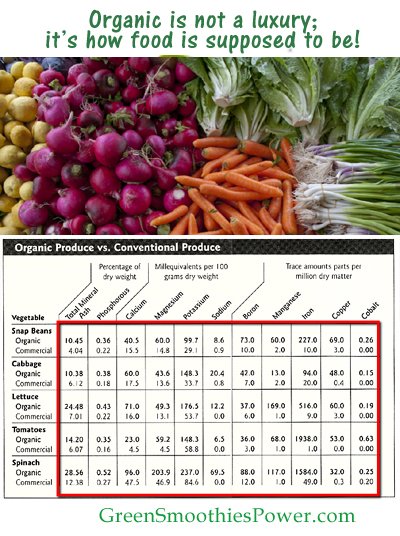
Organic vs conventional produce nutrition; via Green For Life by Victoria Boutenko
Questions? Comments? Suggestions?
If you have a favorite recipe, why not submit it here in the comment section of this smoothie recipes blog for others to enjoy too!
I also welcome any comments, questions and suggestions. Thanks!
If you haven’t been on a highly plant-based diet for a while, chances are you may experience some unpleasant cleansing reactions (detox) when you start drinking your green smoothies.
I’ve had many readers report to me that the experience various symptoms that range from mildly unpleasant to quite unbearable.
“I spent the afternoon and evening (really until I went to bed) in misery!! Achy muscles, head ache, stomach ache, gassy and nautious. Yesterday was the third day in a row I needed a small afternoon nap. I was starting to think I was pregnant again!!”
“I have been experiencing diarreha ever since I started drinking green smoothies. Is there something that I can do to help this go away? I want to continue with the smoothies, but I am getting afraid that something is wrong.”
When I started drinking green smoothies a couple of years ago I remember having flu-like symptoms, with a mucus in the back of my throat for about five weeks.
Fortunately, in most cases these reactions are short lived. They are simply a manifestation of your body using good building and cleansing materials that you are providing, and an opportunity to discard the toxic waste materials.
Why Do I Need to Detox?
Do I need to even answer that question?
Our bodies naturally detoxify every day. Detoxification is a normal body process of eliminating or neutralizing toxins through the colon, liver. However, although the human body is very skilled at filtering out environmental and dietary toxins through the liver, kidneys, lungs, and skin, just like any other filter, prolonged use without proper cleaning can reduce efficiency and cause toxic build up.
Food preservatives, pesticides and herbicides, genetically engineered foods, estrogen-mimicking chemicals leaking from plastic bottles and containers, hormones, antibiotics and drugs infused into the meat, poultry and fish, mercury in fish, chemicals in skin care products, chemicals in water that we drink – there is just so much that your body needs to handle every day.
No wonder our bodies are breaking down and we are feeling sluggish or out of sync! Symptoms of internal toxic build up include lack of energy, chronic fatigue, acne and other skin breakouts, constipation, allergies, dark urine, weight gain, respiratory problems, and many other.
Anybody can benefit from a cleansing. It’s a way to recharge, rejuvenate, and renew. Especially in the spring, when the body is coming out of what might be called hibernation. It’s a way you can jump-start your body for a more active life, a healthier life.
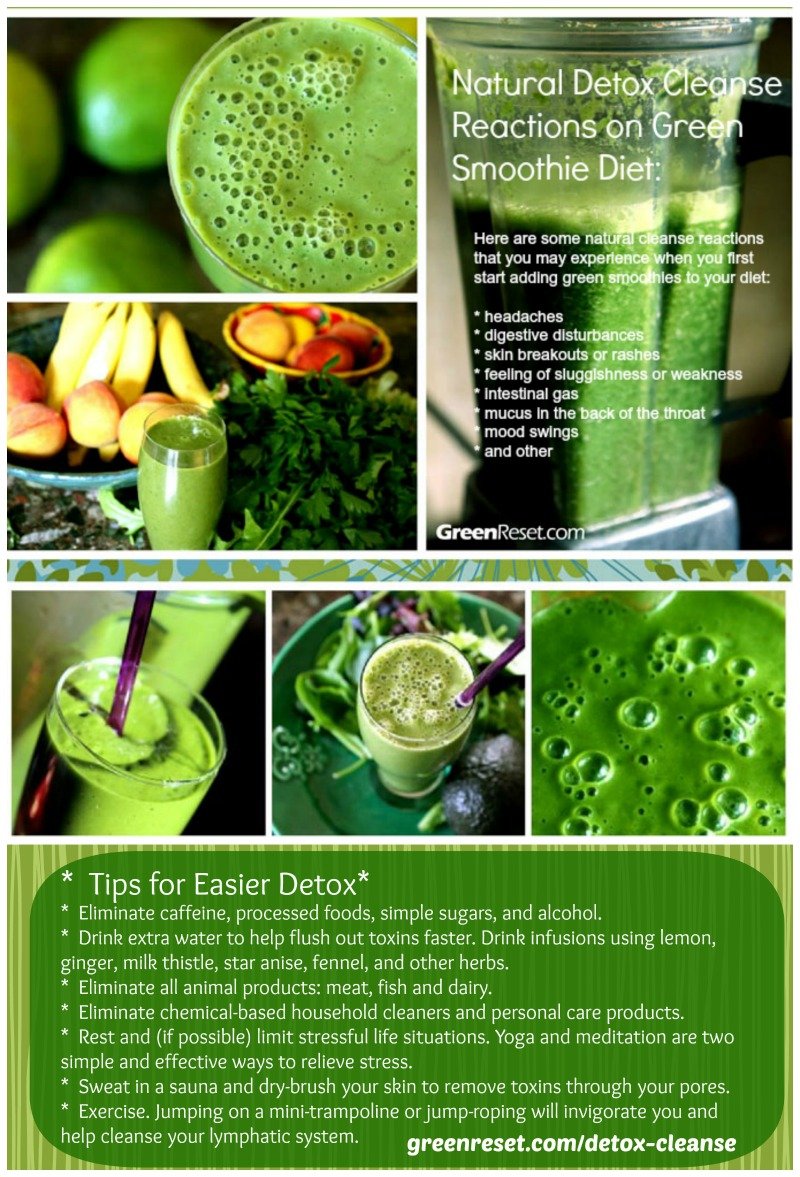
Natural Detox Cleanse Reactions On Green Smoothie Diet:
Here are some natural detox cleanse reactions that you may experience when you start adding green smoothies to your diet:
* headaches
* digestive disturbances
* skin breakouts or rashes
* feeling of sluggishness or weakness
* intestinal gas
* mucus in the back of the throat
* mood swings
* and other
The good news is that those reactions rarely last longer than a couple of days or weeks.
By drinking green smoothies you will be replacing lots of other foods – many of them unhealthy – in your daily diet. So, not only does a green smoothie detox give your digestive system a break, but by eliminating added sugar and other additives in the processed foods, saturated fats, and alcohol, it also rids your diet of things that can exacerbate health issues.
The longer you’ve been eating the S.A.D. (Standard American Diet), and the worse your diet, and the weaker your inherited constitution, the more likely you are to have tough time detoxing. If a “cleansing reaction” lasts longer than 2 weeks, it’s possible that you may be looking at a food sensitivity.
If they are really unpleasant, maybe you may want to reduce the amount of the smoothie that you drink temporarily.
And follow the tips for healthy detox below.
Detox cleanse: You may have to endure some unpleasant symptoms, but just think about the benefits of cleansing your body!
10+ Tips for Healthy Detox
1. Drink green smoothies and green juices.
Make sure you use organic greens and fruits (especially the ones on the Dirty Dozen list – in the United States alone, more than one billion pounds of pesticides are deliberately released into the environment every single year. Among these are some of the most dangerous synthetic chemicals manufactured today.).
2. Rotate your greens (don’t use the same greens all the time). Add some fresh ginger and lemon juice to your smoothies.
3. Eliminate caffeine, processed foods, simple sugars, smoking, and alcohol.
4. Consume lots of raw fruits and vegetables.
5. Drink extra water to help flush out toxins faster. Also, drink infusions using lemon, ginger, senna, milk thistle, star anise, fennel, and other herbs made with warm or hot water.
6. Eliminate all animal products: meat, fish and dairy, even if just for a few days and see how you feel
7. Eliminate or minimize use of chemical-based household cleaners and personal care products (cleansers, shampoos, deodorants and toothpastes), and substitute natural alternatives.
8. Rest and limit stressful life situations along with detoxifying your body. Yoga and meditation are two simple and effective ways to relieve stress.
9. Sweat in a sauna so your body can eliminate wastes through perspiration.
10. Dry-brush your skin to remove toxins through your pores. Special brushes are available at natural products stores.
11. Exercise. Jumping on a mini-trampoline or jump-roping will invigorate you and help cleanse your lymphatic system.
12. Massage your intestines. Before you get out of bed in the morning, deeply massage your transverse colon (you may use a tennis ball or your hands), starting lower right in your pelvis, straight up to the level of your navel, across to a couple inches inside the left hipbone, and down.
But, please, don’t abandon your new routine. Keep in mind that your body is doing good, necessary work, you ARE burning fat, eliminating toxins, and the discomfort is temporary.
If you are trying to lose weight, this you will start seeing results soon. When you replace high-calorie foods with low-calorie, high-nutrition foods (green smoothies!), weight loss will follow. You will start feeling lighter and more energetic soon!
Questions? Comments? Suggestions?
If you have a favorite recipe, why not submit it here in the comment section of this smoothie recipes blog for others to enjoy too!
I also welcome any comments, questions and suggestions. Thanks!
I admit I have been kind of lazy in the past, rarely buying organic produce (I have to drive 5+ miles to the nearest Wholefoods to get organic greens), but shopping mostly at a local grocery store that sells conventionally grown instead.
So one day, I finally decided to really look into this issue a little deeper, starting with checking the pesticide content of the greens that I use for my smoothies.
The fruits and greens that I use in my green smoothies are fabulous foods, full of vital nutrients that are supposed help keep our bodies strong and immune to disease, right?
Well, sort of.
Many studies show that most conventionally farmed foods have pesticide and other chemical residues. Repeated tests show that many of these foods can literally carry “a cocktail of synthetic poisons.” A growing body of science is showing that repeated exposures, to cocktails of small amounts of synthetic chemicals, have a range of adverse health effects.
Of course, I knew that, but I decided to investigate exactly which foods are most contaminated, and make a list of foods that I need to buy organic at your farmer’s market or supermarket that carries organic produce.
Here is what I found out.
The average conventionally grown apple has 20 to 30 artificial chemicals on its skin, even after rinsing. If you’re eating non-organic celery today, you may be ingesting 67 pesticides with it, according to a report from the Environmental Working Group (EWG).
Many scientists believe these exposures, of minute quantities of agricultural chemicals, are very significant, especially for children.
The Environmental Working Group, a nonprofit focused on public health, scoured nearly 100,000 produce pesticide reports from the U.S. Department of Agriculture and the U.S. Food and Drug Administration to determine what fruits and vegetables we eat have the highest, and lowest, amounts of chemical residue.
Most alarming are the fruits and vegetables dubbed the “Dirty Dozen,” which contain 47 to 67 pesticides per serving. These foods are believed to be most susceptible because they have soft skin that tends to absorb more pesticides.
The Dirty Dozen – Buy Organic if possible
So here is the list of the so-called Dirty Dozen, the foods that are most contaminated, so we need to limit their consumption or only buy organic:
Celery
Peaches
Strawberries
Apples
Blueberries
Nectarines
Sweet bell peppers
Spinach, kale and collard greens
Cherries
Potatoes
Grapes (imported)
Lettuce
Other than bananas (that are not on this list) and potatoes (that are on this list buy we don’t eat them as often), this list contains most fruits and vegetables that I frequently use in my green smoothies and salads!
The Clean 15
Conventional Produce Lowest in Pesticides
Not all non-organic fruits and vegetables have a high pesticide level. Some produce has a strong outer layer that provides a defense against pesticide contamination. The group found a number of non-organic fruits and vegetables dubbed the “Clean 15” that contained little to no pesticides.
Onions
Avocados
Sweet corn
Pineapples
Mango
Sweet peas
Asparagus
Kiwi fruit
Cabbage
Eggplant
Cantaloupe
Watermelon
Grapefruit
Sweet potatoes
Sweet onions
Honeydew Melon
To limit your exposure, it makes sense to peel fruits, if possible, and not to eat skins, unless you are able to purchase those vegetables in organic form. Remove and discard the outermost leaves of lettuce and cabbage, and other surfaces that cannot be peeled can be washed with soap and water, or a commercial vegetable wash.
Some of my favorite foods and ingredients for my smoothies are on the dirty-dozen list. And even the “OK to eat produce” isn’t completely safe. At my house, we do consume lots of green smoothies, so, needless to say, I worry about the toxins level, especially when it comes to my son.
For example, a study out of Harvard shows that even tiny, allowable amounts of a common pesticide class can have dramatic effects on brain chemistry. Organophosphate insecticides (OP’s) are among the most widely used pesticides in the U.S. & have long been known to be particularly toxic for children. This is the first study to examine their effects across a representative population with average levels of exposure. Finding :: Kids with above-average pesticide exposures are 2x as likely to have ADHD. Read the full report
The chemicals sprayed on conventional food crops have been linked to numerous diseases, including birth defects, Parkinson’s, numerous cancers and diabetes.
Here is where you can check the pesticide residue on popular produce – go to http://www.whatsonmyfood.org/
I don’t know about you, but I find it appalling that eating these (and other) foods that we buy because they are healthy (and delicious) can make us sick!
Personally, I don’t want to worry about the dangerous toxins when I buy my fruits, vegetables and greens for juicing, blending or cooking.
Organic is not a luxury; it’s how food is supposed to be!
Buying organic and pesticide-free whenever possible makes sense and is an important start. But being a responsible consumer will not make enough of a difference to make our food system sustainable and safe for ourselves and future generations.
In the second installment of this article I’ll be writing about nutritional value of organic versus conventional produce.
Solutions are available, and decisions are being made now. I’ll also be writing about what we can all do to make organic foods more available and affordable.
Questions? Comments? Suggestions?
If you have a favorite recipe, why not submit it here in the comment section of this smoothie recipes blog for others to enjoy too!
I also welcome any comments, questions and suggestions. Thanks!