“What foods should I be eating to relieve menopause signs and symptoms naturally?” is the question asked by many women approaching menopause (myself included).
Hot flashes, insomnia, mood swings, …. these are certainly not fun.
The good news these symptoms can be significantly reduced or even completely stopped when you make some simple changes to your diet and lifestyle.
But is there really a special diet to relieve menopause symptoms?
Well, yes and no.
A diet to relieve perimenopause or menopause symptoms is actually the same diet that you should be eating for optimum health. This diet will keep your body healthy and your hormones balanced, so you will be virtually free from any chronic disorders that are commonly associated with the “western” type diet.
So, in that sense, there is no “special” diet for “menopause symptoms”. This really is a good news for you, because this means that if you only follow the recommendations below, you will not only relieve your menopause symptoms permanently – without any need for hormone replacement therapy, or other menopausal remedies; you will also prevent more serious health problems that are the result of an unhealthy, Western diet, that is filled with processed foods, excessive fats and animal proteins, including breast cancer, cervical cancer, osteoporosis, and heart disease.
What to Eat to Relieve Menopausal Symptoms Naturally?
Natural, plant-based diet is the optimum diet for human beings to remain healthy and disease free.
Fresh, raw fruits, vegetables and leafy greens should constitute the bulk of your daily caloric intake. Other foods to include are whole grains, beans and legumes, nuts and seeds.
This means most your daily calories should be coming from these natural sources.

Relieve Menopause Symptoms Naturally
You should be eating a LOT of these:
- Fresh, raw fruits
- Fresh raw vegetables (in salads and as snacks), lightly cooked vegetables (as in soups, stews, or just steamed veggies),
- Fresh raw greens (eaten in salads, green smoothies)
- Beans and legumes
- Whole grains
- Raw nuts and seeds (limited quantities)
Most of these foods, especially when eaten raw (fruits, vegetables and greens) – you can eat as much of these as you like, as often as you like. If your weight is normal, then you can also eat as much as as you like of legumes and whole grains. If you are overweight, then legumes and whole grains should be eaten in moderation, limiting the amount to 4-6 cups.
Use nuts and seeds as condiment for salads, or eat small portions for snacks – don’t eat too much of them as they are very high in fat (even though these are healthy fats, it’s still not recommended to eat huge amounts of these foods).
Foods to avoid or eliminate completely:
- Cut out completely or limit to minimum all processed foods: white flour products (breads, pastas, pastries, processed cereals), sugary foods, etc.
- Cut out completely or limit to minimum all animal-based foods: meats, fish, dairy.
Many studies consistently demonstrate that for best health, including healthy hormonal balance, you need to eat a diet as close to vegetarian as possible. One reason is that animal products don’t contain any fiber. However, that’s only part of the story. Consuming large amounts of animal-based foods on a daily basis leads to all sorts of chronic health problems, and menopause symptoms is just the tip of an iceberg here.
I know that for most women it’ll be very hard to implement such drastic changes to your diet overnight.
Don’t worry – just start by adding more fresh plant foods to your daily meals as salads, snacks, soups, stews, etc.
Now that you know what to eat, simply go to the grocery store and head straight for the Fresh Produce section. Pack your shopping cart with all kinds of fruits and vegetables that look appealing. Then go find some beans, legumes, and whole grains. Brown rice, barley, oats, quinoa or other.
Then find some recipes to prepare simple vegetarian dishes: salads, soups, stews, baked and steamed veggies.
Now, if you really must have some meat, don’t obsess over it – at least initially. Have a small piece, but try NOT to make it the central part of your meal, but more like a small side dish.
Do this for at least 2-3 weeks and see how you feel. When you start noticing positive results, you should find motivation to continue this way of eating indefinitely.
Killer tip for adding more fruits, vegetables, and greens to your diet
I know that for most people eating such large amounts of fruits and veggies may be difficult, if not impossible. Who has time to prepare all these healthy recipes, chop the salads, etc. Right?
Below is my secret weapon that I’m sharing with you for free, that will make consuming large amounts of fruits, veggies and greens a breeze.
Super Healthy Recipe For Happy Menopause #1
Green Smoothies. Green smoothies are simply blended drinks made from fruits and greens that are super-easy to prepare, super delicious and super-healthy.
Great Ingredients For Your Green Smoothies:
GREENS: spinach, lettuce, kale, parsley, arugula, Swiss chard, mint, basil, cilantro, or other.
FRUITS: bananas, pears, apples, mango, strawberries, raspberries, blueberries, peaches, kiwi, pineapple, melon, papaya, watermelon, grapes, or other.
VEGGIES: celery, avocado, tomatoes, cucumbers.
Some fruit and green combinations you may want to try:
Spinach with bananas and strawberries
Spinach with apple, banana, and some lemon or lime juice
Spinach, banana, peach, mango
Romaine lettuce with bananas
Parsley and ripe pears
Parsley, celery, apple and pears
Tomatoes, celery, basil, parsley, cucumber, peppers, and pear
Drink a big glass of this green drink 2-4 times a day (or even more, if you wish), and I guarantee you that your symptoms will become much lighter, and you will soon forget about your problems with menopause symptoms.
As you can see relieving your menopause symptoms naturally and getting your elimination back on schedule is not so complicated. So get started right as soon as possible with these easy simple steps.
Questions? Comments? Suggestions?
If you have a favorite recipe, why not submit it here in the comment section of this blog for others to enjoy too!
I also welcome any comments, questions and suggestions. Thanks!
I’m happy to present you with another interview in my “Powered by Plants” series. It’s with Ally from MadeofStars.com. I hope you’ll enjoy it as much as I did.
Name: Ally
Location: Australia, the Far North coast of New South Wales
Occupation: Consultant to the not-for-profit sector
Blog Name: Made of Stars
Twitter: @madeofstars1
1. First off, please tell us a bit about yourself (where are you from, what do you do, etc.)
I live in Australia, on the Far North coast of New South Wales. My husband, Mat, and I grew up in Sydney, and moved to the country a decade ago. We are both Social Workers.
I have spent most of my working life advocating for women and children who have experienced family violence, and are navigating the legal system. Currently, I am working (from home) as a consultant to the not-for-profit sector.
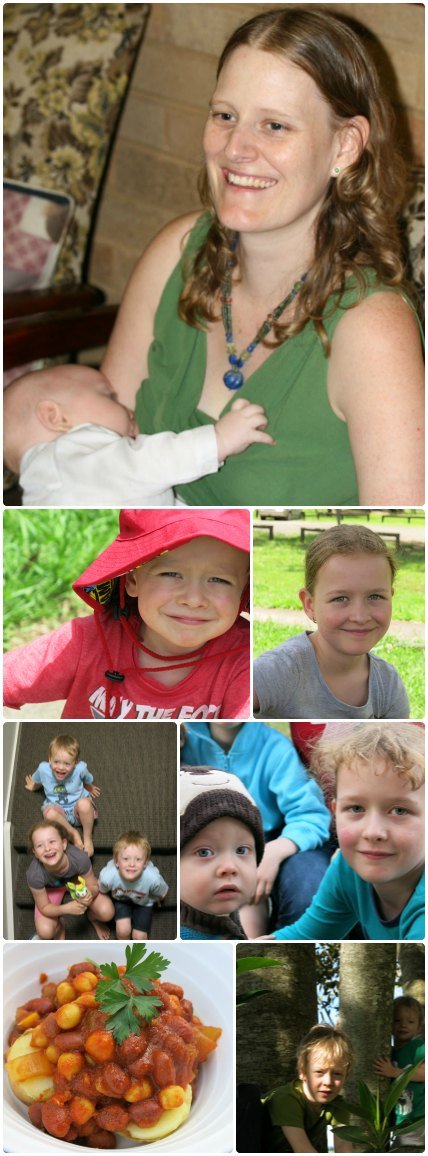
We are the parents of 4 tiny vegans – a daughter aged 9, and three sons aged 6, 4, and 14 months.
2. How long have you been vegan and what was your motivation for going vegan?
I have been an ethical vegan for 17 years. Embracing veganism is one of the best life decisions I have ever made!
As a child, I shared my life with dogs, cats, birds, mice, and fish. I was a self-proclaimed ‘animal lover’. Yet, I ate animals. Rather, I ate some animals. As a child, I would have been repulsed if somebody had suggested that I eat dogs or cats. But, for the most part, I did not question eating cows, chickens, and pigs.
When I was about 6 or 7, I did ask about the origins of the beef on my dinner plate. My godmother told me that ‘the cow’ had died of old age. In other words, the cow had not suffered. I accepted this response. I think that I would have embraced vegetarianism earlier, if an adult had been honest with me. It was another decade before I questioned the necessity of eating meat.
At 16, I stumbled upon a book in my local library: Old MacDonald’s Factory Farm: The Myth of the Traditional Farm and the Shocking Truth about Animal Suffering in Today’s Agribusiness. I was profoundly impacted by the words and images in this book. Why didn’t I know about the barbaric treatment of ‘food’ animals? The scale of misery and torment detailed in the book galvanized me – I stopped eating meat. However, I continued to eat fish, eggs, and dairy products.
Eventually, all of the pieces of the puzzle came together. I awoke to the suffering of ocean dwelling beings, ‘egg-industry’ chickens, and ‘dairy’ cows. I faced up to the fact that fish felt pain, and were just as ‘alive’ as cows and pigs. I began to question how I could continue to support industries that treated bobby calves and male chicks as waste products. How could I, a feminist and human rights advocate, support the enslavement of cows and the theft of their offspring? It became apparent that veganism was the appropriate ‘next step’.
At 19 years of age I embraced, wholeheartedly, a vegan ethic. I have never looked back!
3. What was the transition to all plant-based diet like? What was your greatest challenge? Do you have any advice for people who are considering making the switch or who are still going through a transition?
In the mid-90’s, I was a university student living with my parents, in Sydney. Mat (my ‘new’ boyfriend at that time!) and I frequently visited vegan restaurants. I read New Vegetarian magazine and Vegan Voice magazine. I joined Animal Liberation.
My younger sister embraced veganism as well. Many of our university friends were developing an interest in animal rights.
When I stopped drinking cows’ milk, I began drinking black tea and herbal tea. I switched to soy milk for cereal and baking. At that time, the only non-dairy milk available was soy milk. There was only one brand in the supermarket, and I disliked it. In order to ‘condition’ my taste buds to soy milk, I purchased the chocolate-flavoured variety, and watered it down with ice cubes. Once I had developed a taste for the chocolate variety (without the ice cubes), I switched to plain soy milk.
I adapted to the taste of pasta, pizza, toasted sandwiches, and Mexican food minus the dairy-based cheese. There wasn’t any decent vegan cheese available at that time, so I did not replace dairy cheese with non-dairy cheese. Nowadays, vegan cheese is a bit of a novelty for me. I do like a slice of Vegusto cheese on a cracker, or a sprinkling of cheezly on a pizza. But vegan cheese is not a regular staple in our house.
When transitioning to veganism, I believe it is important to surround yourself with positive, supportive people. Socialising with like-minded vegans is important too. If possible, attend a local vegan ‘meet-up’. We regularly attend meet-ups for vegan families. I believe that it is important for my children to socialise with vegan children and vegan adults. This helps to ‘normalise’ veganism.
Remind yourself constantly, of why you have transitioned. Read health-based and ethics-focused literature. Watch documentaries that promote veganism, and join a local animal rights organisation.
If you do fall off the wagon, jump back on with gusto. Ditch the guilt, and re-ignite your commitment. Remind yourself of the sacrifice that animals make. Keep a picture of a bobby calf on your fridge, or as a screen saver on your phone.
4. Is your family vegan? If yes, how did that happen?
Yes, we are raising our children vegan. They have been vegan their whole lives. I have had 4 four healthy vegan pregnancies.
Promoting veganism to our children goes beyond ‘food’. Vegan parenting involves nurturing our children’s compassion for, and curiosity about, non-human animals. Animals are not a food source in our home. Our children know that meat is a dead animal. They know that a meal of meat means that an animal died – an animal that did not want to die, and fought for life.
My eldest son once asked: ‘can I eat vegan and non-vegan food when I am older’? In my reply, I used chickens as an example, and told him that if he ate ‘chicken’, a chicken must first die. I will not sugar coat that. My children deserve to know the truth. ‘Food’ animals suffer brutality and death at the hands of humans and, for them, I must be truthful. I wish I had been told the truth as a child. My children have no desire to harm animals, and I want them to understand that meat is the product of an animal that has been harmed.
Our 4 year old is going through a stage of asking all our visitors: ‘Are you vegan’? During dinner time at our house recently, he asked our guest – my daughter’s friend- if she was vegan. When she answered ‘no’, he asked: ‘then why are you eating vegan food’? J
My kids rarely watch commercial TV, so they have been largely sheltered from fast food advertising. Recently, however, we saw an ad for a ‘chicken’ fast food outlet. My 4 year old son said: ‘I don’t want to eat chickens. I like chickens’.
My daughter is 9, so we can discuss more advanced concepts with her. Obviously, I am reluctant to reveal too much about the horrors that animals endure at the hands of humans. I have no desire to traumatise her. I shelter myself from news items and online videos about animal abuse.
I am happy that my daughter has embraced a vegan ethic – she ‘gets’ it. Recently, our daughter’s school teacher showed Mat and I a piece of her schoolwork. In class time, the children were required to write a passage of persuasive text about a topic of their choice. My daughter wrote about not eating animals. In her piece, she argues that it is not fair to animals if people eat them when they could eat vegetables instead.
My children are fortunate to have friendships with vegetarian and vegan children. Wonderfully, my daughter’s best friend, Dan, is also a vegan.
My school-age children attend an independent school that promotes a vegetarian diet. School lunchboxes and school functions must comply with a sentient (or yoga) vegetarian diet. In this context, not eating animals is ‘normal’ for my children.
5. Do you have to deal with picky eaters?
My 6 year old son is the least adventurous eater in our family. He is wary of new foods, but he does eat a wide range of foods. He loves fruit. He is not keen on some vegetables, such as mushrooms and tomatoes, but he enjoys others such as broccoli, carrots, and raw capsicum.
His favourite snacks are peanut butter and banana sandwiches, and red apples. He adores salt and pepper tofu. He is partial to mixed berry sorbet. He also likes cake. Which isn’t surprising – he is my son after all! I am not known for my ability to resist a rich chocolate cake or a tangy cheezecake.
6. Can you perhaps share your favorite recipe, if it’s not a secret :-)?
Chilli beans is a meal that is on high rotation in our household. It is simple to prepare, and there are many different ways of serving it. You can find the recipe here.
The weather is cooling down here as we head towards winter. At this time of year, my family also enjoys vegetable curries with rice, vegetable and tofu stir fry, baked root vegetables, soups, dahl with rice, and pasta dishes. I adore a big, warming bowl of spicy Laksa.
Mat and I also enjoy eating a combination of sliced mushrooms – shiitake, enoki, swiss brown, oyster, white button – cooked in olive oil, garlic, and parsley. This is a simple, yet delicious, side dish.
In terms of ‘eating out’, vegan yum cha is a family favourite. My kids also enjoy Japanese food. They all like seaweed!
We don’t eat dessert at home. However, my mum usually bakes a cake if we are having dinner at my parents’ house. She makes delectable chocolate cakes and cheezecakes. These are definitely popular with my children!
7. Do you drink green smoothies or green juices?
Yes, Mat and I drink a green smoothie each morning. We first discovered green smoothies when we became interested in raw food about 5 years ago. Currently, we aim to have a daily green smoothie, and this task is made easier by the presence of a high-powered blender in our kitchen.
This morning, our green smoothie consisted of banana, pear, oranges, strawberries, water, coconut butter, ground flax seeds, kale, and cos (romaine) lettuce. We are currently visiting my mother-in-law in Sydney- and we brought our blender with us! So, she is also indulging in green smoothies each morning. I think we have a convert!
8. What are your strategies and tips for eating out and dealing with social situations? Do you have any advice for new vegans?
Plan ahead.
If I have been invited to an ‘unfamiliar’ restaurant, I find it best to phone them and ask about vegan options, rather than waiting until I arrive.
If you are going to an event that does not permit BYO food, and you are unsure about the availability of vegan food, eat before you go!
When my children receive an invitation to a birthday party, I always contact the parent/s and offer to prepare a vegan dish (or 2) for all of the party-goers to share. I certainly do not expect the party organisers to alter their meal plan – I know how stressful party organising can be! I have found that most children’s parties have ‘incidental’ vegan food on the menu – fruit platters, rice crackers, hommus, popcorn, plain potato chips (crisps).
When my daughter was a toddler, I feared that I would one day develop ‘baking fatigue’ as a result of all the cupcakes I would need to bake for her to take to other children’s birthday parties. However, I have been heartened by the willingness of other parents to cater for my children. It often isn’t necessary for me to send vegan food or even a vegan cake substitute, as many of the parents make sure that vegan food is available, including cake. It is a gesture that I appreciate immensely.
Finally, do not apologise! You do not have to apologise for being vegan. You are not an inconvenience, or a ‘hassle’. Just let people know at the earliest opportunity that you are vegan, and be prepared to bring delicious food to share.
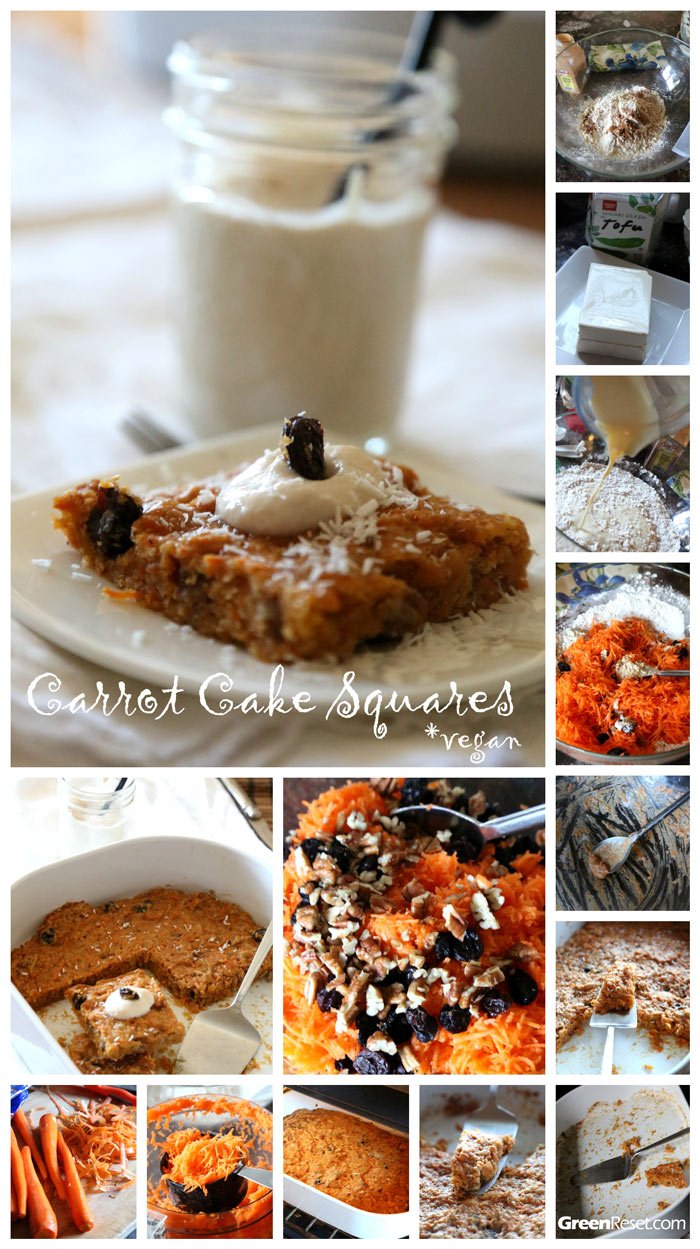
If you are looking for a healthy carrot cake recipe, look no more.
I found this recipe in the Tofu 1-2-3 cookbook by Meribeth Abrams and I decided to give it a try. It turned out very tasty, although a bit too sweet for my taste. Next time I will use a bit less sugar/syrup. I’m also going to experiment with less oil.
Carrot Cake Squares
Servings: 24 squares
Carrot Cake: Dessert Squares Recipe (Dairy Free, Vegan)
Ingredients
- 2/3 cup silken tofu (I used Nigari from Trader Joe's - this stuff is amazing! I heard Nasoya is also excellent)
- 2 cups unbleached all-purpose flour
- 2 tsp ground cinnamon
- 1 tsp ground nutmeg
- 1 tsp baking powder
- ½ tsp salt
- 1 cup brown sugar
- ½ cup maple syrup or agave syrup
- ½ cup vegetable oil
- 1/3 cup soy, rice or almond milk
- 1 teaspoon of vanilla extract (skip it if using vanilla milk)
- 3 cups shredded carrots (about 6 medium or 4 large carrots; I used my food processor to do the job)
- ½ cup chopped pecans or walnuts
- ½ cup raisins (she recommends golden, but I didn't have them, so I used dark)
Instructions
- Preheat oven to 350° F.
- Prepare a 9 x 13-inch baking pan by spraying it with non-stick cooking oil (I don't have a spray, so I just used some coconut oil to moisten the pan.
- In a large bowl, sift together the flour, cinnamon, nutmeg, baking powder, sugar and salt.
- In a blender, combine the tofu, syrup, oil, vanilla extract and non-dairy milk and blend until smooth.
- Pour the liquid into the dry ingredients and stir until combined.
- Mix in the carrots, walnuts, and raisins and stir well. The mixture will be thick and sticky.
- Transfer the dough to the baking dish. Bake for 45 minutes or until a toothpick inserted into the center of the cake comes our clean.
- Remove from the oven, cool and cut into squares and serve as is.
3.1
https://greenreset.com/carrot-cake-dessert/
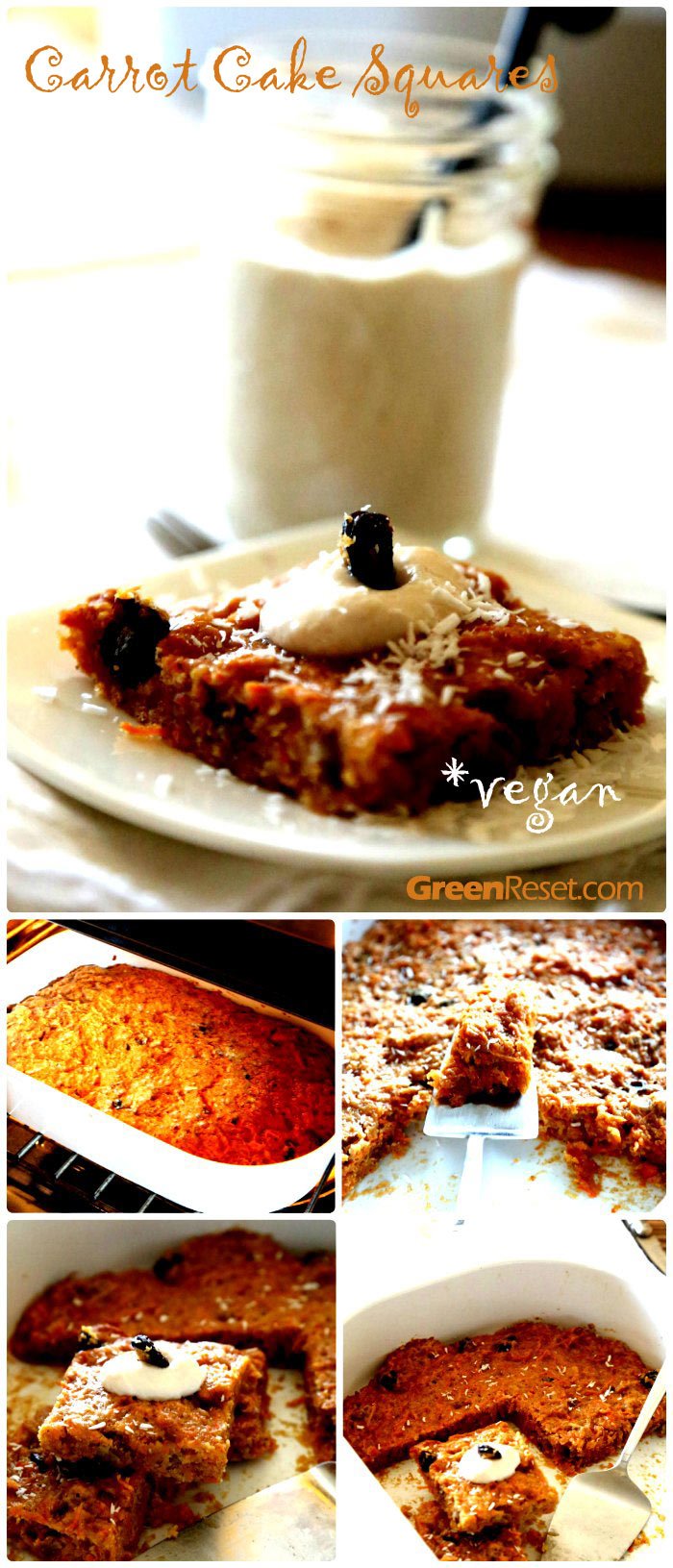
To make coconut frosting for the cake (optional):
8 ounces silken tofu
1/2 cup pure maple syrup
1 teaspoon coconut extract
3/4 cup dried unsweetened coconut flakes
What to do:
Blend tofu with maple syrup and coconut extract, and until smooth. Stir in coconut. Spread the frosting on the cooled cake. Decorate with coconut flakes, walnuts and raisins.
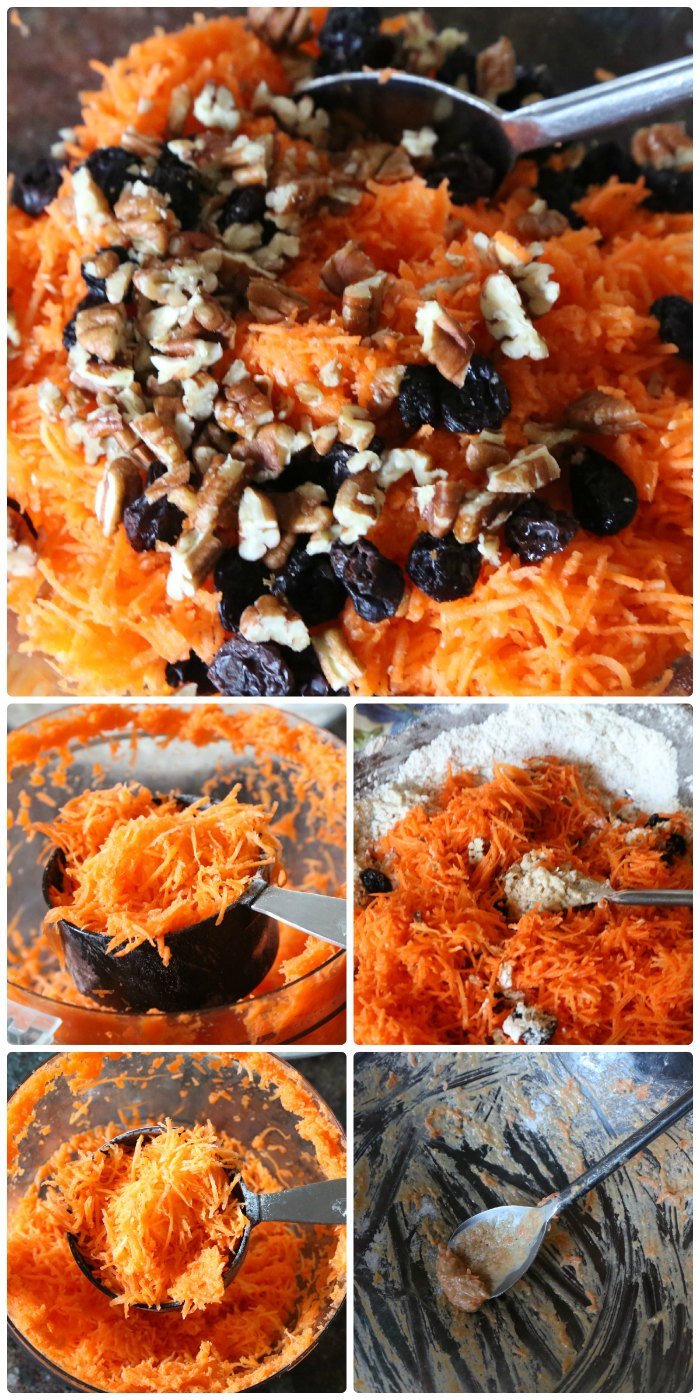
The carrot-tofu-mixture was so delicious I literally licked the bowl. It had no raw eggs, so that was safe!
Who would have thought that a dessert may contain so much of a healthy stuff and still be delicious!
Questions? Comments? Suggestions?
If you have a favorite recipe, why not submit it here in the comment section of this smoothie recipes blog for others to enjoy too!
I also welcome any comments, questions and suggestions. Thanks!
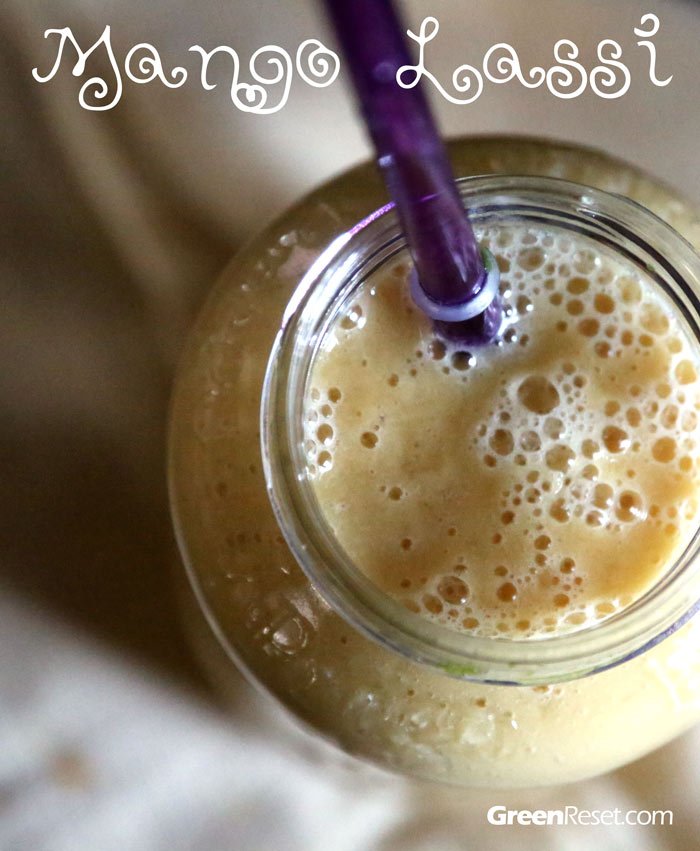
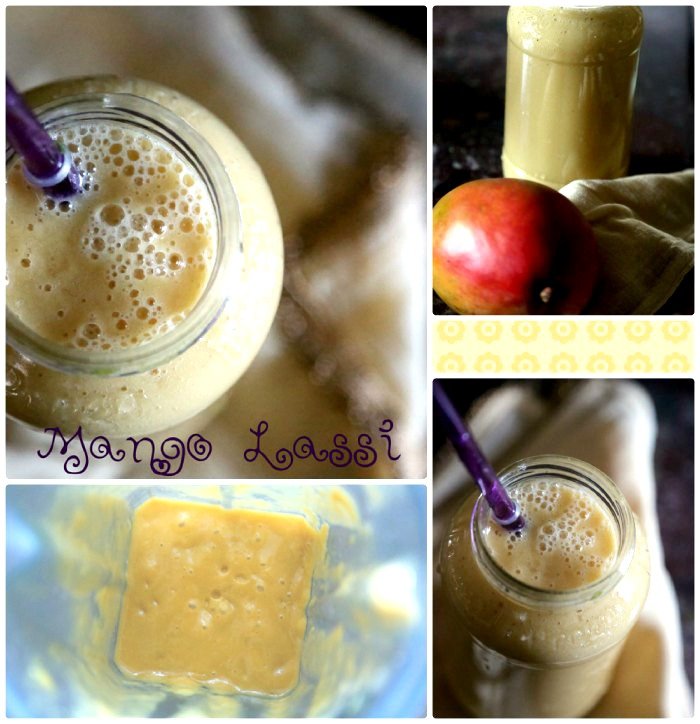
This mango lassi inspired drink is absolutely delightful – smooth, creamy, sweet, with a hint of tartness. Guaranteed to make you happy.
Silky, ripe mangoes and a combination of creamy milk (please use vegan milk) are the keys to getting the decadent texture of this drink just right. You can use any non-dairy milk in this recipe, or you can use raw cashews to make it into a delicious vegan mango lassi sensation.
Mango is actually a good substitute for bananas in smoothies. It’s just as sweet and creamy and many people actually much prefer the taste of it to bananas.
Both these mango drink recipes are gluten-free, dairy-free, vegan, vegetarian, soy-free, using five ingredients or less.
Ingredients
Instructions
- If using cashews, start by blending them with water until smooth.
- Add all ingredients to your blender, and blend until creamy.
- You may need to add a bit more water or milk, depending on how thick you want your lassi to be.
- Pour into a glass, sip, and smile!
3.1
https://greenreset.com/mango-lassi/
Enjoy!

Questions? Comments? Suggestions?
If you have a favorite recipe, why not submit it here in the comment section of this smoothie recipes blog for others to enjoy too!
I also welcome any comments, questions and suggestions. Thanks!
This deliciously sour cucumber soup (zupa ogórkowa) is a traditional Polish dish, very popular in Poland. The soup is quite unlike any soup you’ve ever tasted, with a unique flavor that’s very fresh and refreshing.
It’s an easy-to-make recipe but it requires brined cucumbers (i.e., cucumbers preserved in water with garlic, dill and spices), NOT the ones pickled in vinegar. It is this brine that makes the soup special. The process of natural fermentation in brine is how the cucumbers develop their sour taste – no vinegar is involved.
Now I promise it’s not what you think. The tanginess of the pickles combined with cream and fresh dill gives it a very refreshing flavor, making it a perfect recipe for a spring or summer meal.
In any case, I urge you to try the Polish cucumber soup and post a comment to let me know what you think.
Polish Cucumber Soup
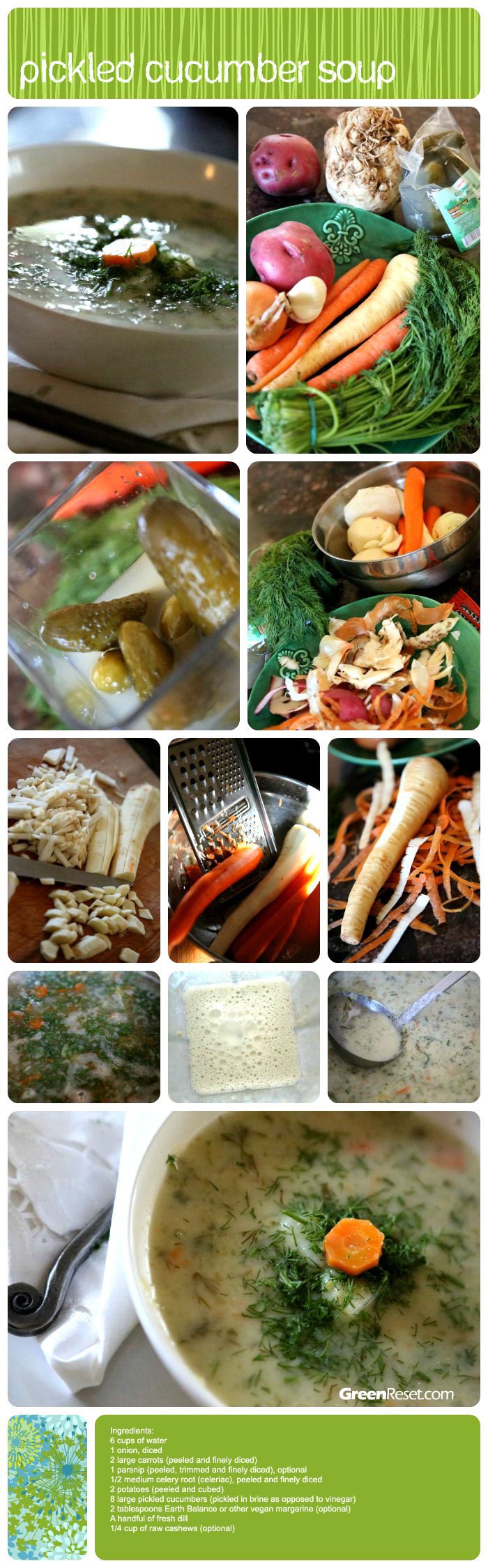
Ingredients:
- 6 cups of water
- 1 onion, diced or 1 medium leek, white and light-green parts, rinsed well, then cut into 1/2-inch pieces
- 2-3 garlic cloves, minced
- 2 large carrots (peeled and finely diced)
- 1 parsnip (peeled, trimmed and finely diced), optional
- 1/2 medium celery root (celeriac), peeled and finely diced, or 2 celery stalks, trimmed; chopped into 1/2-inch pieces
- 2 potatoes (peeled and cubed)
- 8 large pickled cucumbers (pickled in brine as opposed to vinegar)
- 2 tablespoons Earth Balance or other vegan margarine (optional)
- A handful of fresh dill
- 1/4 cup of raw cashews (optional)
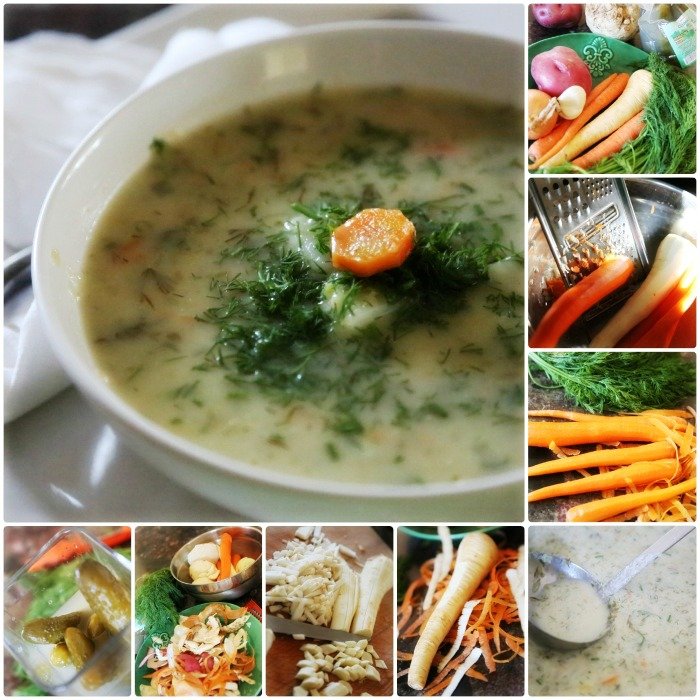
Method:
- Place onion and garlic in a large stock pot and cook for 2-3 minutes in 2-3 tablespoons of water.
- Add 5 cups water, a bay leaf, and bring to a boil. Once boiling, reduce the heat and allow to cook for around 15 minutes, or until all the vegetables are cooked. You may add some pepper, but I wouldn’t add any salt at this point, as the brine is quite salty on its own.
- Meanwhile, grate or process (but not too finely) the pickles. In traditional recipes, the cucumbers are peeled, grated and fried in butter before being added to the pot. You can do that by using vegan butter substitute, such as Earth Balance. What you can do, instead, is just blend the cucumbers whole in brine in my Vitamix. I used all of the cucumbers and all of the brine from the package. I like to add quite a lot of the brine to the soup as I really loved the sour taste, but you may choose to add a little less and see how you like it first. Add the grated or blended pickles (including the juice) to the soup.
- Now, make the cashew cream (this is the secret ingredient to cholesterol-free creamy soups, such as this cream of asparagus or cream of celeriac soup). In the Vitamix, blend the cashews with 1 cup water on high until very smooth. Add to the soup.
- Taste the soup and adjust the flavors to your liking. The soup should have a pleasantly sour taste. If you saved part of the dill pickle juice/brine and you want the soup to be more sour, add some more brine to the soup. If you want a thinner soup, add a little water. Mash or blend some potatoes and veggies if you want a thicker soup.
- Ladle your soup into your serving bowl and garnish with a sprinkling of fresh dill. Serve with a piece of crusty bread.
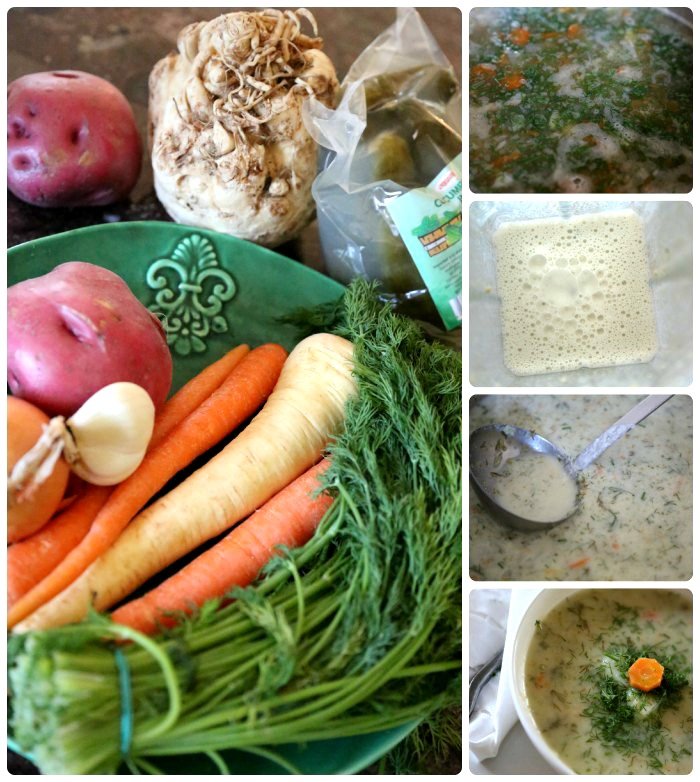
This works better if you use homemade sour pickles, but good sour dill pickles will do.
When I was growing up, brined cucumbers were always present in my home. My father used to make them in the summer when fresh cucumbers are readily available (with lots of dill and garlic; in Polish these are called ogórki kiszone, in English often referred to as Polish dill pickles). We would save some in jars for winter, but we also used to buy them at the farmer’s market from a wooden barrel.
If you have a Polish store in your neighborhood, you can try to find Krakus brand, but others will do just fine. In New Jersey, where I live right now, there is a big Polish population, so you can find them in many stores. Even my farmer’s market sells them in brine from a big wooden barrel.

This cucumber soup is a great make-ahead dish. The soup (minus the dill) can be refrigerated for up to 3 days.
For all my blending recipes I use Vitamix. If you don’t already own a VitaMix, I strongly encourage you to check out what this machine is capable of! For more information about VitaMix you can go directly to the VitaMix website. You may also want to read my post about the Best Blender.
I LOVE my VitaMix and highly recommend investing in one if you are ready to make serious changes to your diet. I have had mine for almost 5 years and use it daily!
If you decide to purchase Vitamix – be sure to use Promotional Code 06-004554 to get free shipping.
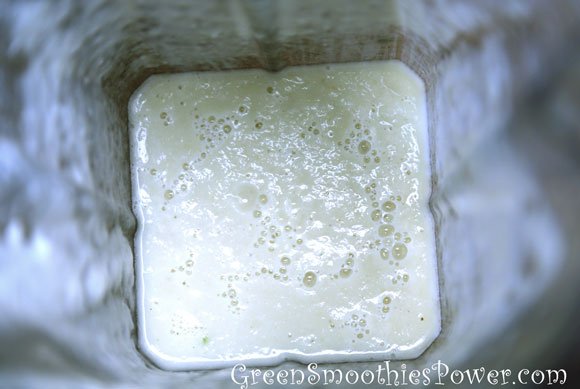
The Making of Cream of Celery Soup: Inside of my Vitamix
Questions? Comments? Suggestions?
If you have a favorite recipe, why not submit it here in the comment section of this smoothie recipes blog for others to enjoy too!
I also welcome any comments, questions and suggestions. Thanks!
I’ve been experimenting lately with easy, no-bake desserts, such as chocolate mousse with tofu and chocolate mousse with avocado. Since I had a bag of frozen strawberries and a package of silken tofu, I thought “Why not try this combination?”
Turns out, this strawberry-tofu combination produces another winning dessert (or snack) that’s rich in protein and low in sugar.
Here is what you’ll need:
Strawberry Mousse Recipe
1/2 cup tofu, silken, firm or extra-firm
1/3 cup strawberries, fresh or frozen
2 tablespoons agave nectar (or to taste)
1 teaspoon fresh lemon juice (orange juice can be used too)
a dash of vanilla extract
a dash of salt (optional)

Blend all ingredients until very smooth in a blender, food processor, or using a hand blender. Refrigerate for at least two hours or until chilled and transfer to a serving bowl or individual dishes. Serve topped or layered with more strawberries and garnished with chocolate curls, or let your imagination run wild. Makes 2 servings.
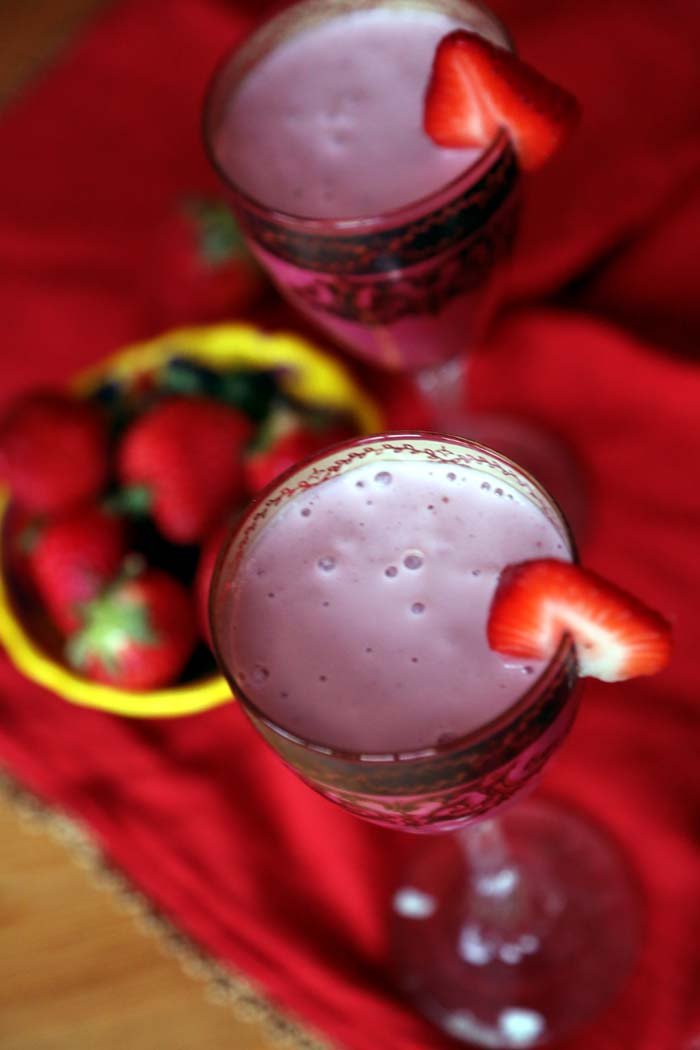
Note: You can reduce the sugar even further in this recipe by reducing agave nectar or substituting it with stevia (the herb).

Many mousse recipes that you will find online contain lots of eggs and heavy cream. This recipe contains neither, resulting in a much healthier desert (for humans, but especially for hens and cows).
On its own, silken tofu has almost no flavor (or, tastes slightly chalky, depending on the variety and whom you ask;-)), but blended (or cooked) with flavorful ingredients, it can take on a myriad of flavors.
By the way, you might have read various scare articles on the Internet about soy (usually based on misleading articles from the Weston A. Price Foundation) but they’re misinterpretations of science. Soy is a healthy food, just like other beans and legumes, and most people can eat it safely (some people are allergic to it). I eat soy in moderation and try for whole soy in natural forms (tofu, tempeh, soy milk). Just make sure you buy organic or GMO-Free soy products.

I added a splash of soy milk into my blender, which resulted in less thick dessert than I would like, but it was still delicious.
Although the pumpkin and cinnamon flavorings are generally associated with autumn, they made for an excellent two-day muffin party in February. Last week, I created a batch of these delicious, healthy treats for my house… and they disappeared shortly thereafter.
Filled with cholesterol-reducing organic oats (I bought as organic as possible to get the best results), the multifaceted superfood flax, and mixed with almond milk, containing plenty of calcium and vitamin E, these were an amazing combination. They also contain cinnamon, which has its own benefits on top of being tasty, like regulating blood flow and circulation.
They tasted perfect, were extremely moist, and were an ideal meeting of a few of my favorite qualities in food: sweetness (but not too sweet) and nourishment.
This recipe makes 12 muffins, and you can play around and add or subtract or modify as you see fit. I made mine on the thicker side, with more oats for texture, but you can use the recommended amount below if you like a lighter muffin.
Cinnamon Pumpkin Muffins Recipe: Simply Delicious and Oh-So-Good-For-You
Ingredients
-
- 1 1/2 cups whole wheat flour
-
- 1/2 cup old fashion oats (more for topping)
-
- 1/2 cup raw sugar
-
- 3 teaspoons cinnamon
-
- 1 teaspoon baking powder
-
- 1/2 teaspoon baking soda
-
- 1/4 teaspoon salt
-
- 1 1/2 cup pumpkin puree
-
- 1 flax egg-replacement (1 tablespoon flax meal, 2 1/2 tablespoons water)
-
- 2 tablespoons extra virgin olive oil
-
- 1 cup almond milk
-
- 1 teaspoon vanilla extract
Instructions
- Fold a paper towel and add a drop of oil, then prime the muffin pan. Warm oven to 375F.
- Mix the flax egg in a large bowl. Combine almond milk, pumpkin, oil, vanilla extract, and raw sugar to the same bowl.
- Delicately combine flour, baking soda, baking powder, cinnamon and salt in a sifter and add to wet ingredients, then whisk together until well blended.
- Spoon batter into muffin pan until each cup is filled to the top. (Go just above if you want larger muffins.) Add oats to the tops if desired.
- Bake for 20-25 minutes (depending on oven power and batter thickness - mine took 25) or until golden brown and a toothpick comes out clean.
- Allow to cool and store in air-tight glass or plastic.
3.1
https://greenreset.com/vegan-cinnamon-pumpkin-muffins/
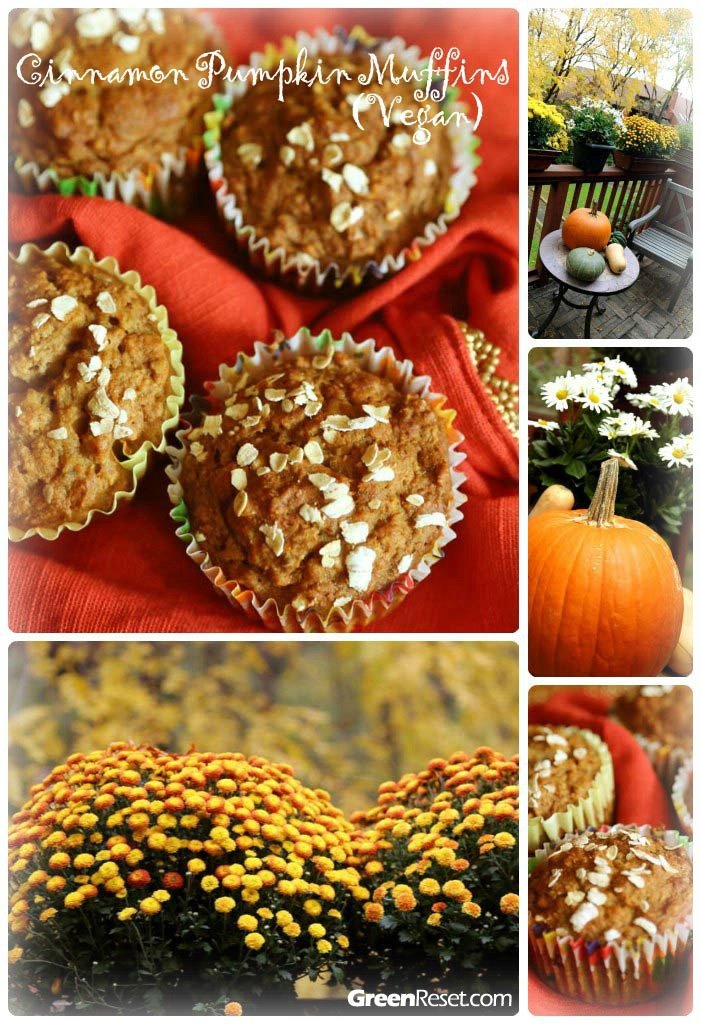

Although the pumpkin and cinnamon flavorings are generally associated with autumn, they made for an excellent two-day muffin party in February.
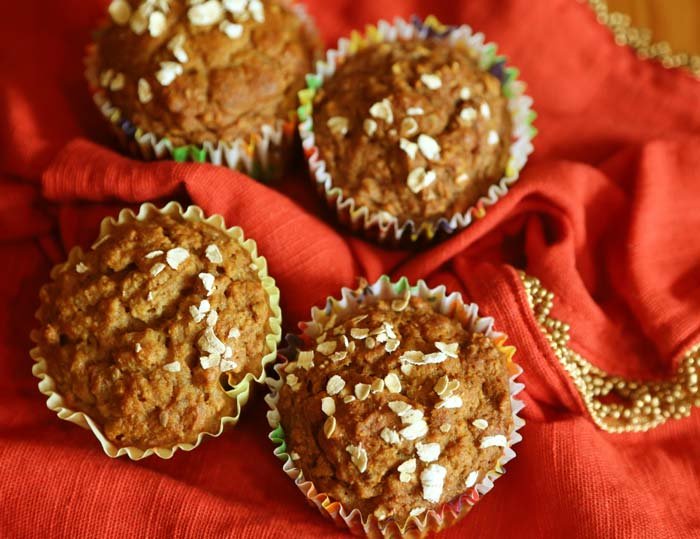
Cinnamon Pumpkin Muffins: Simply Delicious
This guest post is provided by echealthinsurance.com/wellness/eat-well/recipes/. Visit their website to absorb some more healthy, organic and delectable food ideas you can make at home.
Many people believe that fish play an essential role of the human diet. Because of the minerals, proteins, polyunsaturated fats and vitamins that their flesh contains, as well as their content of Omega 3 essential fatty acids, fish are touted to be vital for a person’s growth and healthy living.
But have you ever wondered where does the omega 3 and the other nutrients in the fish come from?
Contrary to what most people believe, fishes do NOT produce these nutrients – they get it from… the ocean plants.
That’s right. One of the primary reasons for the presence of omega-3 fatty acids in fish is because they eat microalgae.
So, why not simply go to the source and eat the plants, just like the fish do. It’s a much healthier, more eco-friendly and much more compassionate alternative. By eating omega-3 rich foods and taking algal oil, you get the essential fatty acids EPA and DHA directly from the source, without the heavy metals and other environmental toxins present in fish.
What Are The Major Vegan Omega-3 Sources Out There?
First, it’s very important to mention that more importantly than the absolute amount of omega-3 in the diet, it is the ratio of Omega 3 to 6 that really matters. You want to keep the Omega 3 to Omega 6 ratio at 1:4 or even below. Most people today have a ratio of 1:50 and above, which is very dangerous.
The biggest vegan source for Omega 3 are flax seeds. In fact, they contain so much omega 3 that all you need a small handful of them each day, provided with a good overall diet that doesn’t over-exceed the usage of Oemga-6 oils.
Other sources of omega 3 fatty acids are avocados and chia seeds.
Fish used to be the main source of omega-3 for many cultures around the world. The truth is that fish also contains a lot of heavy metals (most notoriously – mercury) and toxins, which are disastrous for our health.
Any Benefits of Omega 3?
Omega 3 fatty acids are good for the heart. They have been found to aid in prevention and treatment of cardiovascular diseases. Results of studies suggest that these fatty acids can help protect people against stroke due to plaque build-up and blood clots in the arteries leading to brain. People with heart disease are less likely to have heart attacks if they have sufficient amount of Omega 3 reserves in their blood vessels.
Omega 3 benefits have also been discovered not only for those who have health problems but also for pregnant women and unborn children. Pregnant women getting Omega 3 in their diet can have lower chance of experiencing preeclampsia, preterm labor and reduce risk of developing breast cancer. Effects of Omega 3 to the unborn child include good development of brain and nervous system, better eyesight and better sleeping pattern after birth. Researchers have shown that 70 percent of a new born baby is composed of Omega 3 fatty acids particularly, DHA and EPA. Thus, including these fatty acids in the mother’s diet is beneficial to aid in healthy child development.
Omega 3 is an essential component of children’s brain as well. Deficiency of this nutrient may lead to mental certain disorders like schizophrenia. People characterized with such disorder have difficulty in distinguishing the real and unreal experiences. Moreover, Omega 3 can help children to cope with learning demands. It is beneficial for children who could not focus in a certain object or situation. It is also found to help prevent bipolar disorders and even depression. The mechanism for the Omega 3 benefits to mental health is due to its effect in helping maintain the level of dopamine and serotonin that believed to be associated with the occurrence of these brain disorders.
It has been presented here that Omega 3 fatty acid is recommended not only to those who have serious health issues, but any person of any age or any gender, from pregnant women to the unborn, and from children to adult will all benefit from these fatty acids, and in fact MUST include them in our diet, as they are necessary for a proper functioning of our body.

Did You Know?
Another important nutrient for the brain and nerve cells is vitamin B-12. Vitamin B-12 is produced by bacteria, and is not readily available on a plant based diet. Since plant-based, rich sources of vitamin B-12 are not readily available, supplementing your diet with this nutrient is recommended.
(Guest Recipe) Every so often we all wake up feeling either cranky, groggy or depressed. To completely change your mood and your outlook on life there’s nothing like a superfood smoothie packed with vitamins, minerals, enzymes and other unknown nutrients. A combination of these powerful foods can not only instantly make you feel happier and more alive it can also give you boundless energy throughout a long and grueling workday or you can use it on the weekends to feel amazing while enjoying your time off.
The best time to drink a superfood smoothie is in the morning, because your body is on an empty tank and is able to utilize nutrients more efficiently. The recipe below is not your normal, average superfood smoothie, it’s quite a unique concoction!
Burst of Energy Superfood Smoothie Recipe (With Chia Seeds)
- Start with about 1 cup of cold filtered water in your blender
- 1 cup of chia gel (see directions for making chia gel below)
- 1 handful of almonds
- 1 handful of dates
- 1 organic tangelo (you can also use an orange)
- 1/2 a cup of organic cocoa powder
- 1 handful of organic spinach
- 1/2 a cup of organic coconut shreds
- 1 chunk of ginger
- A hint of nutmeg
Blend for about 10 seconds and enjoy!
This smoothie recipe not only works wonders for your body and mind, it also tastes absolutely amazing; don’t believe me, make it for yourself!

Making chia gel
You can buy chia gel, or make your own by simply adding 1/3 cup chia seeds to 2 cups water (6:1 ratio).
Just put the warm water into a tightly sealed container with a tight-fitting lid and pour the dry seeds into the water. Shake the container for fifteen seconds; let it sit for one minute and then shake it again and your done – chia gel!
This recipe was contributed by CNAinfo; a complete information resource for anyone who is interested in CNA work.
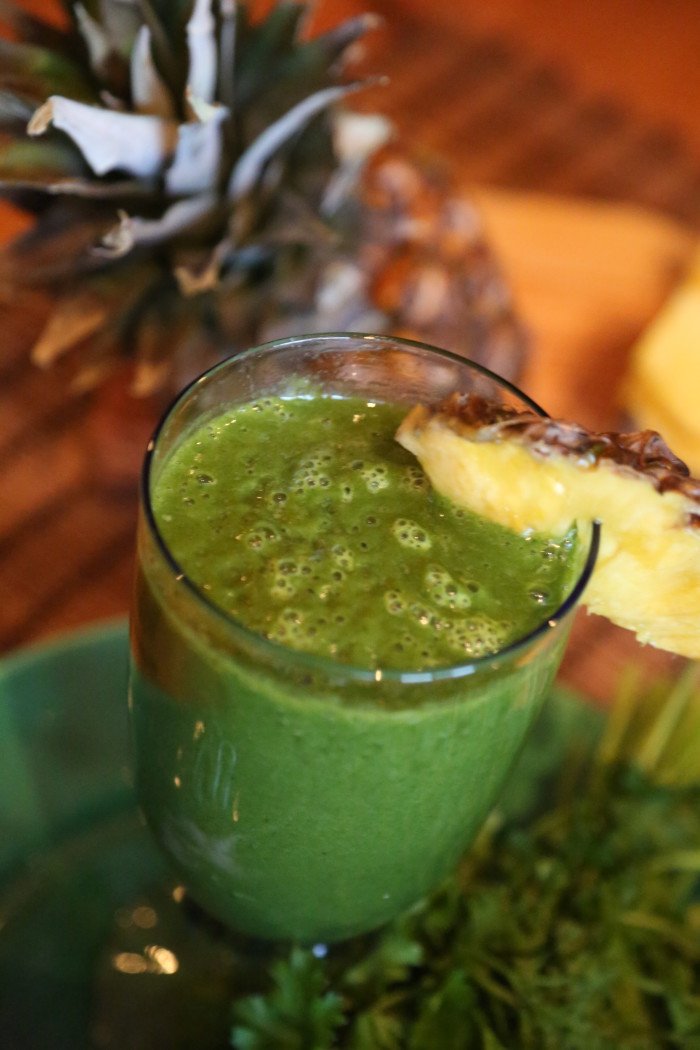
(Guest Post) This smoothie is an incredible morning pick me up or great to enjoy any time of day. Its contains a power packed mix of both greens and vitamin C rich fruits to make a sweet yet potent delight that will make you smile. Spinach leaves are used as the primary leafy green, but the addition of parsley provides extra vitamin C as well as an energy boost that can help to act as a mild appetite suppressant for those trying to lose a few pounds.
On the fruit side of things this recipe calls for ripe mango, orange and pineapple in this smoothie creating a great mix of sweetness to balance the taste of the earthy greens. The high vitamin C content of this smoothie has great immune boosting benefits- as I write this I have made it through this year’s cold and flu season without a touch of illness while many of my family and friends have been down for weeks. I owe a sizable degree of my wellness to drinking two of these smoothies per day for the last 3 months! Here is the recipe; this makes about 32 oz, or roughly two servings.
The Super- C Tropical Pineapple Smoothie
- 2 6 inch pineapple spears
- cup chopped mango
- 1 ripe navel orange
- 2 cups spinach leaves
- 4 sprigs of parsley
- cup of ice
- cup of water
Blend greens, ice and water first until smooth and liquid, and then add pineapple, orange and mango.
I typically drink half of this blender full of goodness first thing, and save the rest in a 20 oz. plastic shaker bottle in the refrigerator. I will shake up and finish the rest around lunch time. If you have a sweet tooth and are looking for an energizing smoothie to jump-start your day, I highly recommend the Super C tropical smoothie- plenty of taste as well as a great blend of nutrients to get you on your way, enjoy!
Chocolate mousse is one of the easiest desserts to make. This one is made from chocolate and tofu, so it’s lower in fat and calories than the chocolate avocado mousse I posted before.
Yes, you can make a rich and creamy vegan chocolate mousse from tofu! Chocolate mousse made with silken tofu is rich, deeply flavored, velvety and tastes just great.
Just dress it up with fresh fruit, such as strawberries or bananas, cashew cream, shredded coconut or crumbled vegan cookies on top, and you have an elegant dessert to serve to your guests!
Also, check out the strawberry mousse recipe for another variation on the healthy desserts theme.
Silken tofu chocolate mousse
Chocolate Mousse (with Tofu)
Ingredients
- 1 packet silken tofu, drained (14 ounces)
- 1/2 cup cocoa powder (sweetened)
- 1/4 cup vanilla soy milk, or other non-dairy milk of your choice
Instructions
- Place all the ingredients in a blender or food processor and puree until creamy.
- Pour the mousse into parfait glasses or individual dessert bowls and chill.
Notes
Optionally, you may use carob powder for part of the chocolate.
If using unsweetened cocoa powder, add a few tablespoons of brown sugar.
3.1
https://greenreset.com/chocolate-mousse-recipe/

Optional ingredients:
120 grams high quality dark chocolate, broken into pieces
2 tablespoons port (such as Grand Marnier)
1/2 cup chocolate chips
garnish with finely chopped chocolate, or another 2 tablespoons chocolate chips
If using dark chocolate or chocolate chips, melt the chocolate first. Place a heatproof bowl over a pot of simmering water and melt the chocolate with milk, water, and sugar stirring occasionally. OR microwave chocolate in 30-second increments, stirring each time, until melted. Once melted, blend with tofu and the rest of the ingredients
Scoop mixture into four serving dishes, and refrigerate until chilled, about 30 minutes. Garnish desserts with finely chopped chocolate or chocolate chips, if desired.

On its own, silken tofu has almost no flavor (or, tastes slightly chalky, depending on the variety and whom you ask;-)), but blended (or cooked) with flavorful ingredients, it can take on a myriad of flavors.
By the way, you might have read various scare articles on the Internet about soy (usually based on misleading articles from the Weston A. Price Foundation) but they’re misinterpretations of science. Soy is a healthy food, just like other beans and legumes, and most people can eat it safely (some people are allergic to it). I eat soy in moderation and try for whole soy in natural forms (tofu, tempeh, soy milk). Just make sure you buy organic or GMO-Free soy products.
Strawberry smoothie recipes are some of my favorites. Unfortunately, if you search online, you find mostly recipes with milk, yogurt or kefir, not the most healthful or compassionate ingredients.
Of course it’s easy to substitute dairy with non-dairy milk or yogurt. There are plenty of options available these days in stores, including almond, hemp, soy, rice and other milks (see the boring classic Strawberry Banana Smoothie Recipe later on).
However, what I want you to do, is to step it up a notch and take your strawberry smoothie into an entirely different dimension.
I mean, like super-power smoothie. Smoothie that will energize you and nourish you, like no other drink you had before!
It’s Time to Step it Up a Notch: Strawberry Banana Smoothie (with Kale)
(Warning: This is not your usual strawberry-banana-smoothie!)
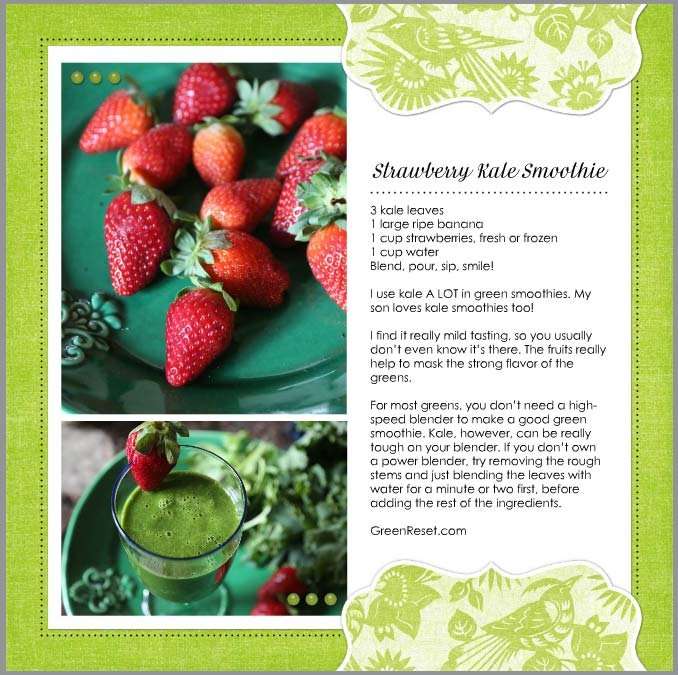
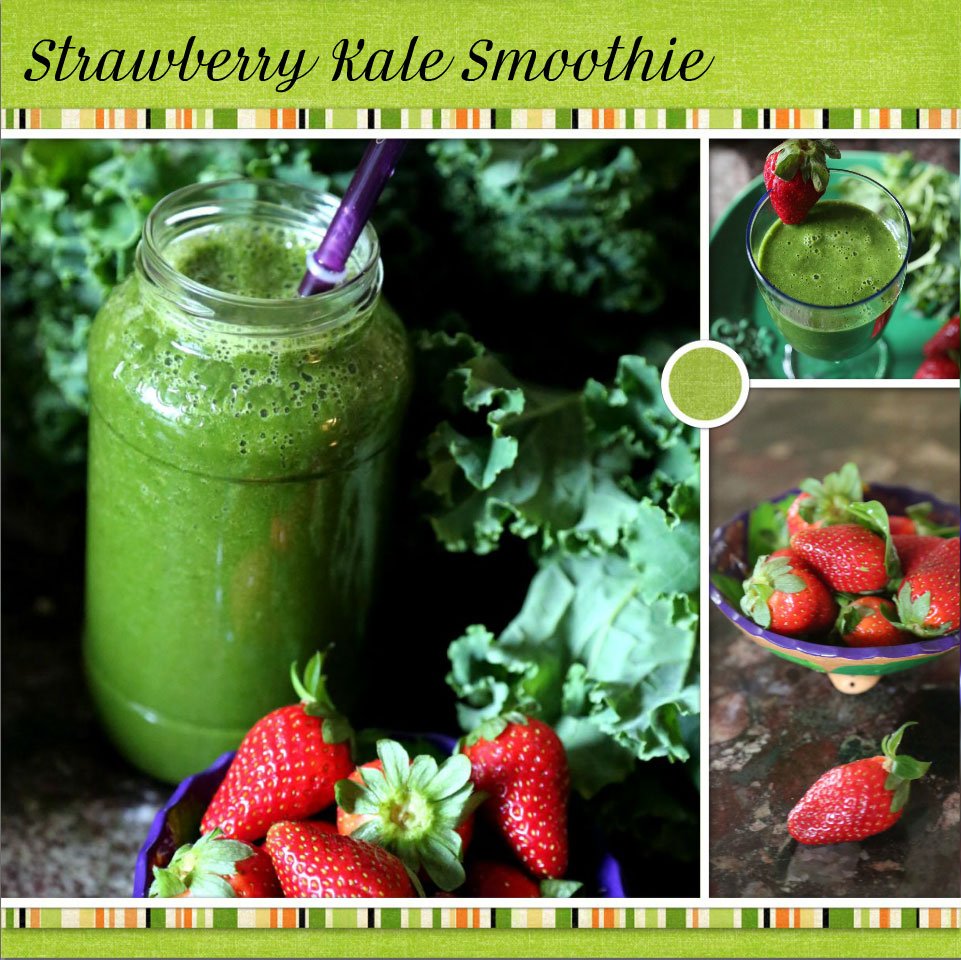
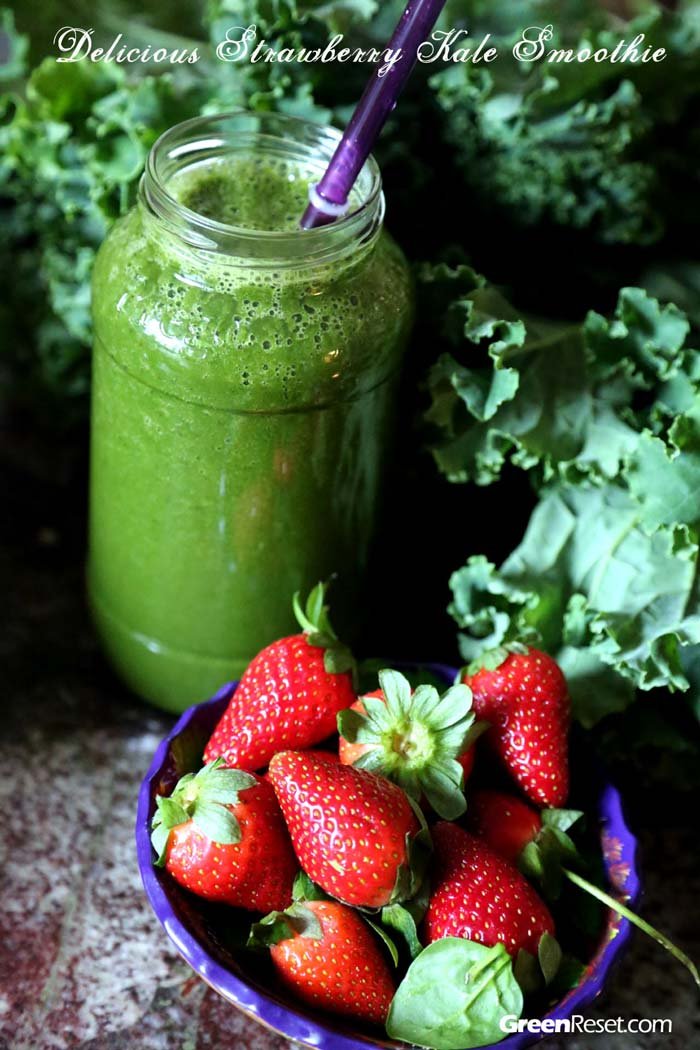
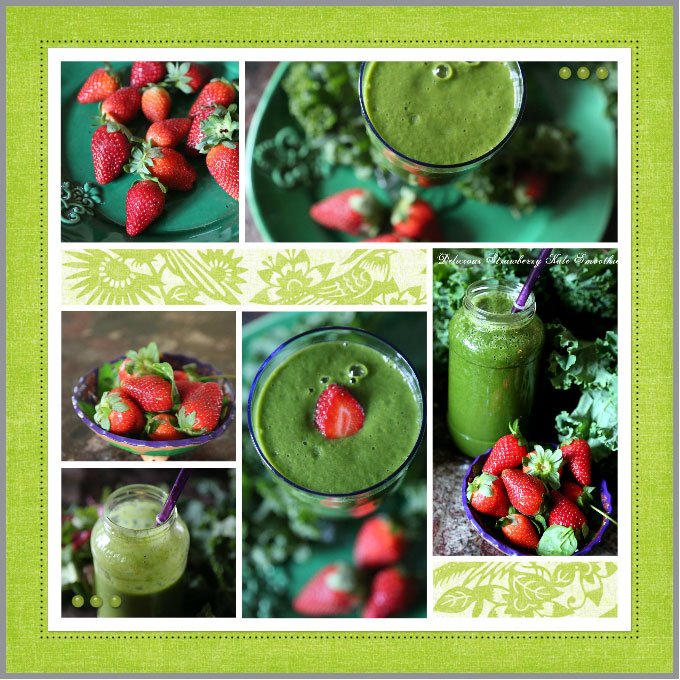
This strawberry banana smoothie is chock-full of great-for-you stuff like green kale leaves, sweet strawberries and creamy bananas. It tastes healthy, sure, but in the most delicious way possible. Plus, you get your daily dose of fruits and greens in one beverage. It’s a winning combination!
I know what you’re thinking – kale? Really? Won’t that taste… weird?
You’d think it would, but the truth is you can barely taste it. The sweetness of the strawberries and banana is sufficient to counteract the bitterness of kale leaves, leaving you with only the leafy greens’ nutrients to enjoy.
So let’s stop wasting time and make it already, shall we?
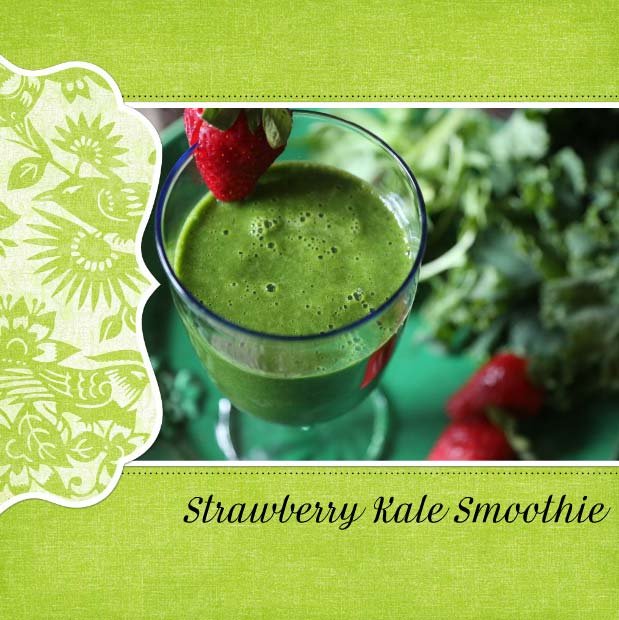
Strawberry Kale Banana Smoothie Recipe
Ingredients
- 3 kale leaves, or more (if you are just starting with green smoothies, begin slowly, and keep adding more as you get used to drinking your greens)
- 1 or 2 ripe bananas
- 1 cup strawberries, fresh or frozen
- 1 cup water
- some sweetener such as agave nectar or stevia to taste (optional)
Instructions
- Blend until very smooth, pour, sip, smile!
3.1
https://greenreset.com/strawberry-banana-smoothie/
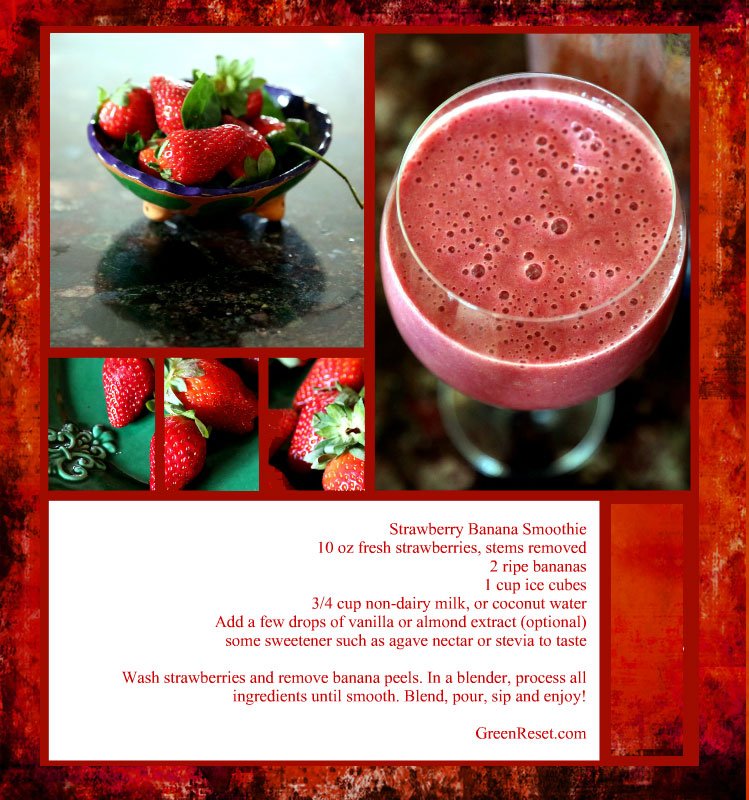
Classic Strawberry Banana Smoothie Recipe
If you are not convinced yet, would much rather stay away from greens, here is a classic strawberry banana smoothie recipe for you.
Strawberry Banana Smoothie
Ingredients
- Strawberry Banana Smoothie
- 10 oz fresh strawberries, stems removed
- 2 ripe bananas
- 1 cup ice cubes
- 3/4 cup non-dairy milk, or coconut water
- Add a few drops of vanilla or almond extract (optional)
- some sweetener such as agave nectar or stevia to taste
Instructions
- Wash strawberries and remove banana peels. In a blender, process all ingredients until smooth. For a little extra flavor, a few drops of vanilla or almond extract may be used, but do not overdo as a few drops go a long way.
3.1
https://greenreset.com/strawberry-banana-smoothie/
When using strawberries in your smoothies, it’s best to use organic, as strawberries are some of the highest produce when it comes to pesticide contamination. If they are not in season, buy frozen organic strawberries, or use other berries. Adding even just a few to your green smoothie will boost the nutrients and taste.
Also, check out the strawberry mousse recipe for another yummy recipe with strawberries.
For all my blending recipes I use Vitamix. If you don’t already own a VitaMix, I strongly encourage you to check out what this machine is capable of! For more information about VitaMix you can go directly to the VitaMix website. You may also want to read my post about the Best Blender.
I LOVE my VitaMix and highly recommend investing in one if you are ready to make serious changes to your diet. I have had mine for almost 5 years and use it daily!
If you decide to purchase Vitamix – be sure to use Promotional Code 06-004554 to get free shipping.
Questions? Comments? Suggestions?
If you have a favorite recipe, why not submit it here in the comment section of this smoothie recipes blog for others to enjoy too!
I also welcome any comments, questions and suggestions. Thanks!